THE CLASSIC COLLECTION✦Creative EvolutionCLASSIC FREE BOOKS
Creative Evolution
Henri Bergson
THE CLASSIC COLLECTION · 1900
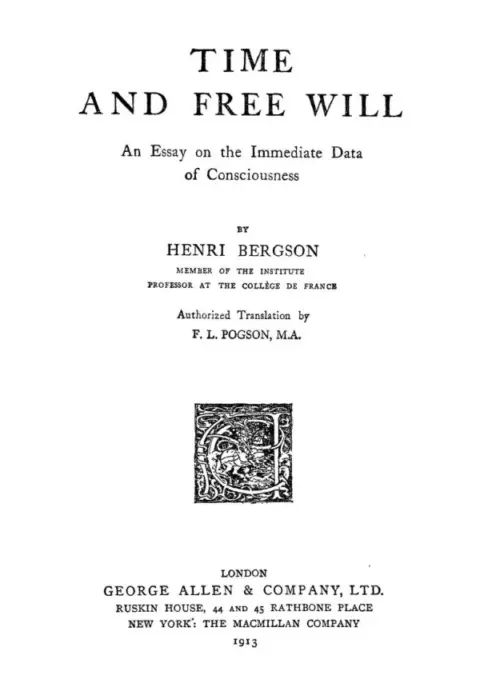
"Time and Free Will: An Essay on the Immediate Data of Consciousness" by Henri Bergson is a philosophical work written during the late 19th century. In this essay, Bergson explores the nature of time, consciousness, and the concept of free will, arguing against traditional deterministic views by emphasizing the importance of real duration and qualitative experiences. The opening of the text sets the stage for Bergson's exploration of the intensity of conscious states, questioning how we perceive and measure qualities such as emotions and sensations. He challenges the notion that these qualitative experiences can be quantified like physical magnitudes, advocating instead for an understanding of consciousness as a complex, interconnected flow of experiences. This critical examination of sensory intensity is just the beginning of Bergson's deeper inquiry into the relationship between consciousness and free will, preparing the reader for a philosophical journey that blends empirical observations with intuitive understanding.
Introduction adapted from the source catalogue; source summaries may be automatically generated.
Free to read · English · 66,044 words · No account needed
MAKE TIME FOR A GOOD BOOK
On by default. Untick to stop anonymous reading totals. Each page counts after 10 seconds in view. How this works.
Anonymous counting is on unless you have switched it off.
Either you keep to what consciousness presents to you or you have recourse to a conventional mode of representation. In the first case you will find a difference between S and S' like that between the shades sense. Of rainbow, and not at all an interval of magnitude. In the second case you may introduce the symbol ΔS if you like, but it is only in a conventional sense that you will speak here of an arithmetical difference, and in a conventional sense, also, that you will assimilate a sensation to a sum. The most acute of Fechner's critics, Jules Tannery, has made the latter point perfectly clear. "It will be said, for example, that a sensation of 50 degrees is expressed by the number of differential sensations which would succeed one another from the point where sensation is absent up to the sensation of 50 degrees.... I do not see that this is anything but a definition, which is as legitimate as it is arbitrary."[26]
[Sidenote: Delbœuf's results seem more plausible but, in the end, all psychophysics revolves in a vicious circle.]
We do not believe, in spite of all that has been said, that the method of mean gradations has set psychophysics on a new path. The novel feature in Delbœuf's investigation was that he chose a particular case, in which consciousness seemed to decide in Fechner's favour, and in which common sense itself played the part of the psychophysicist. He inquired whether certain sensations did not appear to us immediately as equal although different, and whether it would not be possible to draw up, by their help, a table of sensations which were double, triple or quadruple those which preceded them. The mistake which Fechner made, as we have just seen, was that he believed in an interval between two successive sensations S and S', when there is simply a passing from one to the other and not a difference in the arithmetical sense of the word. But if the two terms between which the passing takes place could be given simultaneously, there would then be a contrast besides the transition; and although the contrast is not yet an arithmetical difference, it resembles it in a certain respect; for the two terms which are compared stand here side by side as in a case of subtraction of two numbers. Suppose now that these sensations belong to the same genus and that in our past experience we have constantly been present at their march past, so to speak, while the physical stimulus increased continuously: it is extremely probable that we shall thrust the cause into the effect, and that the idea of contrast will thus melt into that of arithmetical difference. As we shall have noticed, moreover, that the sensation changed abruptly while the stimulus rose continuously, we shall no doubt estimate the distance between two given sensations by a rough guess at the number of these sudden jumps, or at least of the intermediate sensations which usually serve us as landmarks. To sum up, the contrast will appear to us as a difference, the stimulus as a quantity, the sudden jump as an element of equality: combining these three factors, we shall reach the idea of equal quantitative differences. Now, these conditions are nowhere so well realized as when surfaces of the same colour, more or less illuminated, are simultaneously presented to us. Not only is there here a contrast between similar sensations, but these sensations correspond to a cause whose influence has always been felt by us to be closely connected with its distance; and, as this distance can vary continuously, we cannot have escaped noticing in our past experience a vast number of shades of sensation which succeeded one another along with the continuous increase in the cause. We are therefore able to say that the contrast between one shade of grey and another, for example, seems to us almost equal to the contrast between the latter and a third one; and if we define two equal sensations by saying that they are sensations which a more or less confused process of reasoning interprets as such, we shall in fact reach a law like that proposed by Delbœuf. But it must not be forgotten that consciousness has here passed through the same intermediate steps as the psychophysicist, and that its judgment is worth here just what psychophysics is worth; it is a symbolical interpretation of quality as quantity, a more or less rough estimate of the number of sensations which can come in between two given sensations. The difference is thus not as great as is believed between the method of least noticeable differences and that of mean gradations, between the psychophysics of Fechner and that of Delbœuf. The first led to a conventional measurement of sensation; the second appeals to common sense in the particular cases where common sense adopts a similar convention. In a word, all psychophysics is condemned by its origin to revolve in a vicious circle, for the theoretical postulate on which it rests condemns it to experimental verification, and it cannot be experimentally verified unless its postulate is first granted. The fact is that there is no point of contact between the unextended and the extended, between quality and quantity. We can interpret the one by the other, set up the one as the equivalent of the other; but sooner or later, at the beginning or at the end, we shall have to recognize the conventional character of this assimilation.
Your reading position is saved on this browser. Take it to another device with a library code. Reading pages adapt to text, rather than matching a printed edition.
Henri Bergson
Henri Bergson
Henri Bergson
BEHIND THE BOOK
This eBook is for the use of anyone anywhere in the United States and most other parts of the world at no cost and with almost no restrictions whatsoever. You may copy it, give it away or re-use it under the terms of the Project Gutenberg License included with this eBook or online at www.gutenberg.org. If you are not located in the United States, you will have to check the laws of the country where you are located before using this eBook. Read the source licence.
The original source file, including credits and licence, is retained by this library. Request an original-format copy at no charge. Please include the book title and Project Gutenberg identifier #56852.
KEEP YOUR CURIOSITY GOING

David Patterson (Spirit) Hatch
Coulson Kernahan

Ralph Waldo Emerson
Frances Wright

Edwin Abbott Abbott

Joseph Droz