THE CLASSIC COLLECTION✦Creative EvolutionCLASSIC FREE BOOKS
Creative Evolution
Henri Bergson
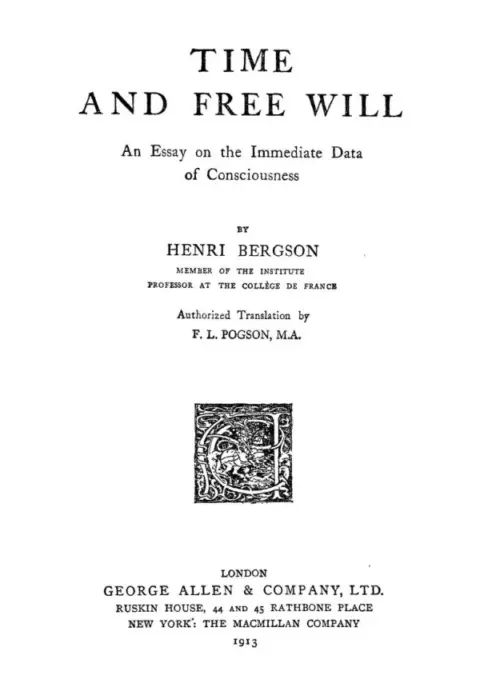
THE CLASSIC COLLECTION · 1900
"Time and Free Will: An Essay on the Immediate Data of Consciousness" by Henri Bergson is a philosophical work written during the late 19th century. In this essay, Bergson explores the nature of time, consciousness, and the concept of free will, arguing against traditional deterministic views by emphasizing the importance of real duration and qualitative experiences. The opening of the text sets the stage for Bergson's exploration of the intensity of conscious states, questioning how we perceive and measure qualities such as emotions and sensations. He challenges the notion that these qualitative experiences can be quantified like physical magnitudes, advocating instead for an understanding of consciousness as a complex, interconnected flow of experiences. This critical examination of sensory intensity is just the beginning of Bergson's deeper inquiry into the relationship between consciousness and free will, preparing the reader for a philosophical journey that blends empirical observations with intuitive understanding.
Introduction adapted from the source catalogue; source summaries may be automatically generated.
Free to read · English · 66,044 words · No account needed
MAKE TIME FOR A GOOD BOOK
On by default. Untick to stop anonymous reading totals. Each page counts after 10 seconds in view. How this works.
Anonymous counting is on unless you have switched it off.
[Sidenote: The feeling of beauty: art puts to sleep our active and resistant powers and makes us responsive to suggestion.]
To understand how the feeling of the beautiful itself admits of degrees, we should have to submit it to a minute analysis. Perhaps the difficulty which we experience in defining: it is largely owing to the fact that we look upon the beauties of nature as anterior to those of art: the processes of art are thus supposed to be nothing more than means by which the artist expresses the beautiful, and the essence of the beautiful remains unexplained. But we might ask ourselves whether nature is beautiful otherwise than through meeting by chance certain processes of our art, and whether, in a certain sense, art is not prior to nature. Without even going so far, it seems more in conformity with the rules of a sound method to study the beautiful first in the works in which it has been produced by a conscious effort, and then to pass on by imperceptible steps from art to nature, which may be looked upon as an artist in its own way. By placing ourselves at this point of view, we shall perceive that the object of art is to put to sleep the active or rather resistant powers of our personality, and thus to bring us into a state of perfect responsiveness, in which we realize the idea that is suggested to us and sympathize with the feeling that is expressed. In the processes of art we shall find, in a weakened form, a refined and in some measure spiritualized version of the processes commonly used to induce the state of hypnosis. Thus, in music, the rhythm and measure suspend the normal flow of our sensations and ideas by causing our attention to swing to and fro between fixed points, and they take hold of us with such force that even the faintest imitation of a groan will suffice to fill us with the utmost sadness. If musical sounds affect us more powerfully than the sounds of nature, the reason is that nature confines itself to expressing feelings, whereas music suggests them to us. Whence indeed comes the charm of poetry? The poet is he with whom feelings develop into images, and the images themselves into words which translate them while obeying the laws of rhythm. In seeing these images pass before our eyes we in our turn experience the feeling which was, so to speak, their emotional equivalent: but we should never realize these images so strongly without the regular movements of the rhythm by which our soul is lulled into self-forgetfulness, and, as in a dream, thinks and sees with the poet. The plastic arts obtain an effect of the same kind by the fixity which they suddenly impose upon life, and which a physical contagion carries over to the attention of the spectator. While the works of ancient sculpture express faint emotions which play upon them like a passing breath, the pale immobility of the stone causes the feeling expressed or the movement just begun to appear as if they were fixed for ever, absorbing our thought and our will in their own eternity. We find in architecture, in the very midst of this startling immobility, certain effects analogous to those of rhythm. The symmetry of form, the indefinite repetition of the same architectural motive, causes our faculty of perception to oscillate between the same and the same again, and gets rid of those customary incessant changes which in ordinary life bring us back without ceasing to the consciousness of our personality: even the faint suggestion of an idea will then be enough to make the idea fill the whole of our mind. Thus art aims at impressing feelings on us rather than expressing them; it suggests them to us, and willingly dispenses with the imitation of nature when it finds some more efficacious means. Nature, like art, proceeds by suggestion, but does not command the resources of rhythm. It supplies the deficiency by the long comradeship, based on influences received in common by nature and by ourselves, of which the effect is that the slightest indication by nature of a feeling arouses sympathy in our minds, just as a mere gesture on the part of the hypnotist is enough to force the intended suggestion upon a subject accustomed to his control. And this sympathy is shown in particular when nature displays to us beings of normal proportions, so that our attention is distributed equally over all the parts of the figure without being fixed on any one of them: our perceptive faculty then finds itself lulled and soothed by this harmony, and nothing hinders any longer the free play of sympathy, which is ever ready to come forward as soon as the obstacle in its path is removed.
Your reading position is saved on this browser. Take it to another device with a library code. Reading pages adapt to text, rather than matching a printed edition.
Henri Bergson
Henri Bergson
Henri Bergson
BEHIND THE BOOK
This eBook is for the use of anyone anywhere in the United States and most other parts of the world at no cost and with almost no restrictions whatsoever. You may copy it, give it away or re-use it under the terms of the Project Gutenberg License included with this eBook or online at www.gutenberg.org. If you are not located in the United States, you will have to check the laws of the country where you are located before using this eBook. Read the source licence.
The original source file, including credits and licence, is retained by this library. Request an original-format copy at no charge. Please include the book title and Project Gutenberg identifier #56852.
KEEP YOUR CURIOSITY GOING

David Patterson (Spirit) Hatch
Coulson Kernahan

Ralph Waldo Emerson
Frances Wright

Edwin Abbott Abbott

Joseph Droz