THE CLASSIC COLLECTION✦Creative EvolutionCLASSIC FREE BOOKS
Creative Evolution
Henri Bergson
THE CLASSIC COLLECTION · 1900
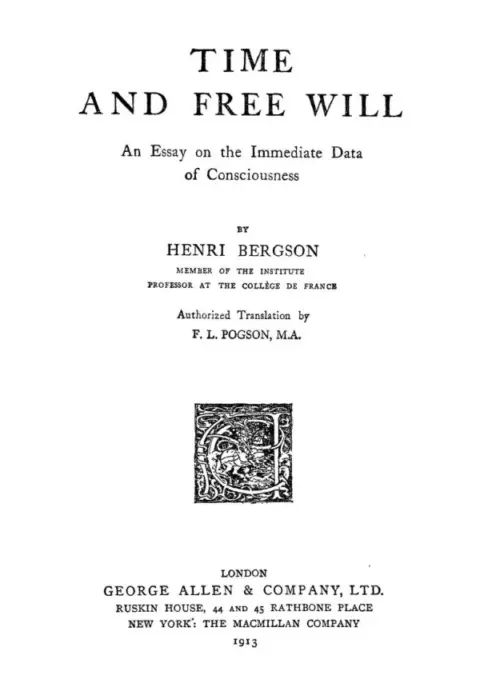
"Time and Free Will: An Essay on the Immediate Data of Consciousness" by Henri Bergson is a philosophical work written during the late 19th century. In this essay, Bergson explores the nature of time, consciousness, and the concept of free will, arguing against traditional deterministic views by emphasizing the importance of real duration and qualitative experiences. The opening of the text sets the stage for Bergson's exploration of the intensity of conscious states, questioning how we perceive and measure qualities such as emotions and sensations. He challenges the notion that these qualitative experiences can be quantified like physical magnitudes, advocating instead for an understanding of consciousness as a complex, interconnected flow of experiences. This critical examination of sensory intensity is just the beginning of Bergson's deeper inquiry into the relationship between consciousness and free will, preparing the reader for a philosophical journey that blends empirical observations with intuitive understanding.
Introduction adapted from the source catalogue; source summaries may be automatically generated.
Free to read · English · 66,044 words · No account needed
MAKE TIME FOR A GOOD BOOK
On by default. Untick to stop anonymous reading totals. Each page counts after 10 seconds in view. How this works.
Anonymous counting is on unless you have switched it off.
Over against this homogeneous space we have put the self as perceived by an attentive consciousness, a living self, whose states, at once undistinguished and unstable, cannot be separated without changing their nature, and cannot receive a fixed form or be expressed in words without becoming public property. How could this self, which distinguishes external objects so sharply and represents them so easily by means of symbols, withstand the temptation to introduce the same distinctions into its own life and to replace the interpenetration of its psychic states, their wholly qualitative multiplicity, by a numerical plurality of terms which are distinguished from one another, set side by side, and expressed by means of words? In place of a heterogeneous duration whose moments permeate one another, we thus get a homogeneous time whose moments are strung on a spatial line. In place of an inner life whose successive phases, each unique of its kind, cannot be expressed in the fixed terms of language, we get a self which can be artificially reconstructed, and simple psychic states which can be added to and taken from one another just like the letters of the alphabet in forming words. Now, this must not be thought to be a mode of symbolical representation only, for immediate intuition and discursive thought are one in concrete reality, and the very mechanism by which we only meant at first to explain our conduct will end by also controlling it. Our psychic states, separating then from each other, will get solidified; between our ideas, thus crystallized, and our external movements we shall witness permanent associations being formed; and little by little, as our consciousness thus imitates the process by which nervous matter procures reflex actions, automatism will cover over freedom.[10] It is just at this point that the associationists and the determinists come in on the one side, and the Kantians on the other. As they look at only the commonest aspect of our conscious life, they perceive clearly marked states, which can recur in time like physical phenomena, and to which the law of causal determination applies, if we wish, in the same sense as it does to nature. As, on the other hand, the medium in which these psychic states are set side by side exhibits parts external to one another, in which the same facts seem capable of being repeated, they do not hesitate to make time a homogeneous medium and treat it as space. Henceforth all difference between duration and extensity, succession and simultaneity, is abolished: the only thing left is to turn freedom out of doors, or, if you cannot entirely throw off your traditional respect for it, to escort it with all due ceremony up to the supratemporal domain of "things in themselves," whose mysterious threshold your consciousness cannot cross. But, in our view, there is a third course which might be taken, namely, to carry ourselves back in thought to those moments of our life when we made some serious decision, moments unique of their kind, which will never be repeated--**any more than the past phases in the history of a nation will ever come back again. We should see that if these past states cannot be adequately expressed in words or artificially reconstructed by a juxtaposition of simpler states, it is because in their dynamic unity and wholly qualitative multiplicity they are phases of our real and concrete duration, a heterogeneous duration and a living one. We should see that, if our action was pronounced by us to be free, it is because the relation of this action to the state from which it issued could not be expressed by a law, this psychic state being unique of its kind and unable ever to occur again. We should see, finally, that the very idea of necessary determination here loses every shred of meaning, that there cannot be any question either of foreseeing the act before it is performed or of reasoning about the possibility of the contrary action once the deed is done, for to have all the conditions given is, in concrete duration, to place oneself at the very moment of the act and not to foresee it. But we should also understand the illusion which makes the one party think that they are compelled to deny freedom, and the others that they must define it. It is because the transition is made by imperceptible steps from concrete duration, whose elements permeate one another, to symbolical duration, whose moments are set side by side, and consequently from free activity to conscious automatism. It is because, although we are free whenever we are willing to get back into ourselves, it seldom happens that we are willing. It is because, finally, even in the cases where the action is freely performed, we cannot reason about it without setting out its conditions externally to one another, therefore in space and no longer in pure duration. The problem of freedom has thus sprung from a misunderstanding: it has been to the moderns what the paradoxes of the Eleatics were to the ancients, and, like these paradoxes, it has its origin in the illusion through which we confuse succession and simultaneity, duration and extensity, quality and quantity.
Your reading position is saved on this browser. Take it to another device with a library code. Reading pages adapt to text, rather than matching a printed edition.
Henri Bergson
Henri Bergson
Henri Bergson
BEHIND THE BOOK
This eBook is for the use of anyone anywhere in the United States and most other parts of the world at no cost and with almost no restrictions whatsoever. You may copy it, give it away or re-use it under the terms of the Project Gutenberg License included with this eBook or online at www.gutenberg.org. If you are not located in the United States, you will have to check the laws of the country where you are located before using this eBook. Read the source licence.
The original source file, including credits and licence, is retained by this library. Request an original-format copy at no charge. Please include the book title and Project Gutenberg identifier #56852.
KEEP YOUR CURIOSITY GOING

David Patterson (Spirit) Hatch
Coulson Kernahan

Ralph Waldo Emerson
Frances Wright

Edwin Abbott Abbott

Joseph Droz