THE CLASSIC COLLECTION✦Creative EvolutionCLASSIC FREE BOOKS
Creative Evolution
Henri Bergson
THE CLASSIC COLLECTION · 1900
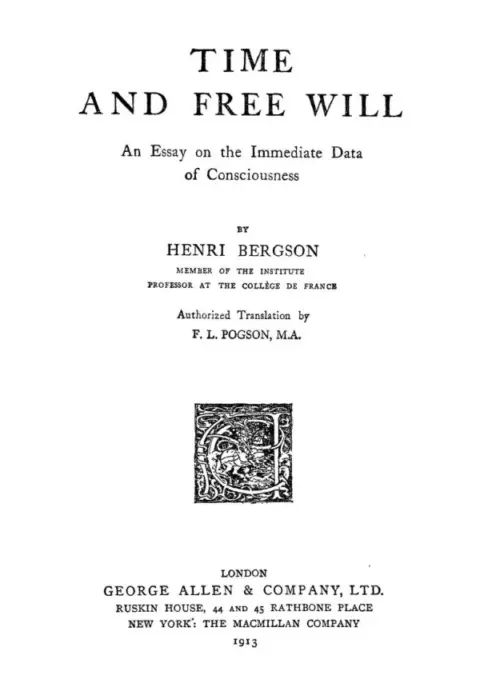
"Time and Free Will: An Essay on the Immediate Data of Consciousness" by Henri Bergson is a philosophical work written during the late 19th century. In this essay, Bergson explores the nature of time, consciousness, and the concept of free will, arguing against traditional deterministic views by emphasizing the importance of real duration and qualitative experiences. The opening of the text sets the stage for Bergson's exploration of the intensity of conscious states, questioning how we perceive and measure qualities such as emotions and sensations. He challenges the notion that these qualitative experiences can be quantified like physical magnitudes, advocating instead for an understanding of consciousness as a complex, interconnected flow of experiences. This critical examination of sensory intensity is just the beginning of Bergson's deeper inquiry into the relationship between consciousness and free will, preparing the reader for a philosophical journey that blends empirical observations with intuitive understanding.
Introduction adapted from the source catalogue; source summaries may be automatically generated.
Free to read · English · 66,044 words · No account needed
MAKE TIME FOR A GOOD BOOK
On by default. Untick to stop anonymous reading totals. Each page counts after 10 seconds in view. How this works.
Anonymous counting is on unless you have switched it off.
It follows from this twofold analysis that the principle of causality involves two contradictory conceptions of duration, two mutually exclusive ways of prefiguring the future in the present. Sometimes all phenomena, physical or psychical, are pictured as enduring in the same way, and therefore in the way that we do: in this case the future will exist in the present only as an idea, and the passing from the present to the future will take the form of an effort which does not always lead to the realization of the idea conceived. Sometimes, on the other hand, duration is regarded as the characteristic form of conscious states; in this case, things are no longer supposed to endure as we do, and a mathematical pre-existence of their future in their present is admitted. Now, each of these two hypotheses, when taken by itself, safeguards human freedom; for the first would lead to the result that even the phenomena of nature were contingent, and the second, by attributing the necessary determination of physical phenomena to the fact that things do not endure as we do, invites us to regard the self which is subject to duration as a free force. Therefore, every clear conception of causality, where we know our own meaning, leads to the idea of human freedom as a natural consequence. Unfortunately, the habit has grown up of taking the principle of causality in both senses at the same time, because the one is more flattering to our imagination and the other is more favourable to mathematical reasoning. Sometimes we think particularly of the regular succession of physical phenomena and of the kind of inner effort by which one becomes another; sometimes we fix our mind on the absolute regularity of these phenomena, and from the idea of regularity we pass by imperceptible steps to that of mathematical necessity, which excludes duration understood in the first way. And we do not see any harm in letting these two conceptions blend into one another, and in assigning greater importance to the one or the other according as we are more or less concerned with the interests of science. But to apply the principle of causality, in this ambiguous form, to the succession of conscious states, is uselessly and wantonly to run into inextricable difficulties. The idea of force, which really excludes that of necessary determination, has got into the habit, so to speak, of amalgamating with that of necessity, in consequence of the very use which we make of the principle of causality in nature. On the one hand, we know force only through the witness of consciousness, and consciousness does not assert, does not even understand, the absolute determination, now, of actions that are still to come: that is all that experience teaches us, and if we hold by experience we should say that we feel ourselves free, that we perceive force, rightly or wrongly, as a free spontaneity. But, on the other hand, this idea of force, carried over into nature, travelling there side by side with the idea of necessity, has got corrupted before it returns from the journey. It returns impregnated with the idea of necessity: and in the light of the rôle which we have made it play in the external world, we regard force as determining with strict necessity the effects which flow from it. Here again the mistake made by consciousness arises from the fact that it looks at the self, not directly, but by a kind of refraction through the forms which it has lent to external perception, and which the latter does not give back without having left its mark on them. A compromise, as it were, has been brought about between the idea of force and that of necessary determination. The wholly mechanical determination of two external phenomena by one another now assumes in our eyes the same form as the dynamic relation of our exertion of force to the act which springs from it: but, in return, this latter relation takes the form of a mathematical derivation, the human action being supposed to issue mechanically, and therefore necessarily, from the force which produces it. There is no doubt that this mingling of two different and almost opposite ideas offers advantages to common sense, since it enables us to picture in the same way, and denote by one and the same word, both the relation which exists between two moments of our life and that which binds together the successive moments of the external world. We have seen that, though our deepest conscious states exclude numerical multiplicity, yet we break them up into parts external to one another; that though the elements of concrete duration permeate one another, duration expressing itself in extensity exhibits moments as distinct as the bodies scattered in space. Is it surprising, then, that between the moments of our life, when it has been, so to speak, objectified, we set up a relation analogous to the objective relation of causality, and that an exchange, which again may be compared to the phenomenon of endosmosis, takes place between the dynamic idea of free effort and the mathematical concept of necessary determination?
Your reading position is saved on this browser. Take it to another device with a library code. Reading pages adapt to text, rather than matching a printed edition.
Henri Bergson
Henri Bergson
Henri Bergson
BEHIND THE BOOK
This eBook is for the use of anyone anywhere in the United States and most other parts of the world at no cost and with almost no restrictions whatsoever. You may copy it, give it away or re-use it under the terms of the Project Gutenberg License included with this eBook or online at www.gutenberg.org. If you are not located in the United States, you will have to check the laws of the country where you are located before using this eBook. Read the source licence.
The original source file, including credits and licence, is retained by this library. Request an original-format copy at no charge. Please include the book title and Project Gutenberg identifier #56852.
KEEP YOUR CURIOSITY GOING

David Patterson (Spirit) Hatch
Coulson Kernahan

Ralph Waldo Emerson
Frances Wright

Edwin Abbott Abbott

Joseph Droz