THE CLASSIC COLLECTION✦Creative EvolutionCLASSIC FREE BOOKS
Creative Evolution
Henri Bergson
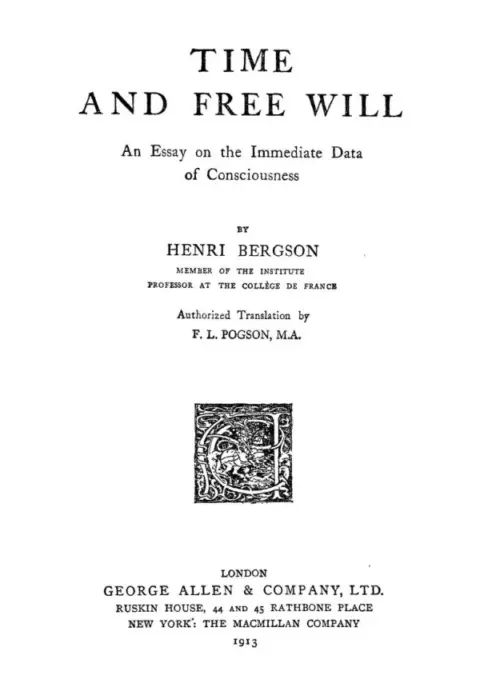
THE CLASSIC COLLECTION · 1900
"Time and Free Will: An Essay on the Immediate Data of Consciousness" by Henri Bergson is a philosophical work written during the late 19th century. In this essay, Bergson explores the nature of time, consciousness, and the concept of free will, arguing against traditional deterministic views by emphasizing the importance of real duration and qualitative experiences. The opening of the text sets the stage for Bergson's exploration of the intensity of conscious states, questioning how we perceive and measure qualities such as emotions and sensations. He challenges the notion that these qualitative experiences can be quantified like physical magnitudes, advocating instead for an understanding of consciousness as a complex, interconnected flow of experiences. This critical examination of sensory intensity is just the beginning of Bergson's deeper inquiry into the relationship between consciousness and free will, preparing the reader for a philosophical journey that blends empirical observations with intuitive understanding.
Introduction adapted from the source catalogue; source summaries may be automatically generated.
Free to read · English · 66,044 words · No account needed
MAKE TIME FOR A GOOD BOOK
On by default. Untick to stop anonymous reading totals. Each page counts after 10 seconds in view. How this works.
Anonymous counting is on unless you have switched it off.
To assert the regular succession of two phenomena is, indeed, to recognize that, the first being given, we already catch sight of the second. But this wholly subjective connexion between two ideas is not enough for common sense. It seems to common sense that, if the idea of the second phenomenon is already implied in that of the first, the second phenomenon itself must exist objectively, in some way or other, within the first phenomenon. And common sense was bound to come to this conclusion, because to distinguish exactly between an objective connexion of phenomena and a subjective association between their ideas presupposes a fairly high degree of philosophical culture. We thus pass imperceptibly from the first meaning to the second, and we picture the causal relation as a kind of prefiguring of the future phenomenon in its present conditions. Now this prefiguring can be understood in two very different ways, and it is just here that the ambiguity begins.
[Sidenote: Causality, as the prefiguring of the future phenomenon in its present conditions, in one form destroys concrete phenomena.]
In the first place, mathematics furnishes us with one type of this kind of prefiguring. The very movement by which we draw the circumference of a circle on a sheet of paper generates all the mathematical properties of this figure: in this sense an unlimited number of theorems can be said to pre-exist within the definition, although they will be spread out in duration for the mathematician who deduces them. It is true that we are here in the realm of pure quantity and that, as geometrical properties can be expressed in the form of equations, it is easy to understand how the original equation, expressing the fundamental property of the figure, is transformed into an unlimited number of new ones, all virtually contained in the first. On the contrary, physical phenomena, which succeed one another and are perceived by our senses, are distinguished by quality not less than by quantity, so that there would be some difficulty in at once declaring them equivalent to one another. But, just because they are perceived through our sense-organs, we seem justified in ascribing their qualitative differences to the impression which they make on us and in assuming, behind the heterogeneity of our sensations, a homogeneous physical universe. Thus, we shall strip matter of the concrete qualities with which our senses clothe it, colour, heat, resistance, even weight, and we shall finally find ourselves confronted with homogeneous extensity, space without body. The only step then remaining will be to describe figures in space, to make them move according to mathematically formulated laws, and to explain the apparent qualities of matter by the shape, position, and motion of these geometrical figures. Now, position is given by a system of fixed magnitudes and motion is expressed by a law, i.e. by a constant relation between variable magnitudes; but shape is a mental image, and, however tenuous, however transparent we assume it to be, it still constitutes, in so far as our imagination has, so to speak, the visual perception of it, a concrete and therefore irreducible quality of matter. It will therefore be necessary to make a clean sweep of this image itself and replace it by the abstract formula of the movement which gives rise to the figure. Picture then algebraical relations getting entangled in one another, becoming objective by this very entanglement, and producing, by the mere effect of their complexity, concrete, visible, and tangible reality,--you will be merely drawing the consequences of the principle of causality, understood in the sense of an actual prefiguring of the future in the present. The scientists of our time do not seem, indeed, to have carried abstraction so far, except perhaps Lord Kelvin. This acute and profound physicist assumed that space is filled with a homogeneous and incompressible fluid in which vortices move, thus producing the properties of matter: these vortices are the constituent elements of bodies; the atom thus becomes a movement, and physical phenomena are reduced to regular movements taking place within an incompressible fluid. But, if you will notice that this fluid is perfectly homogeneous, that between its parts there is neither an empty interval which separates them nor any difference whatever by which they can be distinguished, you will see that all movement taking place within this fluid is really equivalent to absolute immobility, since before, during, and after the movement nothing changes and nothing has changed in the whole. The movement which is here spoken of is thus not a movement which actually takes place, but only a movement which is pictured mentally: it is a relation between relations. It is implicitly supposed, though perhaps not actually realized, that motion has something to do with consciousness, that in space there are only simultaneities, and that the business of the physicist is to provide us with the means of calculating these relations of simultaneity for any moment of our duration. Nowhere has mechanism been carried further than in this system, since the very shape of the ultimate elements of matter is here reduced to a movement. But the Cartesian physics already anticipated this interpretation; for if matter is nothing, as Descartes claimed, but homogeneous extensity, the movements of the parts of this extensity can be conceived through the abstract law which governs them or through an algebraical equation between variable magnitudes, but cannot be represented under the concrete form of an image. And it would not be difficult to prove that the more the progress of mechanical explanations enables us to develop this conception of causality and therefore to relieve the atom of the weight of its sensible qualities, the more the concrete existence of the phenomena of nature tends to vanish into algebraical smoke.
Your reading position is saved on this browser. Take it to another device with a library code. Reading pages adapt to text, rather than matching a printed edition.
Henri Bergson
Henri Bergson
Henri Bergson
BEHIND THE BOOK
This eBook is for the use of anyone anywhere in the United States and most other parts of the world at no cost and with almost no restrictions whatsoever. You may copy it, give it away or re-use it under the terms of the Project Gutenberg License included with this eBook or online at www.gutenberg.org. If you are not located in the United States, you will have to check the laws of the country where you are located before using this eBook. Read the source licence.
The original source file, including credits and licence, is retained by this library. Request an original-format copy at no charge. Please include the book title and Project Gutenberg identifier #56852.
KEEP YOUR CURIOSITY GOING

David Patterson (Spirit) Hatch
Coulson Kernahan

Ralph Waldo Emerson
Frances Wright

Edwin Abbott Abbott

Joseph Droz