THE CLASSIC COLLECTION✦Creative EvolutionCLASSIC FREE BOOKS
Creative Evolution
Henri Bergson
THE CLASSIC COLLECTION · 1900
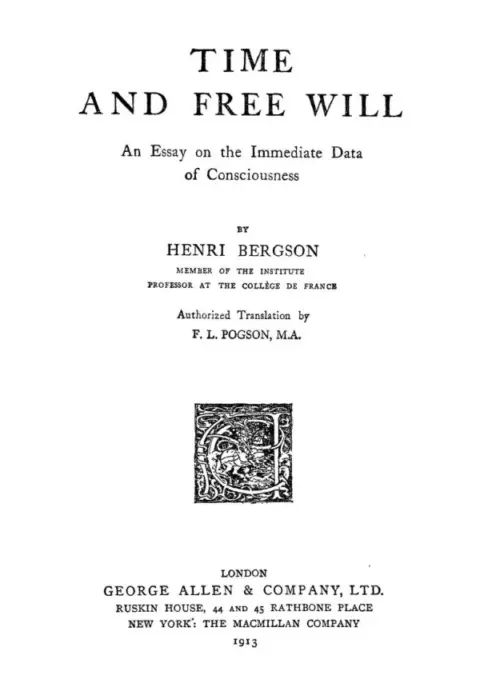
"Time and Free Will: An Essay on the Immediate Data of Consciousness" by Henri Bergson is a philosophical work written during the late 19th century. In this essay, Bergson explores the nature of time, consciousness, and the concept of free will, arguing against traditional deterministic views by emphasizing the importance of real duration and qualitative experiences. The opening of the text sets the stage for Bergson's exploration of the intensity of conscious states, questioning how we perceive and measure qualities such as emotions and sensations. He challenges the notion that these qualitative experiences can be quantified like physical magnitudes, advocating instead for an understanding of consciousness as a complex, interconnected flow of experiences. This critical examination of sensory intensity is just the beginning of Bergson's deeper inquiry into the relationship between consciousness and free will, preparing the reader for a philosophical journey that blends empirical observations with intuitive understanding.
Introduction adapted from the source catalogue; source summaries may be automatically generated.
Free to read · English · 66,044 words · No account needed
MAKE TIME FOR A GOOD BOOK
On by default. Untick to stop anonymous reading totals. Each page counts after 10 seconds in view. How this works.
Anonymous counting is on unless you have switched it off.
There are several ways of picturing the mental condition of a person at a given moment. We try to do it when e.g. we read a novel; but whatever care the author may have taken in depicting the feelings of his hero, and even in tracing back his history, the end, foreseen or unforeseen, will add something to the idea which we had formed of the character: the character, therefore, was only imperfectly known to us. In truth, the deeper psychic states, those which are translated by free acts, express and sum up the whole of our past history: if Paul knows all the conditions under which Peter acts, we must suppose that no detail of Peter's life escapes him, and that his imagination reconstructs and even lives over again Peter's history. But we must here make a vital distinction. When I myself pass through a certain psychic state, I know exactly the intensity of this state and its importance in relation to the others, not by measurement or comparison, but because the intensity of e.g. a deep-seated feeling is nothing else than the feeling itself. On the other hand, if I try to give you an account of this psychic state, I shall be unable to make you realize its intensity except by some definite sign of a mathematical kind: I shall have to measure its importance, compare it with what goes before and what follows, in short determine the part which it plays in the final act. And I shall say that it is more or less intense, more or less important, according as the final act is explained by it or apart from it. On the other hand, for my own consciousness, which perceived this inner state, there was no need of a comparison of this kind: the intensity was given to it as an inexpressible quality of the state itself. In other words, the intensity of a psychic state is not given to consciousness as a special sign accompanying this state and denoting its power, like an exponent in algebra; we have shown above that it expresses rather its shade, its characteristic colouring, and that, if it is a question of a feeling, for example, its intensity consists in being felt. Hence we have to distinguish two ways of assimilating the conscious states of other people: the one dynamic, which consists in experiencing them oneself; the other static, which consists in substituting for the consciousness of these states their image or rather their intellectual symbol, their idea. In this case the conscious states are imagined instead of being reproduced; but, then, to the image of the psychic states themselves some indication of their intensity should be added, since they no longer act on the person in whose mind they are pictured and the latter has no longer any chance of experiencing their force by actually feeling them. Now, this indication itself will necessarily assume a quantitative character: it will be pointed out, for example, that a certain feeling has more strength than another feeling, that it is necessary to take more account of it, that it has played a greater part; and how could this be known unless the later history of the person were known in advance, with the precise actions in which this multiplicity of states or inclinations has issued? Therefore, if Paul is to have an adequate idea of Peter's state at any moment of his history, there are only two courses open; either, like a novelist who knows whither he is conducting his characters, Paul must already know Peter's final act, and must thus be able to supplement his mental image of the successive states through which Peter is going to pass by some indication of their value in relation to the whole of Peter's history; or he must make up his mind to pass through these different states, not in imagination, but in reality. The former hypothesis must be put on one side since the very point at issue is whether, the antecedents alone being given, Paul will be able to foresee the final act. We find ourselves compelled, therefore, to alter radically the idea which we had formed of Paul: he is not, as we had thought at first, a spectator whose eyes pierce the future, but an actor who plays Peter's part in advance. And notice that you cannot exempt him from any detail of this part, for the most common-place events have their importance in a life-story; and even supposing that they have not, you cannot decide that they are insignificant except in relation to the final act, which, by hypothesis, is not given. Neither have you the right to cut short--were it only by a second--the different states of consciousness through which Paul is going to pass before Peter; for the effects of the same feeling, for example, go on accumulating at every moment of duration, and the sum total of these effects could not be realized all at once unless one knew the importance of the feeling, taken in its totality, in relation to the final act, which is the very thing that is supposed to remain unknown. But if Peter and Paul have experienced the same feelings in the same order, if their minds have the same history, how will you distinguish one from the other? Will it be by the body in which they dwell? They would then always differ in some respect, viz., that at no moment of their history would they have a mental picture of the same body. Will it be by the place which they occupy in time? In that case they would no longer be present at the same events: now, by hypothesis, they have the same past and the same present, having the same experience. You must now make up your mind about it: Peter and Paul are one and the same person, whom you call Peter when he acts and Paul when you recapitulate his history. The more complete you made the sum of the conditions which, when known, would have enabled you to predict Peter's future action, the closer became your grasp of his existence and the nearer you came to living his life over again down to its smallest details: you thus reached the very moment when, the action taking place, there was no longer anything to be foreseen, but only something to be done. Here again any attempt to reconstruct ideally an act really willed ends in the mere witnessing of the act whilst it is being performed or when it is already done.
Your reading position is saved on this browser. Take it to another device with a library code. Reading pages adapt to text, rather than matching a printed edition.
Henri Bergson
Henri Bergson
Henri Bergson
BEHIND THE BOOK
This eBook is for the use of anyone anywhere in the United States and most other parts of the world at no cost and with almost no restrictions whatsoever. You may copy it, give it away or re-use it under the terms of the Project Gutenberg License included with this eBook or online at www.gutenberg.org. If you are not located in the United States, you will have to check the laws of the country where you are located before using this eBook. Read the source licence.
The original source file, including credits and licence, is retained by this library. Request an original-format copy at no charge. Please include the book title and Project Gutenberg identifier #56852.
KEEP YOUR CURIOSITY GOING

David Patterson (Spirit) Hatch
Coulson Kernahan

Ralph Waldo Emerson
Frances Wright

Edwin Abbott Abbott

Joseph Droz