READ · DISCOVER · ENJOYClassic literature · Always free
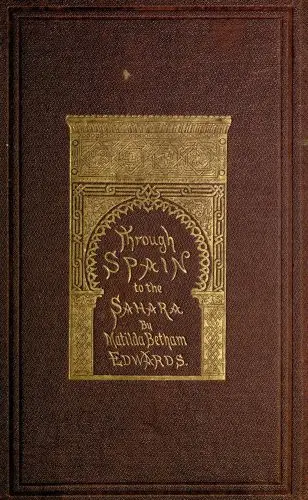
Through Spain to the Sahara — digital edition cover

THE CLASSIC COLLECTION · 1868

Through Spain to the Sahara

"Through Spain to the Sahara" by Matilda Betham-Edwards is a travel narrative written in the late 19th century. The book chronicles the author’s journey from France into Spain and eventually towards the Sahara, exploring the landscapes, cultures, and societal nuances she encounters along the way. Edwards seems particularly interested in the Moorish influences within Spain and the interactions she has with local people, setting the stage for a deeper exploration of culture and history. The opening of the narrative introduces readers to the author's journey as she reflects on her anticipation before traveling from England to Spain. Starting in Tours, she finds joy in the beautiful French landscape, mingling with church-goers and visiting a reformatory for boys, which highlights themes of redemption and education. The author expresses her thoughts on the Saracen influence in European history while preparing for her trip across the Pyrenees into Spain. Through her keen observations and encounters, she sets a tone of curiosity and reflection, suggesting that her travels will be filled with both personal growth and discoveries of the rich cultural tapestry of the regions she visits.

Introduction adapted from the source catalogue; source summaries may be automatically generated.

Start reading ↓

Free to read · English · 61,116 words · No account needed

MAKE TIME FOR A GOOD BOOK

Through Spain to the Sahara

On by default. Untick to stop anonymous reading totals. Each page counts after 10 seconds in view. How this works.

Anonymous counting is on unless you have switched it off.

Through Spain to the Sahara

What Malaga must be in the summer-time I have no idea, not having lived in tropical climates; but whilst we were there, in the last week of November, the heat was very trying. The much-vaunted Alameda, which is really a pretty walk, was unbearable on account of the wind, and sun, and dust; and it was not till we had got a mile out of the town that the air was fresh and pure. There are some charming country-houses with gardens, around Malaga, but it is only within the last half-dozen years that the proprietors have been able to use or let them. The banditti ruled the country with a rod of iron; land was comparatively worthless; travelling unsafe. As late as 1857 murder and assassination were so common in the streets of Malaga that a resident[9] wrote home, “The country is in a miserable state. The streets are not safe for a single person late at night. Murder is not thought much more of here than pocket-picking in England.”

Later, however, government has been working with a will to put down the brigands, and with such success that purchasing land is become a profitable speculation. People may now build country-houses, plant groves, and vineyards in safety. It is a pity there is no good hotel in the suburbs, for I think few invalids could support the bad smells and heat of the town.

Besides the palms and the purple hills, Malaga possesses superb vineyards. Who does not associate the very name of the place with raisins and sweet wine? And those who want to know what a Spanish vintage is, should come here in the early autumn. Wherever we went, we came in contact with mules heavily laden with boxes of raisins, of which I believe a million are exported every year; but the vintage was over, and after a week we were ready to go into Granada. Whilst we are yet in Catholic Spain (for who thinks of anything but the Moors at Granada?) let me recur to a very important subject. Of course, the passing traveller through Spain has very little opportunity of judging such important questions as the practical working of the Church. But it is a question of the deepest interest, and cannot fail to rise in an earnest mind again and again. Spain is the country of all others which Romanists will be inclined to regard as the faithful child of the only true Church. Is she indeed as faithful as tradition warrants--as love takes on credence? Alas! I fear the most devoted Catholic would not be able to say, yes. The first thing that strikes you on coming into the country is the contemptuous tone taken by all classes when speaking of the priests. What wonder, indeed? The priesthood is recruited from the lowest ranks; the priest is uneducated, ill-paid, often reputed to be immoral, always without dignity. Confessional is a dead letter. Infidelity is found among the rich; immorality among the poor. Wherever we went, we noticed the coarse, dull faces of the priests, and the irreverence of the people towards them. Of course there are exceptions, but, as a rule, the priest is held in slight esteem, whether deserving or no. “Not even the courtesy of Spaniards can make them behave decently to a priest,” says a candid and careful writer, who spent several years in Spain, and published some admirable letters on the practical working of the Church there.[10] From these letters, and my own observations, I have come to the painful conclusion that good Romanists will find Spain far from being the orthodox Utopia of their imagination. The churches are falling into ruin, the clergy are miserably paid, partly by a tax, partly by fees, a parish priest receiving about £80 a year, a beneficiado, or curate, about £40. Confessional and Communion are neglected by the young; and, where orthodoxy exists, it goes hand in hand with the deepest ignorance. Mariolatry is carried to the highest pitch, and the most absurd stories of modern miracles are believed in, and the Scriptures are a sealed book. In a little volume called the Manual of the Seminarista, is a chapter on the Scriptures which, the author states, “boys and women are not to have, because their natural simplicity is often mixed with ignorance and presumption, and leads them into heresies.” “Never shall I forget,” says the author first quoted, “the eagerness with which Don F---- borrowed my Spanish Testament when he found it was what he called puro. “We only get garbled scraps here,” he said; and he gives some most interesting and valuable letters from a Spanish priest to an English clergyman, wherein occur the following passages: “As you well know, the true and genuine gospel of Christ cannot be preached in Spain, but the gospel of the Pope, which is a very different thing indeed from that. Here there is not the Spirit, for where the Spirit is there is liberty. Our very bishops have nothing in common with the Apostles: they do not preach the Word--they do not instruct the people. All they do is for hire; they accommodate everything to their sensual conceptions and earthly desires.... The Bishop of ---- has never preached the word of God, and so ignorant is he that he knows nothing except the ceremonies, and this is all that he requires in a priest. At the last synod for providing curas (priests) he forbade the theologians, as is the old custom, to test the candidates’ sufficiency by theological questions and dissertations! The Spaniards, having all these things before their eyes, laugh at the mission of the Christian priesthood, are losing their faith and morals, and sinking into atheism.... It cannot be denied that the Spaniards of the present day are generally opposed to Roman practices, and rather agree with you and me in thinking and doing than with them; such is the force of reason and truth. However, while they are giving up the errors of Romanism, they have no rule of faith and morality to embrace, and, led as by a blind impulse, each has prescribed a liberal and irregular belief for himself, which sometimes he follows and sometimes relinquishes.... Will you, then, associate yourselves together for the work of the Gospel in these regions? Will you, in your charity, lead this people to the true faith of Christ? Will you recall them from atheism or indifferentism to the Church of God? Establish evangelical missions, and support them with your pious alms. The Romanists labour night and day to propagate their errors; they send their fanatical missionaries to go round the world, and all sorts of sectaries run eagerly to the work. But ye, who profess the true faith of Christ, will ye leave a thirsty people to perish, and give them naught out of your abundance when they ask?” These extracts, short as they are, throw floods of light upon the present state of religious feeling in Spain. I remember that we saw, with some surprise, a translation of Renan’s Vie de Jésus in a bookseller’s shop at Madrid, and heard two young men discuss it over their purchases with no few heresies expressed or implied. I suppose infidelity is a lesser crime than Protestantism in Catholic Spain. Protestantism is, in fact, entirely forbidden. Foreigners, being Protestants, are allowed to meet together for religious purposes at the office or house of their respective Consuls; but any Spaniard found among the congregation would be liable to some punishment. In 1850, the Rev. James Meyrick was assured by a canon of Cordova Cathedral that, according to the existing law of Spain, any Spaniard departing from the Romish doctrine is liable to capital punishment, though he added that he thought no government would now attempt to enforce that law. Any Protestant reading the service of the Protestant Church, excepting under the protection of his flag, would, with his congregation, be liable to fines, imprisonment, or dismissal from the country.

Your reading position is saved on this browser. Take it to another device with a library code. Reading pages adapt to text, rather than matching a printed edition.

More from this author

BEHIND THE WORDS

About Matilda Betham-Edwards

Matilda Betham-Edwards (1836–1919). Explore Through Spain to the Sahara, In the Heart of the Vosges and Other Sketches by a “Devious Traveller”, The Roof of France; Or, the Causses of the Lozère and other works in this collection. These books span travel & exploration.

Explore this author’s books →

THE READERS’ VERDICT

How did this story stay with you?

Not rated yet
Your rating for Through Spain to the Sahara

Be the first to share your verdict.

One rating per browser, which you can change or remove. A necessary browser identifier remembers your vote. How ratings work

A GOOD STORY DESERVES COMPANY

Pass this book along.

A great read is even better when it’s shared.

SEND A LITTLE INSPIRATION

Share this book

BEHIND THE BOOK

Edition & source details.

Title
Through Spain to the Sahara
Author
Matilda Betham-Edwards
First publication (Open Library catalogue match)
1868
Digital edition publisher
Project Gutenberg
Gutenberg release date
2017-12-27
Language
English
Source edition imprint
Not stated in source catalogue
Source identifier
Project Gutenberg #56260
Contributors
No additional named contributors in source metadata

Public-domain source & licence

This eBook is for the use of anyone anywhere in the United States and most other parts of the world at no cost and with almost no restrictions whatsoever. You may copy it, give it away or re-use it under the terms of the Project Gutenberg License included with this eBook or online at www.gutenberg.org. If you are not located in the United States, you will have to check the laws of the country where you are located before using this eBook. Read the source licence.

Full source licence and obtaining an original copy

The original source file, including credits and licence, is retained by this library. Request an original-format copy at no charge. Please include the book title and Project Gutenberg identifier #56260.

the full Project Gutenberg License must appear
prominently whenever any copy of a Project Gutenberg work (any work
on which the phrase “Project Gutenberg” appears, or with which the
phrase “Project Gutenberg” is associated) is accessed, displayed,
performed, viewed, copied or distributed:

This eBook is for the use of anyone anywhere in the United States and most
other parts of the world at no cost and with almost no restrictions
whatsoever. You may copy it, give it away or re-use it under the terms
of the Project Gutenberg™ License included with this eBook or online
at www.gutenberg.org. If you
are not located in the United States, you will have to check the laws
of the country where you are located before using this eBook.

1.E.2. If an individual Project Gutenberg electronic work is
derived from texts not protected by U.S. copyright law (does not
contain a notice indicating that it is posted with permission of the
copyright holder), the work can be copied and distributed to anyone in
the United States without paying any fees or charges. If you are
redistributing or providing access to a work with the phrase “Project
Gutenberg” associated with or appearing on the work, you must comply
either with the requirements of paragraphs 1.E.1 through 1.E.7 or
obtain permission for the use of the work and the Project Gutenberg
trademark as set forth in paragraphs 1.E.8 or 1.E.9.

1.E.3. If an individual Project Gutenberg electronic work is posted
with the permission of the copyright holder, your use and distribution
must comply with both paragraphs 1.E.1 through 1.E.7 and any
additional terms imposed by the copyright holder. Additional terms
will be linked to the Project Gutenberg License for all works
posted with the permission of the copyright holder found at the
beginning of this work.

1.E.4. Do not unlink or detach or remove the full Project Gutenberg
License terms from this work, or any files containing a part of this
work or any other work associated with Project Gutenberg.

1.E.5. Do not copy, display, perform, distribute or redistribute this
electronic work, or any part of this electronic work, without
prominently displaying the sentence set forth in paragraph 1.E.1 with
active links or immediate access to the full terms of the Project
Gutenberg License.

1.E.6. You may convert to and distribute this work in any binary,
compressed, marked up, nonproprietary or proprietary form, including
any word processing or hypertext form. However, if you provide access
to or distribute copies of a Project Gutenberg work in a format
other than “Plain Vanilla ASCII” or other format used in the official
version posted on the official Project Gutenberg website
(www.gutenberg.org), you must, at no additional cost, fee or expense
to the user, provide a copy, a means of exporting a copy, or a means
of obtaining a copy upon request, of the work in its original “Plain
Vanilla ASCII” or other form. Any alternate format must include the
full Project Gutenberg License as specified in paragraph 1.E.1.

1.E.7. Do not charge a fee for access to, viewing, displaying,
performing, copying or distributing any Project Gutenberg works
unless you comply with paragraph 1.E.8 or 1.E.9.

1.E.8. You may charge a reasonable fee for copies of or providing
access to or distributing Project Gutenberg electronic works
provided that:

• You pay a royalty fee of 20% of the gross profits you derive from
the use of Project Gutenberg works calculated using the method
you already use to calculate your applicable taxes. The fee is owed
to the owner of the Project Gutenberg trademark, but he has
agreed to donate royalties under this paragraph to the Project
Gutenberg Literary Archive Foundation. Royalty payments must be paid
within 60 days following each date on which you prepare (or are
legally required to prepare) your periodic tax returns. Royalty
payments should be clearly marked as such and sent to the Project
Gutenberg Literary Archive Foundation at the address specified in
Section 4, “Information about donations to the Project Gutenberg
Literary Archive Foundation.”

• You provide a full refund of any money paid by a user who notifies
you in writing (or by e-mail) within 30 days of receipt that s/he
does not agree to the terms of the full Project Gutenberg™
License. You must require such a user to return or destroy all
copies of the works possessed in a physical medium and discontinue
all use of and all access to other copies of Project Gutenberg™
works.

• You provide, in accordance with paragraph 1.F.3, a full refund of
any money paid for a work or a replacement copy, if a defect in the
electronic work is discovered and reported to you within 90 days of
receipt of the work.

• You comply with all other terms of this agreement for free
distribution of Project Gutenberg™ works.


1.E.9. If you wish to charge a fee or distribute a Project
Gutenberg™ electronic work or group of works on different terms than
are set forth in this agreement, you must obtain permission in writing
from the Project Gutenberg Literary Archive Foundation, the manager of
the Project Gutenberg™ trademark. Contact the Foundation as set
forth in Section 3 below.

1.F.

1.F.1. Project Gutenberg volunteers and employees expend considerable
effort to identify, do copyright research on, transcribe and proofread
works not protected by U.S. copyright law in creating the Project
Gutenberg™ collection. Despite these efforts, Project Gutenberg™
electronic works, and the medium on which they may be stored, may
contain “Defects,” such as, but not limited to, incomplete, inaccurate
or corrupt data, transcription errors, a copyright or other
intellectual property infringement, a defective or damaged disk or
other medium, a computer virus, or computer codes that damage or
cannot be read by your equipment.

1.F.2. LIMITED WARRANTY, DISCLAIMER OF DAMAGES - Except for the “Right
of Replacement or Refund” described in paragraph 1.F.3, the Project
Gutenberg Literary Archive Foundation, the owner of the Project
Gutenberg™ trademark, and any other party distributing a Project
Gutenberg™ electronic work under this agreement, disclaim all
liability to you for damages, costs and expenses, including legal
fees. YOU AGREE THAT YOU HAVE NO REMEDIES FOR NEGLIGENCE, STRICT
LIABILITY, BREACH OF WARRANTY OR BREACH OF CONTRACT EXCEPT THOSE
PROVIDED IN PARAGRAPH 1.F.3. YOU AGREE THAT THE FOUNDATION, THE
TRADEMARK OWNER, AND ANY DISTRIBUTOR UNDER THIS AGREEMENT WILL NOT BE
LIABLE TO YOU FOR ACTUAL, DIRECT, INDIRECT, CONSEQUENTIAL, PUNITIVE OR
INCIDENTAL DAMAGES EVEN IF YOU GIVE NOTICE OF THE POSSIBILITY OF SUCH
DAMAGE.

1.F.3. LIMITED RIGHT OF REPLACEMENT OR REFUND - If you discover a
defect in this electronic work within 90 days of receiving it, you can
receive a refund of the money (if any) you paid for it by sending a
written explanation to the person you received the work from. If you
received the work on a physical medium, you must return the medium
with your written explanation. The person or entity that provided you
with the defective work may elect to provide a replacement copy in
lieu of a refund. If you received the work electronically, the person
or entity providing it to you may choose to give you a second
opportunity to receive the work electronically in lieu of a refund. If
the second copy is also defective, you may demand a refund in writing
without further opportunities to fix the problem.

1.F.4. Except for the limited right of replacement or refund set forth
in paragraph 1.F.3, this work is provided to you ‘AS-IS’, WITH NO
OTHER WARRANTIES OF ANY KIND, EXPRESS OR IMPLIED, INCLUDING BUT NOT
LIMITED TO WARRANTIES OF MERCHANTABILITY OR FITNESS FOR ANY PURPOSE.

1.F.5. Some states do not allow disclaimers of certain implied
warranties or the exclusion or limitation of certain types of
damages. If any disclaimer or limitation set forth in this agreement
violates the law of the state applicable to this agreement, the
agreement shall be interpreted to make the maximum disclaimer or
limitation permitted by the applicable state law. The invalidity or
unenforceability of any provision of this agreement shall not void the
remaining provisions.

1.F.6. INDEMNITY - You agree to indemnify and hold the Foundation, the
trademark owner, any agent or employee of the Foundation, anyone
providing copies of Project Gutenberg™ electronic works in
accordance with this agreement, and any volunteers associated with the
production, promotion and distribution of Project Gutenberg™
electronic works, harmless from all liability, costs and expenses,
including legal fees, that arise directly or indirectly from any of
the following which you do or cause to occur: (a) distribution of this
or any Project Gutenberg work, (b) alteration, modification, or
additions or deletions to any Project Gutenberg work, and (c) any
Defect you cause.

Section 2. Information about the Mission of Project Gutenberg

Project Gutenberg is synonymous with the free distribution of
electronic works in formats readable by the widest variety of
computers including obsolete, old, middle-aged and new computers. It
exists because of the efforts of hundreds of volunteers and donations
from people in all walks of life.

Volunteers and financial support to provide volunteers with the
assistance they need are critical to reaching Project Gutenberg’s
goals and ensuring that the Project Gutenberg collection will
remain freely available for generations to come. In 2001, the Project
Gutenberg Literary Archive Foundation was created to provide a secure
and permanent future for Project Gutenberg and future
generations. To learn more about the Project Gutenberg Literary
Archive Foundation and how your efforts and donations can help, see
Sections 3 and 4 and the Foundation information page at www.gutenberg.org.

Section 3. Information about the Project Gutenberg Literary Archive Foundation

The Project Gutenberg Literary Archive Foundation is a non-profit
501(c)(3) educational corporation organized under the laws of the
state of Mississippi and granted tax exempt status by the Internal
Revenue Service. The Foundation’s EIN or federal tax identification
number is 64-6221541. Contributions to the Project Gutenberg Literary
Archive Foundation are tax deductible to the full extent permitted by
U.S. federal laws and your state’s laws.

The Foundation’s business office is located at 41 Watchung Plaza #516,
Montclair NJ 07042, USA, +1 (862) 621-9288. Email contact links and up
to date contact information can be found at the Foundation’s website
and official page at www.gutenberg.org/contact

Section 4. Information about Donations to the Project Gutenberg
Literary Archive Foundation

Project Gutenberg™ depends upon and cannot survive without widespread
public support and donations to carry out its mission of
increasing the number of public domain and licensed works that can be
freely distributed in machine-readable form accessible by the widest
array of equipment including outdated equipment. Many small donations
($1 to $5,000) are particularly important to maintaining tax exempt
status with the IRS.

The Foundation is committed to complying with the laws regulating
charities and charitable donations in all 50 states of the United
States. Compliance requirements are not uniform and it takes a
considerable effort, much paperwork and many fees to meet and keep up
with these requirements. We do not solicit donations in locations
where we have not received written confirmation of compliance. To SEND
DONATIONS or determine the status of compliance for any particular state
visit www.gutenberg.org/donate.

While we cannot and do not solicit contributions from states where we
have not met the solicitation requirements, we know of no prohibition
against accepting unsolicited donations from donors in such states who
approach us with offers to donate.

International donations are gratefully accepted, but we cannot make
any statements concerning tax treatment of donations received from
outside the United States. U.S. laws alone swamp our small staff.

Please check the Project Gutenberg web pages for current donation
methods and addresses. Donations are accepted in a number of other
ways including checks, online payments and credit card donations. To
donate, please visit: www.gutenberg.org/donate.

Section 5. General Information About Project Gutenberg electronic works

Professor Michael S. Hart was the originator of the Project
Gutenberg concept of a library of electronic works that could be
freely shared with anyone. For forty years, he produced and
distributed Project Gutenberg eBooks with only a loose network of
volunteer support.

Project Gutenberg eBooks are often created from several printed
editions, all of which are confirmed as not protected by copyright in
the U.S. unless a copyright notice is included. Thus, we do not
necessarily keep eBooks in compliance with any particular paper
edition.

Most people start at our website which has the main PG search
facility: www.gutenberg.org.

This website includes information about Project Gutenberg,
including how to make donations to the Project Gutenberg Literary
Archive Foundation, how to help produce our new eBooks, and how to
subscribe to our email newsletter to hear about new eBooks.


KEEP YOUR CURIOSITY GOING

Your next chapter awaits.