THE CLASSIC COLLECTION✦Italian Days and WaysCLASSIC FREE BOOKS
Italian Days and Ways
Anne Hollingsworth Wharton
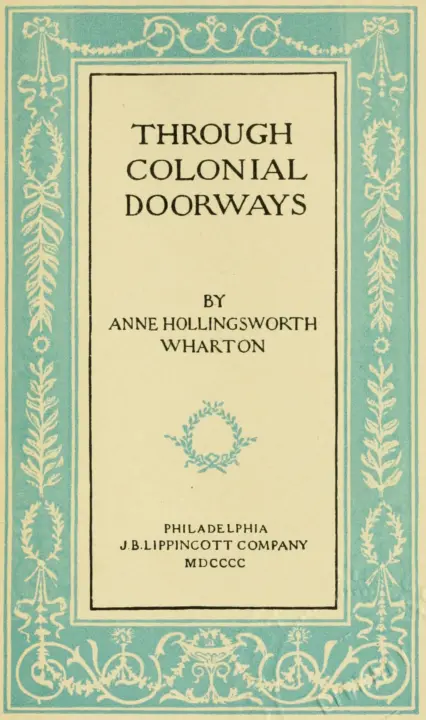
THE CLASSIC COLLECTION · 1893
"Through Colonial Doorways" by Anne Hollingsworth Wharton is a historical account written in the late 19th century. The work seeks to illuminate the social and domestic lives of people during the Colonial and Revolutionary times, focusing on the personal and intimate aspects of their lives rather than just historical events. This book finds relevance as readers gain insights into the lives of lesser-known figures and everyday experiences that shaped their time away from the battles and politics of the era. At the start of the work, the author reflects on the growing interest in understanding the social dimensions of Colonial America. The opening discusses the value of personal anecdotes, letters, and journals as a way to connect modern readers with their ancestors, revealing the more relatable aspects of these historical figures. Wharton emphasizes the importance of humor, affection, and human connection, weaving in examples from letters and diaries that showcase the lighter side of life during a tumultuous time. The work introduces intriguing characters like Miss Sally Wister and Major Stoddert, whose carefree adventures highlight the charm and social intricacies of the era, while setting the stage for further exploration of the lives woven into the fabric of America's past.
Introduction adapted from the source catalogue; source summaries may be automatically generated.
Free to read · English · 41,496 words · No account needed
MAKE TIME FOR A GOOD BOOK
On by default. Untick to stop anonymous reading totals. Each page counts after 10 seconds in view. How this works.
Anonymous counting is on unless you have switched it off.
“The Knights of the Blended Roses and of the Burning Mount have resigned their laurels to Rebel officers, who will lay them at the feet of those virtuous daughters of America, who cheerfully gave up ease and affluence in a city, for liberty and peace of mind in a cottage.”[9]
[2] It is pleasant to learn that Mr. Joseph Wharton, the owner of Walnut Grove, if proud was also benevolent, as we find his name among liberal contributors to one of the first Philadelphia almshouses.
[3] This sketch, by Major André, is in the possession of Mr. Edward
Shippen, of Philadelphia.
[4] “We all know of Burgoyne’s surrender, but hardly one knows Burgoyne’s comedies, and yet there are few cleverer or more brilliant, of a second order, than ‘The Heiress,’ and ‘Maid of Oaks.’ In a letter, dated New York, June 2, 1777, he says, ‘You cannot imagine anything half so beautiful as this country. It is impossible to conceive anything so delightful. Lady Holland, in spite of her politics, would, I am sure, feel for it, if she could see the ruin and desolation we have introduced into the most beautiful and, I verily believe, happiest part of the universe.’”--World Essays: William B. Reed, pp. 176, 177.
[5] From a letter of the late Lawrence Lewis, Jr., written in 1879.
[6] It appears that this knight with the shining name and emblem had not a reputation to match them. We learn that he entered the army only to get to America, was discharged, tried to join the Colonial army, and was seized and sent to England. (German Allied Troops, 1776-1783, p. 333.)
[7] Fred. D. Stone. Pennsylvania Magazine, vol. iii. p. 336.
[8] Watson’s Annals of Philadelphia, vol. ii. p. 297.
[9] Biographical Sketch of General Anthony Wayne, Hazard’s Register, p.
389.
Amid elaborate ceremonials attending the reception and inauguration of the first President of the Republic, we find some homely touches of nature, as when those two admirable housewives Mrs. Washington and Mrs. Adams were detained at home, in April and May, 1789, by domestic duties, and so missed all the joyful demonstrations along the route, as well as the brave welcome accorded their distinguished husbands in the city of New York. Mrs. Washington was busied in putting her household in order, and shipping china, cut glass, silver-ware, and linen from Mount Vernon to the capital, while from John Adams’s letters we gather that the wife, whom he so trusted that he permitted her to dispose of sheep, cows, and other live-stock, on her own responsibility, was attending to such matters at Braintree, Massachusetts, prior to the removal of her household goods to the fine country-place at Richmond Hill that Mr. Adams had rented for the season.[10]
Your reading position is saved on this browser. Take it to another device with a library code. Reading pages adapt to text, rather than matching a printed edition.
Anne Hollingsworth Wharton
Anne Hollingsworth Wharton
BEHIND THE BOOK
This eBook is for the use of anyone anywhere in the United States and most other parts of the world at no cost and with almost no restrictions whatsoever. You may copy it, give it away or re-use it under the terms of the Project Gutenberg License included with this eBook or online at www.gutenberg.org. If you are not located in the United States, you will have to check the laws of the country where you are located before using this eBook. Read the source licence.
The original source file, including credits and licence, is retained by this library. Request an original-format copy at no charge. Please include the book title and Project Gutenberg identifier #67788.
KEEP YOUR CURIOSITY GOING
Cécile Tormay

Moritz Busch
John L. Ransom
Frances Wright
Cécile Tormay

Mabel Potter Daggett