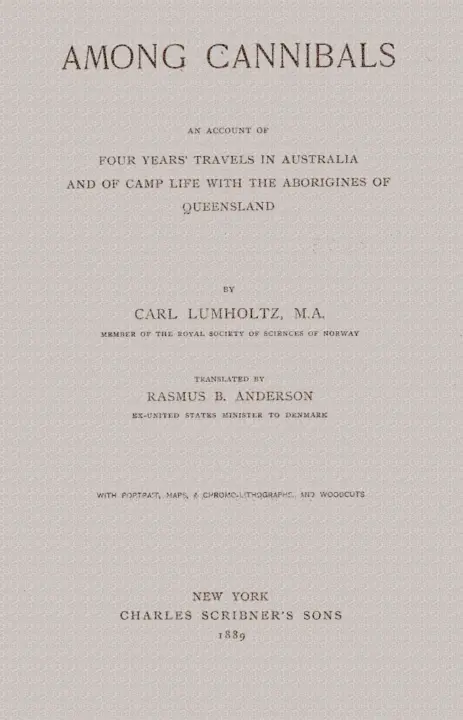
Among Cannibals: An Account of Four Years’ Travels in Australia and of Camp Life With the Aborigines of Queensland
Carl Lumholtz
THE CLASSIC COLLECTION · 1920
"Through Central Borneo" by Carl Lumholtz is an ethnographic and travel account written during the early 20th century. The book chronicles Lumholtz's journey through the largely uncharted territories of Borneo between 1913 and 1917, focusing on his interactions with various indigenous tribes, including the headhunting cultures of the Dayaks. The narrative provides insights into the sociocultural dynamics, flora, and fauna of the region while reflecting on the broader themes of civilization versus primitivism, showcasing Lumholtz's admiration for the perceived simplicity and richness of life among the “savages” he encounters. The opening of the book introduces readers to Lumholtz's ambitious expedition and sets the stage for his explorations. After receiving funding and planning the journey, he embarks on a race against time to catch a glimpse of the eastern territories before the outbreak of World War I alters his plans. He shares vivid impressions of his travels through Japan and Singapore, before arriving at Batavia, Java, where he expresses eagerness for his forthcoming adventures in Borneo. This segment establishes the purpose of his expedition, which includes research on various tribes, specimen collection, and observation of the natural environment, immediately immersing readers in his adventurous spirit and anticipation of discovery in the unknown lands of Borneo.
Introduction adapted from the source catalogue; source summaries may be automatically generated.
Free to read · English · 131,369 words · No account needed
MAKE TIME FOR A GOOD BOOK
On by default. Untick to stop anonymous reading totals. Each page counts after 10 seconds in view. How this works.
Anonymous counting is on unless you have switched it off.
Mountains of Borneo:
Kinabalu;
Gunong Rega;
first appearance of;
on Busang River;
crossing the Bukit;
Lung Karang;
seen from Batokelau;
canyon through;
Mountain of Images;
seen from Tumingki;
the stone man and the stone wife;
Muller
Mourning garments
Mouse-deer, capture of a;
superstition concerning
Moving-pictures shown to natives
Muara Laong
Muara Tewe, in
Muara Topu
Mud, taken from pool bottom
Muller mountains, home of the Penyahbongs
Murder, vendetta resulting from.
See also Killing
Murungs, the, physical appearance of;
a stay among;
dance of;
dress of;
soldiers killed by;
filing of teeth by;
marriage customs of;
funeral customs of;
location of;
tatuing of;
customs regarding childbirth;
wooden images employed by;
belief of, concerning number and location of souls
Muruts, the
Musangs, tame
Museum, nucleus of, in Bandjermasin
Music, good spirits attracted by
Musical instruments: the drum;
the flute;
the jews'-harp;
the sapi;
the sarunai;
the shield;
trumpet;
folk-tale about
Mustaches
Nagah, good and evil spirit;
represented in decorative designs;
description of;
names given to, by different tribes
Nagasaki, western influence in
Nahamerang, village of
Names, in vogue among Katingans;
custom of changing
Naming of children
Nangca (fruit)
Napoleonic Wars, the
Nasalis larvatus
Natives of Borneo. See Dayaks and Tribes
Necklaces, bead;
made of stalks of plants;
on kapatongs
Negara
Nepenthes
Netherlands India, Governor-General of
New Guinea, securing men for expedition to;
fitting out of expedition to, interrupted by war;
omen bird heard at start of an expedition to
Newspapers, received at Long Kai
Nieuwenhuis, Dr. A.W.;
attempt to kill
Nipa palm
Nohacilat, aboriginal wearing apparel from
"Nokken," Norwegian superstition of the
Nomorunge, village of
Nose, in Long-Glat leave-taking
Nudity, chasteness of
Numbers, sacred
Nuncilao, village of
Nundun, the
Oatmeal
Obongbadjang, folk-tale about
Oeloe Soungei, district of
Oil, at Balik Papan
Oma-Gaai, Kayan sub-tribe
Oma-Lakan, the, Kayan sub-tribe
Oma-Lokvi, the
Oma-Palp, the;
festival of
Oma-Sulings, the, country of;
characteristics of;
and the Long-Glats;
the great festival of;
the women of;
funeral customs of;
hair colour of;
a second visit to;
meaning of the name;
from Apo Kayan;
weaving no longer done by;
villages of, on Upper Mahakam;
food of;
desire of, for large families;
included in Orang Bahau;
beliefs and customs of;
customs regarding childbirth;
marriage customs of;
omen before naming children;
sacred numbers of;
use by, of nagah in decorative designs
Oma-Tapi, the
Ome-Tepe, the
Omamahak
Omen birds;
not eaten;
kapatongs of images of
Omens: fire, before tuba-fishing;
taken from birds;
from pig's liver;
the centipede;
taken by top-spinning;
concerning headhunting;
from dreams;
from banana leaves before naming children;
hunting expeditions abandoned because of;
good and evil, among the Katingans
"Onder," the;
head-hunting by
Ong Sangi, village of
Onions, white
Oostenbroek, G.
Your reading position is saved on this browser. Take it to another device with a library code. Reading pages adapt to text, rather than matching a printed edition.
BEHIND THE BOOK
This eBook is for the use of anyone anywhere in the United States and most other parts of the world at no cost and with almost no restrictions whatsoever. You may copy it, give it away or re-use it under the terms of the Project Gutenberg License included with this eBook or online at www.gutenberg.org. If you are not located in the United States, you will have to check the laws of the country where you are located before using this eBook. Read the source licence.
The original source file, including credits and licence, is retained by this library. Request an original-format copy at no charge. Please include the book title and Project Gutenberg identifier #7489.
KEEP YOUR CURIOSITY GOING
Wilfrid Scawen Blunt
Wilfrid Scawen Blunt

E. W. (Edgar Watson) Howe
Cécile Tormay

Moritz Busch
John L. Ransom