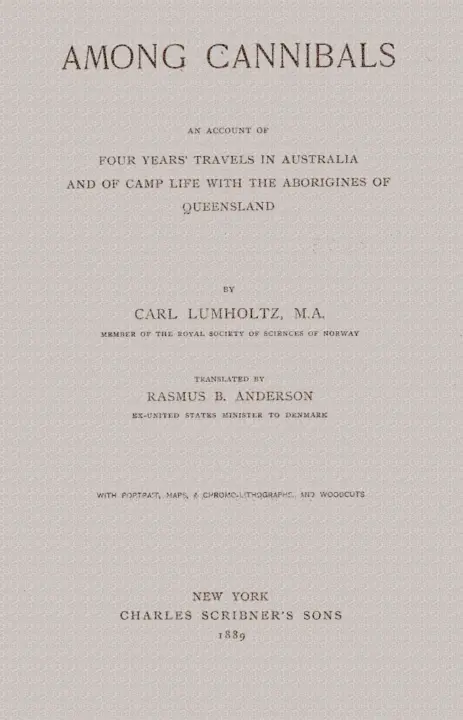
Among Cannibals: An Account of Four Years’ Travels in Australia and of Camp Life With the Aborigines of Queensland
Carl Lumholtz
THE CLASSIC COLLECTION · 1920
"Through Central Borneo" by Carl Lumholtz is an ethnographic and travel account written during the early 20th century. The book chronicles Lumholtz's journey through the largely uncharted territories of Borneo between 1913 and 1917, focusing on his interactions with various indigenous tribes, including the headhunting cultures of the Dayaks. The narrative provides insights into the sociocultural dynamics, flora, and fauna of the region while reflecting on the broader themes of civilization versus primitivism, showcasing Lumholtz's admiration for the perceived simplicity and richness of life among the “savages” he encounters. The opening of the book introduces readers to Lumholtz's ambitious expedition and sets the stage for his explorations. After receiving funding and planning the journey, he embarks on a race against time to catch a glimpse of the eastern territories before the outbreak of World War I alters his plans. He shares vivid impressions of his travels through Japan and Singapore, before arriving at Batavia, Java, where he expresses eagerness for his forthcoming adventures in Borneo. This segment establishes the purpose of his expedition, which includes research on various tribes, specimen collection, and observation of the natural environment, immediately immersing readers in his adventurous spirit and anticipation of discovery in the unknown lands of Borneo.
Introduction adapted from the source catalogue; source summaries may be automatically generated.
Free to read · English · 131,369 words · No account needed
MAKE TIME FOR A GOOD BOOK
On by default. Untick to stop anonymous reading totals. Each page counts after 10 seconds in view. How this works.
Anonymous counting is on unless you have switched it off.
Garrison, in Apo Kayan;
at Long Iram;
at Long Kai;
at Long Nawang;
at Puruk Tjahu, ill
German missionaries
Gibbon (man-like ape)
Glit River, the
Gnats
Go Hong Cheng, interpreter
Goat, at times an antoh
Goitre
Gold;
of Barito River country;
hunting for, on Busang River;
in Samba and Braui Rivers;
on Katingan River;
not used by Penyahbongs
Gompul
Governor-General of Netherlands India
Grass, in the jungle
Grasshoppers
Grijson, H.J.
Grotius, Dutch steamer
Guitar, a native
Gunong, camp
Gunong Porok, village of, folk-lore from
Gunong Rega, height of
Haddon, Doctor A.C.
Hageman, Captain J.J.M., on character of the Dayak
Hair, removal of body;
on body, resembling orang-utan;
colour of head;
parasites in;
mustaches;
beards;
worn cut, by Duhoi;
shaving of forehead;
cut from head and placed in tree;
arrangement of women's
Harelip
Harvest, paddi;
festival
Hawk, worship of;
a tame
Head-hunters, song of;
seen on board steamer;
meeting an imaginary attack of;
food of
Head-hunting, measures taken by Dutch government to eradicate;
among various tribes;
religious fanaticism incentive to;
a recent raid;
description of a raid;
customs regarding the practice of;
omens concerning;
the purposes of;
Captain Hageman quoted concerning;
effect of, on disposition of natives;
kapatongs of prime importance in;
rice-throwing before;
folktale about;
principal weapon used in;
Dayaks incited to by Malays;
of the Bukats;
not practised by Bukits;
of Duhoi chief;
of the Duhoi and Katingans;
raids of the Ibans;
of the Kenyahs;
discontinued by Ot-Danums;
of the Punans;
of the Ulu-Ots
Head ornament, women's
Heat, intense, in jungle
Hens, sacrificed at rubber gatherers' feast;
sacrificed at wedding;
sacrificed at funeral;
hung in bags at night;
chickens eaten by
Hindu Javanese, first settlers in Borneo;
kingdoms founded by;
absorbed by Malays
Hinduism of first settlers in Borneo
Hindus, in South Africa;
antiquities of, found in Borneo;
brass statue;
influence of, among Dayaks
Hoang Tshirao, village of
Honesty, of natives
Honey, native methods of gathering
Hong Seng, Chinese merchant
Hornbills;
the rhinoceros;
the tail feathers of;
image of, on flying prahu;
image of, on pantar
Hornets
Hose, Doctor
Hospitality, of natives
House of worship, at Angkipi;
at Ado;
at Tumingki
Houses: camping, for travellers;
communal;
with upright pillars before;
at Tumbang Marowei;
custom of burying slave alive underneath;
at Long Kai;
at Long Pahangei;
with beautiful carvings;
Malay;
high-gabled, in Negara;
of the Katingans;
form of salutation on entering and leaving;
dancing on completion of
How the Penganun was Caught Alive, folktale
Humidity
Humour, sense of, among natives
Hunchback
Hunting, deer;
wild pig;
rhinoceros;
by the Penyahbongs;
part taken by women in;
omens concerning
Hydrophobia
Ibans, the;
head-hunting raids of;
known as Orang Bahau
Idenburg, A.W.F., Governor-General of Netherlands India
Your reading position is saved on this browser. Take it to another device with a library code. Reading pages adapt to text, rather than matching a printed edition.
BEHIND THE BOOK
This eBook is for the use of anyone anywhere in the United States and most other parts of the world at no cost and with almost no restrictions whatsoever. You may copy it, give it away or re-use it under the terms of the Project Gutenberg License included with this eBook or online at www.gutenberg.org. If you are not located in the United States, you will have to check the laws of the country where you are located before using this eBook. Read the source licence.
The original source file, including credits and licence, is retained by this library. Request an original-format copy at no charge. Please include the book title and Project Gutenberg identifier #7489.
KEEP YOUR CURIOSITY GOING
Wilfrid Scawen Blunt
Wilfrid Scawen Blunt

E. W. (Edgar Watson) Howe
Cécile Tormay

Moritz Busch
John L. Ransom