
Letters to a Friend, Written to Mrs. Ezra S. Carr, 1866-1879
John Muir
THE CLASSIC COLLECTION · 1897
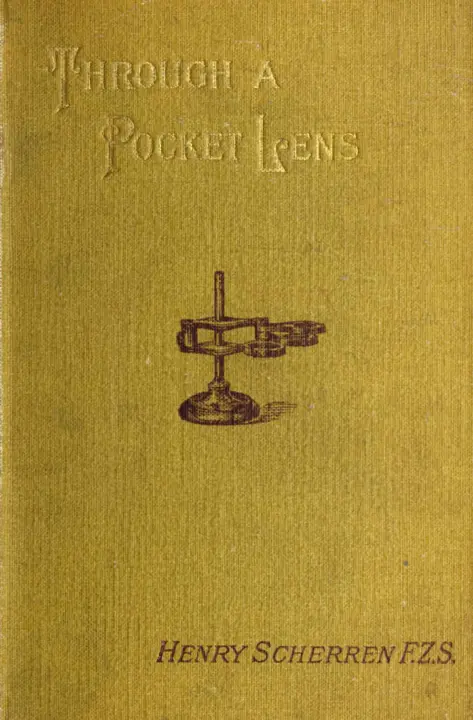
"Through a Pocket Lens" by Henry Scherren is a scientific publication written in the late 19th century. The book aims to educate readers on the usage of simple optical instruments, such as pocket lenses and dissecting microscopes, to observe and study natural specimens, particularly focusing on various types of arthropods. Scherren emphasizes that significant discoveries can be made with basic tools, making the exploration of nature accessible to beginners and enthusiasts alike. The opening of the work introduces the context and purpose of the book, highlighting the importance of simple methods in natural observation. Scherren references notable figures like Charles Darwin to underscore the effectiveness of using basic equipment over complex instruments. He lays groundwork for practical observation by detailing various tools that can be easily obtained or even homemade, preparing the reader for subsequent discussions on specific types of insects and methods of observation that will follow in later chapters.
Introduction adapted from the source catalogue; source summaries may be automatically generated.
Free to read · English · 46,203 words · No account needed
MAKE TIME FOR A GOOD BOOK
On by default. Untick to stop anonymous reading totals. Each page counts after 10 seconds in view. How this works.
Anonymous counting is on unless you have switched it off.
Stebbing, Rev. T. R. R., on etymology of Dytiscus, 33 n.;
on Malacostraca, 128;
on meaning of chelate and sub-chelate, 132 n.;
on Amphipods, 141.
Stewart, Professor, incident of, 20.
Stilopyga, 63.
Swammerdam on Blatta, 74;
on Nepa, 89;
on Water Mites, 114;
on Woodlice, 156;
on Dytiscus larva, 158, 159.
Tailed Wasp, 82.
Talitrus locusta, 151;
Bate and Westwood on, 151;
Mr. Robertson on, 152.
Tanypus, larva of, 176.
Tegetmeier, Mr. W. B., on destruction of shells, 34.
Thomson, J. A., on Spiders, 100.
Trap-door Spider, 97.
Vertebrates, 28.
Wart-eater, 81.
Water Beetle, Margined, 31;
the Great, 49.
Water Boatman, 93.
Water Bugs, 86.
Water-devil, 157.
Water Mites, 113;
Swammerdam on, 114;
De Geer on, 116;
Dugès on, 117;
Mainland on, 118.
Water Scorpion, 86.
Water-tiger, 157.
Westwood on Locusta, 81.
White, Gilbert, on Blatta, 64.
Wing-cases, 41.
Wireworm, 126.
Wood, Rev. J. G., on lens stand, 15.
Woodlice, 155;
Swammerdam on, 156.
Worms, 29.
Wright, Mr. L., on microscopes, 16.
Zeiss, lenses of, 15.
[1] Darwin, Descent of Man (2nd ed.), p. 159, note 23.
[2] The power of magnification of a lens is the ratio of its focal distance to 10 inches. Thus a lens of 1 inch focus (or focal distance) magnifies 10 times (written × 10, or ten diameters); one of ½ in. focal distance, 20 times, and so on.
[3] A Popular Handbook to the Microscope, p. 39.
[4] Journal of the Quekett Microscopical Club, v. 148.
[5] Ponds and Rock Pools, p. 17.
[6] Bulletin of the Illinois State Laboratory of Natural
History, iv. 158.
[7] ‘Dytiscus’ is written of set purpose. It is not, as some people tell us, a miswriting for Dyticus; but a properly formed diminutive, from the Greek dutēs = a diver; like paidiskos = a little boy. Linnaeus consistently calls the genus Dytiscus from 1735 onwards. Dyticus only dates from Geoffroy’s Histoire Abrégée des Insectes, first published anonymously in 1762. On this question of nomenclature I am glad to have the support of the Rev. T. R. R. Stebbing, F.R.S., who, in answer to my inquiries, kindly wrote, ‘Darwin uses “Dytiscus” in the Origin of Species, and I should decidedly recommend its being upheld.’
[8] April 4, 1896.
[9] Popular History of the Aquarium, p. 258.
[10] May 2, 1896.
[11] International Science Series, No. lxv.
[12] Aquatic Insects, pp. 55, 56.
[13] Zeitschrift f. wiss. Zoologie, Bd. xl. S. 481.
[14] Mémoires du Muséum d’histoire naturelle, xviii. 454 sqq.
[15] I have purposely given Blatta as the generic name, rather than Stilopyga, which should properly be used, as the former is only employed in very recent literature.
[16] Miall and Denny, The Cockroach, p. 20.
[17] Cambridge Natural History, v. 231.
[18] The Senses of Animals, p. 44.
[19] Cambridge Nat. Hist. v. 223.
[20] Book of Nature, p. 94.
[21] This refers to the gizzard. Echinus was used to denote the third stomach of Ruminants (now called the manyplies), because it was thought to resemble a hedgehog rolled up.
[22] Miall and Denny, The Cockroach, p. 118 (note).
[23] Introduction to Entomology, letter xi.
[24] Proceedings of the Zoological Society, 1892, p. 586.
[25] Our Household Insects, pp. 159–163.
[26] Kirby and Spence, Introd. to Entomology, ed. 1870, p. 484.
Your reading position is saved on this browser. Take it to another device with a library code. Reading pages adapt to text, rather than matching a printed edition.
BEHIND THE BOOK
This eBook is for the use of anyone anywhere in the United States and most other parts of the world at no cost and with almost no restrictions whatsoever. You may copy it, give it away or re-use it under the terms of the Project Gutenberg License included with this eBook or online at www.gutenberg.org. If you are not located in the United States, you will have to check the laws of the country where you are located before using this eBook. Read the source licence.
The original source file, including credits and licence, is retained by this library. Request an original-format copy at no charge. Please include the book title and Project Gutenberg identifier #68981.
KEEP YOUR CURIOSITY GOING
John Muir

Asa Gray
Asa Gray

Florence Nightingale
Elizabeth Robins Pennell
Denison Olmsted