THE CLASSIC COLLECTION✦My diaries, being a personal narrative of events 1888-1914, Part 2 (1900-1914)CLASSIC FREE BOOKS
My diaries, being a personal narrative of events 1888-1914, Part 2 (1900-1914)
Wilfrid Scawen Blunt
THE CLASSIC COLLECTION · 1847
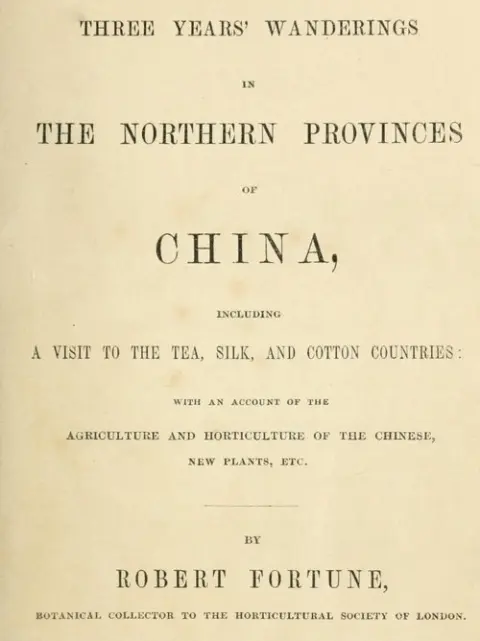
"Three Years' Wanderings in the Northern Provinces of China" by Robert Fortune is an exploration and botanical account written in the mid-19th century. The book recounts the author's extensive travels across various provinces in China, detailing his observations on the local flora, agriculture, and the socio-cultural dynamics he encounters. Fortune's narrative emerges from a unique perspective, as he serves as a botanical collector, aiming to document and understand a land often shrouded in Western misconceptions and mystique. The opening of the work introduces the author’s motivations and challenges as he embarks on his journey. Fortune reflects on the flawed Western perceptions of China, criticizing prior narratives for their reliance on hearsay and exaggerations. He presents a realistic depiction of the country, noting both its advancements and stagnations in comparison to the West. Additionally, he touches on the character of the Chinese people, their government, and agricultural practices while establishing the tone for a detailed, firsthand investigation into China’s natural and cultural landscape. This sets the stage for a journey filled with rich observations and personal anecdotes as Fortune navigates both the physical and social terrains of China.
Introduction adapted from the source catalogue; source summaries may be automatically generated.
Free to read · English · 106,245 words · No account needed
MAKE TIME FOR A GOOD BOOK
On by default. Untick to stop anonymous reading totals. Each page counts after 10 seconds in view. How this works.
Anonymous counting is on unless you have switched it off.
The only other Chinese towns on the island of any note besides the new one just noticed, are on the south side, and used to be called Little Hong-kong and Chuckehew; their names have been changed lately by the governor, Sir J. Davis, into Stanley and Aberdeen. They are merely fishing-towns; but the government always keeps up a military station at the latter, which renders it of some importance.
Hong-kong is one of the largest islands near the mouth of the Canton river. It is about eight miles from east to west, and the widest part of it is not more than six miles; but it is very irregular, some parts being only three miles in breadth, and the land jutting out here and there, forming a succession of headlands and bays. Imagine, then, an island considerably longer than it is broad, perfectly mountainous, and sloping in a rugged manner to the water's edge, having here and there deep ravines almost at equal distances along the coast, which extend from the tops of the mountains down to the sea, deepening and widening in their course. There are immense blocks of granite in these ravines, which have either been bared by the rapid currents of water in its descent during the rains, or which have tumbled into them from the sides of the mountains at some former period of time. The water in these ravines is abundant and excellent; and hence the poetical name which the Chinese have given our island. Hong-kong, or more properly Heang-Keang, the "Island of fragrant streams." During the wet season--for it rains in torrents then--these little streams swell with the augmentation of fresh water; and rush down from the mountains with a velocity which sweeps every thing before them. In May, 1845, one of these storms of thunder and rain visited Victoria; and the effects produced by it were perfectly astonishing; houses were undermined, roads made at a great expense only a few months before, were swept away; drains were burst open; and many of the bridges and other public works rendered perfectly useless. "The Hong-kong Register" thus notices the storm to which I allude:--"The damage was very great, both to the recently-formed roads and to many buildings in the course of erection; and had the violence of the rain continued an hour or two longer, many houses must have been undermined and destroyed. As it was, much individual inconvenience has been sustained. About 5 o'clock the whole of Queen's Road, from the entrance to the large bazaar to the market-place, was completely flooded, to the depth of from two to four feet. All the streets leading upwards to the hill served as feeders to this lake. In Peel Street particularly, the torrent rushed along, bearing every thing before it, and the street still resembles a dried up water-course, covered with stones and wrecks of buildings. The passages from the Queen's Road to the sea were all full; the one leading through Chunam's Hong for hours presented the appearance of a rapid river, and many of the houses on each side were only saved from the flood by mud walls hastily raised. About 6 o'clock the rain moderated, but for some time after the road was quite impassable. A Coolie, attempting to ford the stream rushing down D'Aguilar Street, was borne off his feet, but saved himself by catching hold of the frame of a mat-shed. The drain lately formed could not carry off the water, which committed great devastation, flooding a new house in its vicinity to the depth of nearly three feet, and destroying some new walls. All the open drains in the upper streets have suffered, many are entirely destroyed, leaving scarcely a trace of the street. A stream from a distant water-course flowed along the road above the bungalow, occupied by the attorney-general, and descending with great fury upon the roof of one of his out-offices, carried away a great part of it. In many places the Queen's Road has been covered with soil, sand, &c., to the depth of more than two feet, and nearly all the cross drains are choked up. The bridge at the Commissariat has been carried away, and that in the Wong-nai-chung has also disappeared. Several lives were lost by the fall of a house in which some Chinese resided; and it is said the stream at Pokfowlum burst upon a mat hut in which were a number of Coolies, employed upon the new road; three saved themselves in a tree, but many more are missing, and are supposed to have been carried out to sea."
Your reading position is saved on this browser. Take it to another device with a library code. Reading pages adapt to text, rather than matching a printed edition.
BEHIND THE BOOK
This eBook is for the use of anyone anywhere in the United States and most other parts of the world at no cost and with almost no restrictions whatsoever. You may copy it, give it away or re-use it under the terms of the Project Gutenberg License included with this eBook or online at www.gutenberg.org. If you are not located in the United States, you will have to check the laws of the country where you are located before using this eBook. Read the source licence.
The original source file, including credits and licence, is retained by this library. Request an original-format copy at no charge. Please include the book title and Project Gutenberg identifier #54720.
KEEP YOUR CURIOSITY GOING
Wilfrid Scawen Blunt
Wilfrid Scawen Blunt

E. W. (Edgar Watson) Howe
Francis Greenleaf Allinson & Anne C. E. (Anne Crosby Emery) Allinson
Cyrenus Cole

John Martineau