THE CLASSIC COLLECTION✦My diaries, being a personal narrative of events 1888-1914, Part 2 (1900-1914)CLASSIC FREE BOOKS
My diaries, being a personal narrative of events 1888-1914, Part 2 (1900-1914)
Wilfrid Scawen Blunt
THE CLASSIC COLLECTION · 1847
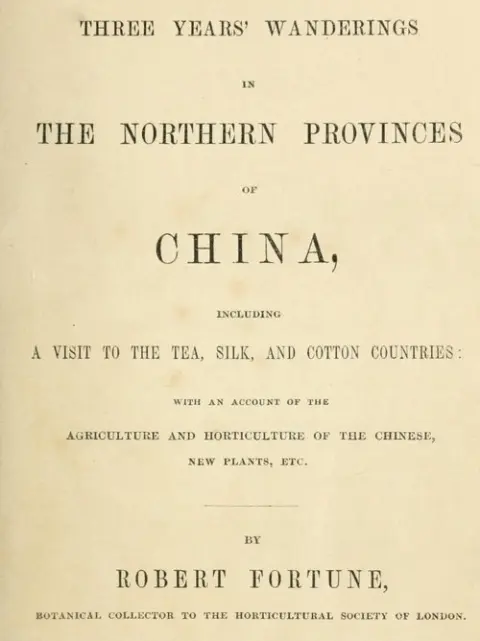
"Three Years' Wanderings in the Northern Provinces of China" by Robert Fortune is an exploration and botanical account written in the mid-19th century. The book recounts the author's extensive travels across various provinces in China, detailing his observations on the local flora, agriculture, and the socio-cultural dynamics he encounters. Fortune's narrative emerges from a unique perspective, as he serves as a botanical collector, aiming to document and understand a land often shrouded in Western misconceptions and mystique. The opening of the work introduces the author’s motivations and challenges as he embarks on his journey. Fortune reflects on the flawed Western perceptions of China, criticizing prior narratives for their reliance on hearsay and exaggerations. He presents a realistic depiction of the country, noting both its advancements and stagnations in comparison to the West. Additionally, he touches on the character of the Chinese people, their government, and agricultural practices while establishing the tone for a detailed, firsthand investigation into China’s natural and cultural landscape. This sets the stage for a journey filled with rich observations and personal anecdotes as Fortune navigates both the physical and social terrains of China.
Introduction adapted from the source catalogue; source summaries may be automatically generated.
Free to read · English · 106,245 words · No account needed
MAKE TIME FOR A GOOD BOOK
On by default. Untick to stop anonymous reading totals. Each page counts after 10 seconds in view. How this works.
Anonymous counting is on unless you have switched it off.
"The tea was then handed in small quantities, on broad shallow baskets, to a number of women and children, who carefully picked out the stalks, and coarse or uncurled leaves; and, when this had been done, it was passed in succession through sieves of different degrees of fineness. The first sifting produced what was sold as Hyson-skin, and the last bore the name of Young Hyson. As the party did not see the intermediate step between the picking and sifting, there is reason to believe that the size of the leaves was first reduced by chopping or cutting with shears. If the tea has not highly deleterious qualities, it can only be in consequence of the colouring matter existing in a small proportion to the leaf[3]; and the Chinese seemed quite conscious of the real character of the occupation in which they were engaged; for, on attempting to enter several other places where the same process was going on, the doors were speedily closed upon the party. Indeed, had it not been for the influence of the Hongist who conducted them, there would have been little chance of their seeing as much as they did."
[1] Charles Knight and Co., Ludgate Street, 1840.
[2] Prussiate of iron, and sulphate of lime.
[3] The turmeric and gypsum are perfectly innocuous; but the prussian blue, being a combination of prussic acid with iron, is a poison.
CHUSAN ARCHIPELAGO.--STORM IN A SMALL BOAT.--NEARLY UPSET.--KIN-TANG, OR SILVER ISLAND.--ITS INHABITANTS.--THEIR SURPRISE ON SEEING A FOREIGNER.--YANG-TSE-KIANG RIVER.--ITS NUMEROUS SAND BANKS.--OUR SCHOONER AGROUND.--NOVEL METHOD OF GETTING ASSISTANCE FROM THE CHINESE.--VILLAGE OF WOO-SUNG.--OPIUM STATION.--REMARKS ON THE OPIUM TRADE.--ITS EFFECTS UPON THE CHINESE.
In the summer of 1844 I was frequently engaged in exploring the islands of the Chusan Archipelago, more particularly that portion which lies between Chusan and the opposite shores of the main-land. It was of course necessary for this purpose to employ Chinese boats, which are not very trustworthy. The distance from Chusan to the town of Chinhae, at the mouth of the Ning-po river, is about thirty miles. A sail across a sea such as this is generally pleasant enough, because the water, which is hemmed in on all sides, is frequently as smooth as a mill-pond. Sometimes, however, the wind comes down in gusts from the openings amongst the hills, and then the little China boats are all laid nearly upon their beam-ends before the sail can be taken in. Once, in particular, I had a narrow escape from a watery grave amongst these islands. I had engaged a boat to take me across from the city of Ning-po to Chusan; and, as I was in a hurry at the time, I was anxious to reach my destination as soon as possible. The wind blew rather fresh as we were going down the Ning-po river, and when we reached the town of Chinhae, at its mouth, evening had set in, and the sky had a threatening and stormy appearance. The boatmen pointed this out to me, and were anxious to remain where we were until daylight. As I was afraid of being too late for a passage in an English vessel, which was then at anchor in the bay of Chusan, I would not consent to this prudent proposal, but insisted that they should proceed across without further delay. After exhausting all their arguments, they at length unwillingly got up the anchor, and we proceeded on our voyage. The land and hills on our way from Ning-po to the mouth of the river had sheltered us, and prevented me from feeling the full force of the wind; but no sooner had we passed the forts, and reached the open sea, than I found I had done a very foolish thing in urging the boatmen to take me across in such a night, and I would gladly have gone back had it been prudent or indeed possible to have done so. It was now, however, too late, for with a strong spring tide and a heavy head sea, it was impossible to get back again to Chinhae, and we therefore kept on in the direction of Chusan. "Are you not carrying too much sail in such a wind as this, and with such a heavy rolling sea?" said I to the captain of the boat, an old weather-beaten man from the province of Fokien. "No fear, no fear," he replied in his broken Chusan English, "my can manage he." "But I think there is fear, Fokei," I replied; and the words were scarcely said, when a tremendous gust came down upon us, and at the same moment a heavy sea struck the side of our boat, and laid her fairly on her beam-ends. In an instant the boat filled in all her divisions from bow to stern. "Lower the sail, lower the sail, quick, quick," cried the helmsman, "or we shall all go to the bottom." Several of the crew flew to the sail, which fortunately came down readily, and our little craft righted once more, but rolled and plunged very heavily in consequence of the great quantity of water in her hold, and seemed as if she would go down at every plunge, and leave us exposed to the fury of the waves. We again got a few feet of sail hoisted, and kept her away before the wind. It was now dark, not a star was to be seen in the heavens, the mountains, although not distinctly visible, yet loomed through the gloom, and the only objects clearly distinguished were some lights flickering on the distant shore. The crew now surrounded the helmsman, and besought him to try and get back to Chinhae, but I was sailor enough to know that if we attempted to put the helm down and bring the boat round, in all probability we should ship another sea, and had we done so we must have gone down. I immediately went and stood by the helmsman, and kept the crew from interfering, telling him to keep on our course and try to get under the lee of some island as soon as possible. The men now began to throw off their clothes as a last resource, and so completely lost all their self-possession that no remonstrances could induce them to attend to the boat and get some of the water out of her. The captain or helmsman, however, did his duty well, and to his firmness and knowledge we, doubtless, owed our lives. Providentially the wind lulled for a short time, which enabled us to hoist more sail; and soon afterwards we got to leeward of one of the numerous small islands which are scattered over this part of the coast. As soon as we had anchored all hands began baling the water out of the boat. We were in a most pitiful condition, all our clothes and beds being completely soaked with seawater; some plants, but luckily only duplicates, which I had with me, were, of course, totally destroyed; but our hearts were light, and we were thankful that our lives had been saved. Before daylight the boat was all right again, and as the weather had moderated, we were able to proceed on our course to Chusan.
Your reading position is saved on this browser. Take it to another device with a library code. Reading pages adapt to text, rather than matching a printed edition.
BEHIND THE BOOK
This eBook is for the use of anyone anywhere in the United States and most other parts of the world at no cost and with almost no restrictions whatsoever. You may copy it, give it away or re-use it under the terms of the Project Gutenberg License included with this eBook or online at www.gutenberg.org. If you are not located in the United States, you will have to check the laws of the country where you are located before using this eBook. Read the source licence.
The original source file, including credits and licence, is retained by this library. Request an original-format copy at no charge. Please include the book title and Project Gutenberg identifier #54720.
KEEP YOUR CURIOSITY GOING
Wilfrid Scawen Blunt
Wilfrid Scawen Blunt

E. W. (Edgar Watson) Howe
Francis Greenleaf Allinson & Anne C. E. (Anne Crosby Emery) Allinson
Cyrenus Cole

John Martineau