THE CLASSIC COLLECTION✦My diaries, being a personal narrative of events 1888-1914, Part 2 (1900-1914)CLASSIC FREE BOOKS
My diaries, being a personal narrative of events 1888-1914, Part 2 (1900-1914)
Wilfrid Scawen Blunt
THE CLASSIC COLLECTION · 1847
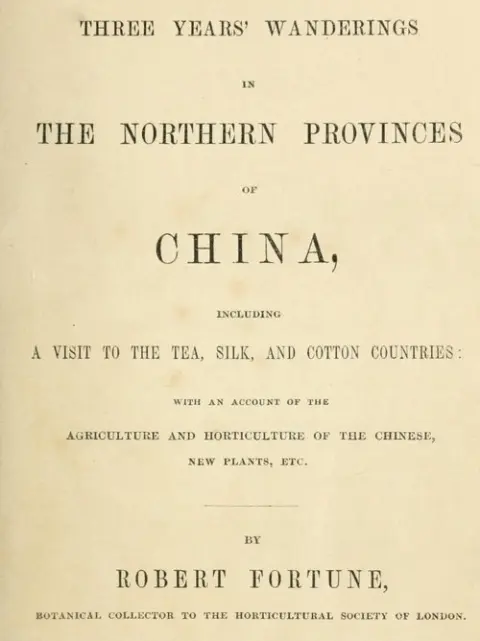
"Three Years' Wanderings in the Northern Provinces of China" by Robert Fortune is an exploration and botanical account written in the mid-19th century. The book recounts the author's extensive travels across various provinces in China, detailing his observations on the local flora, agriculture, and the socio-cultural dynamics he encounters. Fortune's narrative emerges from a unique perspective, as he serves as a botanical collector, aiming to document and understand a land often shrouded in Western misconceptions and mystique. The opening of the work introduces the author’s motivations and challenges as he embarks on his journey. Fortune reflects on the flawed Western perceptions of China, criticizing prior narratives for their reliance on hearsay and exaggerations. He presents a realistic depiction of the country, noting both its advancements and stagnations in comparison to the West. Additionally, he touches on the character of the Chinese people, their government, and agricultural practices while establishing the tone for a detailed, firsthand investigation into China’s natural and cultural landscape. This sets the stage for a journey filled with rich observations and personal anecdotes as Fortune navigates both the physical and social terrains of China.
Introduction adapted from the source catalogue; source summaries may be automatically generated.
Free to read · English · 106,245 words · No account needed
MAKE TIME FOR A GOOD BOOK
On by default. Untick to stop anonymous reading totals. Each page counts after 10 seconds in view. How this works.
Anonymous counting is on unless you have switched it off.
During dinner our host informed us that there were about a hundred priests connected with the monastery, but that many were always absent on missions to various parts of the country. On questioning him as to the mode by which the establishment was supported, he informed us that a considerable portion of land in the vicinity belonged to the temple, and that large sums were yearly raised from the sale of bamboos, which are here very excellent, and of the branches of trees and brushwood, which are made up in bundles for fire-wood. A number of tea and rice farms also belong to the priests, which they themselves cultivate. Besides the sums raised by the sale of these productions, a considerable revenue must be derived from the contributions of the devotees who resort to the temple for religious purposes, as well as from the sums collected by those of the order who are out on begging excursions at stated seasons of the year. The priests are of course of all grades, some of them being merely the servants of the others, both in the house and in the fields. They seem a harmless and simple race, but are dreadfully ignorant and superstitious. The typhoon of the previous year, or rather the rain which had accompanied it, had occasioned a large slip of earth on one of the hill-sides near the temple, and completely buried ten or twelve acres of excellent paddy land. On our remarking this, the priests told us with great earnestness that every one said it was a bad omen for the temple; but one of them with true Chinese politeness remarked that he had no doubt any evil influence would now be counteracted, since the temple had been honoured with a visit from us.
After inspecting the tea farms and the mode of manufacturing it, Mr. Thom, Mr. Morrison, a son of the late Dr. Morrison, and Mr. Sinclair, returned to Ningpo, leaving me to prosecute my research in natural history in this part of the country. I was generally absent from the temple the whole day, returning at dark with the collections of plants and birds which I had been lucky enough to meet with in my peregrinations. The friends of the priests came from all quarters of the adjacent country to see the foreigner; and, as in the case of a wild animal, my feeding time seemed to be the most interesting moment to them. My dinner was placed on a round table in the centre of the room, and although rather curiously concocted, being half Chinese and half English, the exercise and fresh air of the mountains gave me a keen appetite. The difficulties of the chopsticks were soon got over, and I was able to manage them nearly as well as the Chinese themselves. The priests and their friends tilled the chairs, which are always placed down the sides of a Chinese hall, each man with his pipe in his mouth and his cup of tea by his side. With all deference to my host and his friends, I was obliged to request the smoking to be stopped, as it was disagreeable to me while at dinner; in other respects, I believe I was "polite" enough. I shall never forget how inexpressibly lonely I felt the first night after the departure of my friends. The Chinese one by one dropt off to their homes or to bed, and at last my host himself gave several unequivocal yawns, which reminded me that it was time to retire for the night. My bed-room was upstairs, and to get to it I had to pass through a small temple, such as I have already noticed, dedicated to Tein-how, or the "Queen of Heaven," and crowded with other idols. Incense was burning on the altar in front of the idols; a solitary lamp shed a dim light over the objects in the room, and a kind of solemn stillness seemed to pervade the whole place. In the room below, and also in one in an adjoining house, I could hear the priests engaged in their devotional exercises, in that singing tone which is peculiar to them. Then the sounds of the gong fell upon my ears; and, at intervals, a single solemn toll of the large bronze bell in the belfry; all which showed that the priests were engaged in public as well as private devotion. Amidst scenes of this kind, in a strange country, far from friends and home, impressions are apt to be made upon the mind, which remain vivid through life; and I feel convinced I shall never forget the strange mixture of feelings which filled my mind during the first night of my stay with the priests in the temple of Tein-tung. I have visited the place often since, passed through the same little temple, slept in the same bed, and heard the same solemn sounds throughout the silent watches of the night, and yet the first impressions remain in my mind distinct and single.
Your reading position is saved on this browser. Take it to another device with a library code. Reading pages adapt to text, rather than matching a printed edition.
BEHIND THE BOOK
This eBook is for the use of anyone anywhere in the United States and most other parts of the world at no cost and with almost no restrictions whatsoever. You may copy it, give it away or re-use it under the terms of the Project Gutenberg License included with this eBook or online at www.gutenberg.org. If you are not located in the United States, you will have to check the laws of the country where you are located before using this eBook. Read the source licence.
The original source file, including credits and licence, is retained by this library. Request an original-format copy at no charge. Please include the book title and Project Gutenberg identifier #54720.
KEEP YOUR CURIOSITY GOING
Wilfrid Scawen Blunt
Wilfrid Scawen Blunt

E. W. (Edgar Watson) Howe
Francis Greenleaf Allinson & Anne C. E. (Anne Crosby Emery) Allinson
Cyrenus Cole

John Martineau