
Last letters from the living dead man
David Patterson (Spirit) Hatch
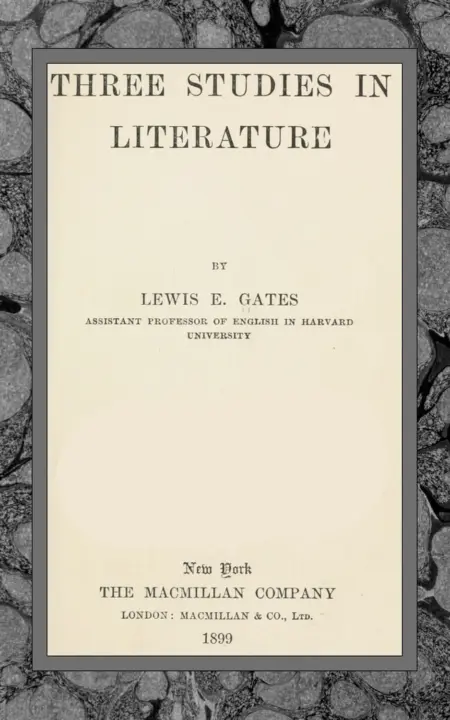
THE CLASSIC COLLECTION · 1899
"Three Studies in Literature" by Lewis E. Gates is a collection of literary critiques written in the late 19th century. This work evaluates the critical contributions and reputations of three notable literary figures: Francis Jeffrey, John Henry Newman, and Matthew Arnold. It delves into their styles and the lasting impact they have made on literature and criticism, exploring how these writers shaped public opinion and literary discourse. The opening of the book begins with an exploration of Francis Jeffrey's critical prowess, setting the stage for a discussion of his fluctuating reputation in literary circles. It describes how Jeffrey, once a prominent figure revered for his contributions to the "Edinburgh Review", has somewhat faded from scholarly attention. Gates praises Jeffrey's versatility and sharp style while also raising questions about the relative merits of his critiques. Through careful analysis, the text presents Jeffrey's influence on literary criticism and situates it within a broader narrative of the evolving landscape of 19th-century literature. This initial examination hints at the deeper evaluations of Newman and Arnold that will follow, making it clear that this work aims to provide a comprehensive understanding of these critics' roles in shaping literary criticism.
Introduction adapted from the source catalogue; source summaries may be automatically generated.
Free to read · English · 49,848 words · No account needed
MAKE TIME FOR A GOOD BOOK
On by default. Untick to stop anonymous reading totals. Each page counts after 10 seconds in view. How this works.
Anonymous counting is on unless you have switched it off.
Whatever work of Newman’s, then, we take up, we may be sure that its construction will repay careful analysis. In trying to present any set of truths, Newman was consciously confronting a delicate psychological problem; he was aware of the elements that entered into the problem; he knew what special difficulties he had to face because of the special nature of the truth he was dealing with,--its abstractness, or complexity, or novelty. He had measured, also, the precise degree of resistance he must expect because of the peculiar prejudices or preoccupations of his readers. And the shape which his discussion finally took--the particular methods that he followed--were the result of a deliberate adaptation of means to ends; they were the methods that his trained rhetorical instinct and his insight into the truth he was handling and into the temperaments and intelligences he was to address himself to dictated as most likely to persuade.
Although ordinarily Newman does not explain the method he follows or comment on the difficulties of his problem, he has, in his Apologia, departed from this rule, and taken his readers into his confidence. In the first thirty pages of this self-justificatory piece of writing, he sets forth minutely the prejudices against which he must make his way, considers various possible modes of overcoming these prejudices, notes the precise reasons that finally lead him to the actual plan he chooses, and is entirely explicit as to the elaborate design that underlies and controls the seeming desultoriness of his whole discussion.
The problem which in this case confronted Newman was briefly as follows. He had been charged by Kingsley with teaching “lying on system.” He had protested against the charge and had obtained a half-hearted apology. Later, however, the charge had been reiterated more formally, and with the added taunt that as Newman recommended systematic dissimulation no one could be expected to accept his self-exculpating word. These charges fell in, as Newman recognized, first, with the general trend of British prejudice against Roman Catholics, and, secondly, with the particular prejudice against Newman himself that sprang from his early attempts to make the Anglican Church more Catholic, and his subsequent secession to Rome. How, then, was Newman to persuade the public of Kingsley’s injustice and his own innocence? He saw at once that to deal with each separate charge would be mere waste of time; to prove that in a special case he had not lied or recommended lying would carry him no whit towards his end, as long as contemptuous distrust remained the dominant mood of the British mind towards himself and his party. First of all, he must conquer this mood; he must overthrow the presumption against him, and win for his cause at least such an unbiassed hearing as is accorded to the ordinary man upon trial whose record has been hitherto clean; then he might hope to secure for his particular denials a universal scope. The method that he chose in order to win his readers was admirably conceived. He would put himself vitally and almost dramatically before them; he would bring them within the actual sound of his voice and the glance of his eye; he would let them follow him through the long course of his years as student, tutor, preacher, and leader, and come to know him as intimately as those few friends had known him with whom he had lived most freely. Then, he would ask his readers, when he had put his personality before them in its many shifting, but continuous aspects, and with all the intense persuasiveness of a dramatic portrayal, whether they were ready to believe of the man they had thus watched through the round of his duties that he was a liar. Of the peculiar power which Newman could count on exerting in thus appealing to his personal charm he was, of course, unable to speak in his Preface. In truth, however, he was having recourse to an influence which had always been potent whenever it had had a chance to make itself felt. Throughout his life at Oxford it was true of his relations to others that “friends unasked, unhoped” had “come,”--all men who met him falling almost inevitably under the sway of his winning and commanding personality. Newman was, therefore, well advised when he resolved to reveal himself to the world and to trust to the conciliating effect of this self-revelation to prepare for his specific denial of Kingsley’s charges.
Your reading position is saved on this browser. Take it to another device with a library code. Reading pages adapt to text, rather than matching a printed edition.
BEHIND THE BOOK
This eBook is for the use of anyone anywhere in the United States and most other parts of the world at no cost and with almost no restrictions whatsoever. You may copy it, give it away or re-use it under the terms of the Project Gutenberg License included with this eBook or online at www.gutenberg.org. If you are not located in the United States, you will have to check the laws of the country where you are located before using this eBook. Read the source licence.
The original source file, including credits and licence, is retained by this library. Request an original-format copy at no charge. Please include the book title and Project Gutenberg identifier #74191.
KEEP YOUR CURIOSITY GOING
David Patterson (Spirit) Hatch

David Patterson (Spirit) Hatch

David Patterson (Spirit) Hatch
Cécile Tormay

Moritz Busch
John L. Ransom