THE CLASSIC COLLECTION✦A scarlet poppy, and other storiesCLASSIC FREE BOOKS
A scarlet poppy, and other stories
Harriet Elizabeth Prescott Spofford
THE CLASSIC COLLECTION · 1894
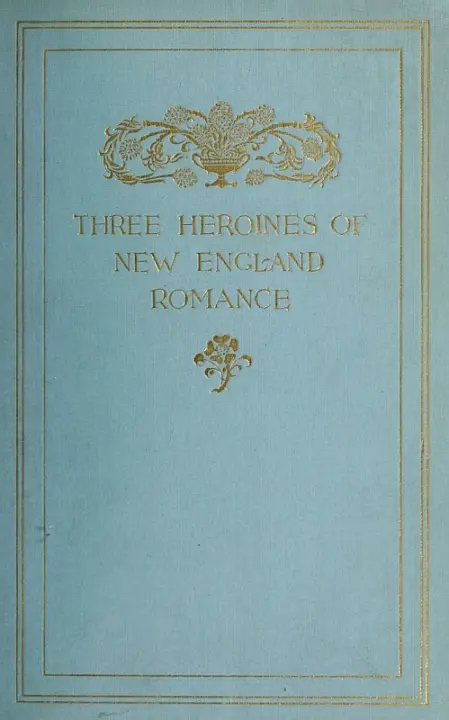
"Three Heroines of New England Romance" by Harriet Prescott Spofford, Louise Imogen Guiney, and Alice Brown is a collection of historical narratives written during the late 19th century. This book explores the lives and love stories of three women from New England, combining history with elements of romance and human emotion. It likely seeks to illuminate the narratives of women who played significant roles within their communities during a time when women's stories were often overlooked in favor of their male counterparts. The book profiles three central figures: Priscilla Mullins, associated with the Pilgrims of Plymouth; Agnes Surriage, a beautiful fisher girl who captures the heart of a British collector; and Martha Hilton, who rises from humble beginnings to become Lady Wentworth. Each section tells their unique stories of love, resilience, and societal challenges, set against the backdrop of colonial New England. The narratives highlight the complexities of their relationships, their struggles, and the impact of their actions on their communities. Through richly descriptive language, the work draws readers into a vivid portrayal of the period, while offering a nostalgic lens on the aspirations and lives of women who contributed significantly to American history.
Introduction adapted from the source catalogue; source summaries may be automatically generated.
Free to read · English · 13,908 words · No account needed
MAKE TIME FOR A GOOD BOOK
On by default. Untick to stop anonymous reading totals. Each page counts after 10 seconds in view. How this works.
Anonymous counting is on unless you have switched it off.
But if any one reading the tale of these wilful dwellings should soberly doubt the common interests of the people, let him climb the rocky eminence in their midst to the old graveyard, where stood the little church, the oldest of all; here the first settlers worshipped, and here, in comforting nearness, they buried their dead, within the niches spared them by the rock. It was set thus high, this homely tabernacle of faith, to overlook land and water, that no stealthy Indian band might creep upon the worshippers unaware,—for those were the days of the church militant in more than a poetic sense. An admirable spot this for the antiquary, wherein to pursue his loving labor of coaxing forward a reluctant past! Ancient headstones will salute his eye, and of these said one local lingerer, garrulous as he who discoursed on Yorick’s skull, “I can tell the date of ’em all, jest as I could a buildin’, by the architectur’!” But let him not conclude that in scanning the slabs erected two centuries ago he has seen all,—for here lies many an unrecorded grave. “They had to send to England for their stones then,” said the Oldest Inhabitant. “Poor folks couldn’t afford that, an’ most of ’em went without.”
Across the little harbor, at nightfall populous with white sails, stretches the “Neck,” once a lonely, rock-defended treasury of beauty, besieged by wave, and alternately lashed and caressed by the fickle, but persistent foam. Well fitted are its girdling citadels for enduring warfare; their towers outlast the feet that climb them, and their masonry crumbles not below, save slowly, through the infinite patience of the eternally tossing sea. And when the eye tired of this majesty of the illimitable, when it wearied of ocean spray, spouting column-like through some gigantic cleft, and found itself oppressed by the rhythm of rolling foam, what would it have seen, on turning inland from Castle Rock, that century and a half agone? A stretch of green pasture-land, becoming yellow as August marches on,—the “Neck” itself. Then, wandering on unwearied, still traversing the “Neck,” sweet, bosky hollows, where lie to-day such treasures of shining leaf and soft-lipped flower as Paradise might claim. These are the wild, sunken gardens on the road to Devereux, glowing in the gold of a royal tansy, greenly odorous of fern, and sweet with the wild azalea,—honey-smeared and pollen-powdered, loved of the bee, and his chief tempter to drunken revels on the way from market. The button-bush holds aloft her sign of cool white balls; loosestrife stars the green undergrowth with yellow; and over stick and stone the blackberry clings and crowds. There the wild rose lives and blooms, fed on manna brought by roving winds and fleeting sunlight, never unblest, even when the purveyors of honey come winging by, to rifle her sweets, and leave her to the ripening of maturity and the solid glow of her red-hipped matron-hood. And on the left again, still facing south, is the insistent sea, dragging down its pebbly beach, and on the right, the dimpling harbor, reddened, for him who is wise enough to wander that way at sunset, with flaming banners of the sky. To cross the harbor again, and follow the mainland back to a point nearly opposite the lighthouse of the Neck, is to find, neighbored by the old graveyard, ruined and grassy Fort Sewall, to-day the lounging-place for village great-grandfathers, or vantage-ground for overlooking a yacht race, but in 1742, when Charles Henry Frankland was Collector of the Port of Boston, just a building. And one day in the previous year, the gallant young Collector, smartly dressed in the fine feathers of the period, and no doubt humming a song,—since he seems to have fulfilled all the conditions of an interesting young galliard,—came riding down on some business connected with the prospective fort. He stopped at the Fountain Inn for a draught,—not so innocent, perhaps, as that from the clear well still springing near the spot,—and, scrubbing the tavern floor, there knelt before him, in lovely disarray, the sweet beggar-maid destined to be crowned at once by the favor of this careless Cophetua. Let that phrase be swiftly amended! Agnes Surriage was no beggar-maid, but the honest daughter of hard-working fisher-folk, and patient under her own birthright of toil. Her beauty was something rare and delicate, calculated to arrest the eye and chain the heart; the simple dignity of her demeanor was no more to be affected through her menial task than a rose by clouded skies. Her fair feet were naked, and blushed not at their poverty, but Frankland’s heart ached with pity of them, and he closed her fingers over a coin, to buy shoes and stockings. Then he gave her “good-day,” and rode away,—but not to forget her; only to muse on her grace, and to start at the vision of her eyes, shining between him and his bills of merchandise and lading. Again he came riding that way, and again he found her, still barefooted; but when he reproached her for having failed to put his coin to its destined use, she blushed, and answered in the homely dialect of Marblehead, which yet had no power over the music of her voice, that the shoes and stockings were bought, but that she kept them to wear to meeting. And now the young Collector went often and more often to Marblehead, until the day came when he obtained her parents’ permission to become her guardian, and take her away to be educated. So the wild bird entered voluntarily into the life of cages, to learn the demeanor and song-notes which were approved by the fashionable Boston of the day.
Your reading position is saved on this browser. Take it to another device with a library code. Reading pages adapt to text, rather than matching a printed edition.
Harriet Elizabeth Prescott Spofford

Rebecca Harding Davis & Thomas De Quincey & Charles Dickens & Nathaniel Hawthorne & Edward Bulwer Lytton, Baron Lytton & Edgar Allan Poe & Harriet Elizabeth Prescott Spofford
Dinah Maria Mulock Craik & Allan Cunningham & Oliver Wendell Holmes & Harriet Elizabeth Prescott Spofford & John Wilson
Louise Imogen Guiney
BEHIND THE BOOK
This eBook is for the use of anyone anywhere in the United States and most other parts of the world at no cost and with almost no restrictions whatsoever. You may copy it, give it away or re-use it under the terms of the Project Gutenberg License included with this eBook or online at www.gutenberg.org. If you are not located in the United States, you will have to check the laws of the country where you are located before using this eBook. Read the source licence.
The original source file, including credits and licence, is retained by this library. Request an original-format copy at no charge. Please include the book title and Project Gutenberg identifier #54028.
KEEP YOUR CURIOSITY GOING
Cécile Tormay

Moritz Busch
Coulson Kernahan
John L. Ransom

Maurice Baring
Frances Wright