THE CLASSIC COLLECTION✦Life and times of Frederick DouglassCLASSIC FREE BOOKS
Life and times of Frederick Douglass
Frederick Douglass
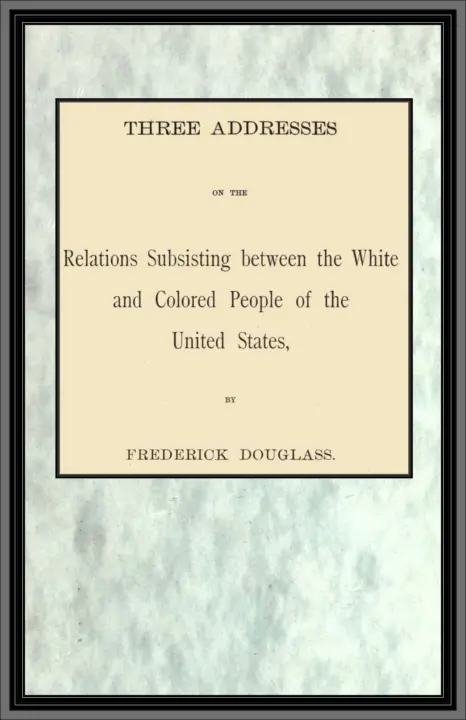
THE CLASSIC COLLECTION · 1886
"Three Addresses on the Relations Subsisting Between the White and Colored People of the United States" by Frederick Douglass is a collection of orations delivered in the late 19th century, specifically in the 1880s. This work discusses the complex and often fraught dynamics between black and white citizens in America, particularly in the wake of emancipation and the ongoing struggles for civil rights and social equality. Douglass addresses the progress made since the abolition of slavery, as well as the persistent challenges faced by African Americans in their quest for full citizenship and acceptance within the nation. The opening of the addresses features Douglass speaking at a convention of colored men in Louisville, Kentucky, in 1883. He begins by acknowledging the hardships still endured by recently freed black citizens and emphasizes the need for unity and collective action to improve their standing in society. Douglass articulates the importance of these gatherings as a means to foster understanding and address grievances, while also confronting the deeply ingrained prejudices that continue to affect the lives of African Americans. He underscores that, despite legal advancements, systemic inequality and social injustice persist, urging his audience to assert their rights and organize for justice. This powerful initiation sets the stage for Douglass’s eloquent explorations of race relations, civil rights, and social justice that follow in the text.
Introduction adapted from the source catalogue; source summaries may be automatically generated.
Free to read · English · 28,302 words · No account needed
MAKE TIME FOR A GOOD BOOK
On by default. Untick to stop anonymous reading totals. Each page counts after 10 seconds in view. How this works.
Anonymous counting is on unless you have switched it off.
It is one of the most conspicuous evils of caste and oppression, that they inevitably tend to make cowards and serviles of their victims, men ever ready to bend the knee to pride and power that thrift may follow fawning, willing to betray the cause of the many to serve the ends of the few; men who never hesitate to sell a friend when they think they can thereby purchase an enemy. Specimens of this sort may be found everywhere and at all times. There were Northern men with Southern principles in the time of slavery, and Tories in the revolution for independence. There are betrayers and informers to-day in Ireland, ready to kiss the hand that smites them and strike down the arm reached out to save them. Considering our long subjection to servitude and caste, and the many temptations to which we are exposed to betray our race into the hands of their enemies, the wonder is not that we have so many traitors among us as that we have so few.
The most of our people, to their honor be it said, are remarkably sound and true to each other. To those who think we have no cause to hold this convention, we freely admit that, so far as the organic law of the land is concerned, we have indeed nothing to complain of, to ask or desire. There may be need of legislation, but the organic law is sound.
Happily for us and for the honor of the Republic, the United States Constitution is just, liberal, and friendly. The amendments to that instrument, adopted in the trying times of reconstruction of the Southern States, are a credit to the courage and statesmanship of the leading men of that crisis. These amendments establish freedom and abolish all unfair and invidious discrimination against citizens on account of race and color, so far as law can do so. In their view, citizens are neither black nor white, and all are equals. With this admission and this merited reproof to trimmers and traitors, we again come to the question, Why are we here in this National Convention? To this we answer, first, because there is a power in numbers and in union; because the many are more than the few; because the voice of a whole people, oppressed by a common injustice, is far more likely to command attention and exert an influence on the public mind than the voice of single individuals and isolated organizations; because, coming together from all parts of the country, the members of a National convention have the means of a more comprehensive knowledge of the general situation, and may, therefore, fairly be presumed to conceive more clearly and express more fully and wisely the policy it may be necessary for them to pursue in the premises. Because conventions of the people are in themselves harmless, and when made the means of setting forth grievances, whether real or fancied, they are the safety-valves of the Republic, a wise and safe substitute for violence, dynamite, and all sorts of revolutionary action against the peace and good order of society. If they are held without sufficient reason, that fact will be made manifest in their proceedings, and people will only smile at their weakness and pass on to their usual business without troubling themselves about the empty noise they are able to make. But if held with good cause, and by wise, sober, and earnest men, that fact will be made apparent and the result will be salutary. That good old maxim, which has come down to us from revolutionary times, that error may be safely tolerated, while truth is left free to combat it, applies here. A bad law is all the sooner repealed by being executed, and error is sooner dispelled by exposure than by silence. So much we have deemed it fit to say of conventions generally, because our resort to this measure has been treated by many as if there were something radically wrong in the very idea of a convention. It has been treated as if it were some ghastly, secret conclave, sitting in darkness to devise strife and mischief. The fact is, the only serious feature in the argument against us is the one which respects color. We are asked not only why hold a convention, but with emphasis, why hold a colored convention? Why keep up this odious distinction between citizens of a common country, and thus give countenance to the color line? It is argued that, if colored men hold conventions, based upon color, white men may hold white conventions based upon color, and thus keep open the chasm between one and the other class of citizens, and keep alive a prejudice which we profess to deplore. We state the argument against us fairly and forcibly, and will answer it candidly and we hope conclusively. By that answer it will be seen that the force of the objection is, after all, more in sound than in substance. No reasonable man will ever object to white men holding conventions in their own interests, when they are once in our condition and we in theirs, when they are the oppressed and we the oppressors. In point of fact, however, white men are already in convention against us in various ways and at many important points. The practical construction of American life is a convention against us. Human law may know no distinction among men in respect of rights, but human practice may. Examples are painfully abundant.
Your reading position is saved on this browser. Take it to another device with a library code. Reading pages adapt to text, rather than matching a printed edition.
Frederick Douglass
Frederick Douglass
Frederick Douglass
Frederick Douglass
BEHIND THE BOOK
This eBook is for the use of anyone anywhere in the United States and most other parts of the world at no cost and with almost no restrictions whatsoever. You may copy it, give it away or re-use it under the terms of the Project Gutenberg License included with this eBook or online at www.gutenberg.org. If you are not located in the United States, you will have to check the laws of the country where you are located before using this eBook. Read the source licence.
The original source file, including credits and licence, is retained by this library. Request an original-format copy at no charge. Please include the book title and Project Gutenberg identifier #67919.
KEEP YOUR CURIOSITY GOING

David Patterson (Spirit) Hatch

David Patterson (Spirit) Hatch

David Patterson (Spirit) Hatch
Cécile Tormay

Moritz Busch
John L. Ransom