
The South African Question
Olive Schreiner
THE CLASSIC COLLECTION · 1923
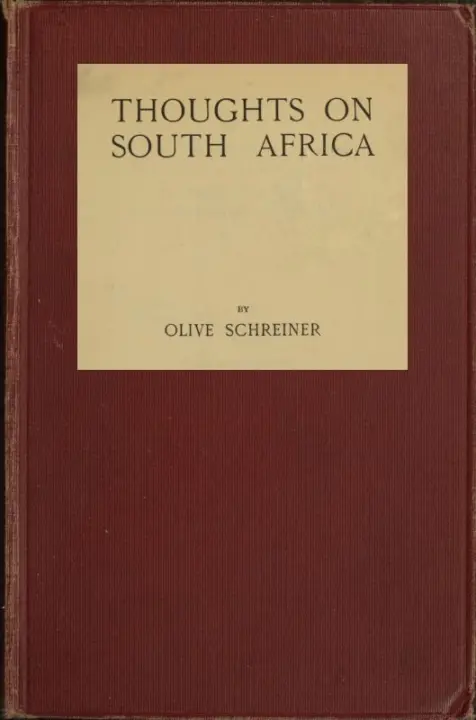
"Thoughts on South Africa" by Olive Schreiner is a collection of essays written in the late 19th century. The work is an exploration of the complexities of South African society, reflecting on its natural landscapes, diverse peoples, and intricate political issues. Schreiner engages deeply with the experiences of the people, particularly the Boers, and investigates the intertwined relationships between various racial and cultural groups in South Africa. The opening of the book introduces Schreiner’s personal connection to South Africa, as she reflects on her childhood and upbringing in the region. She emphasizes the richness of the South African environment, characterized by its striking natural features and its diverse populations. Through her narrative, she recalls the moments that shaped her understanding of the country and her evolving sentiments towards the Boer community, ultimately expressing a desire to articulate her perceptions and feelings about her homeland. The text serves as a thoughtful commentary on the social dynamics at play in South Africa, setting the stage for a deeper examination of the inherent challenges facing the nation.
Introduction adapted from the source catalogue; source summaries may be automatically generated.
Free to read · English · 150,301 words · No account needed
MAKE TIME FOR A GOOD BOOK
On by default. Untick to stop anonymous reading totals. Each page counts after 10 seconds in view. How this works.
Anonymous counting is on unless you have switched it off.
She who has been the companion of man in peace and war will know how to find her way with him into the new fields of life and intellectual toil. And if it were possible without the intervention of a period of parasitism and enervation for the old Boer woman of the laager and the trek, who with her companion man first tamed South Africa and peopled it, to transform herself in the person of her descendant into the labouring woman in the new and complex fields of modern civilization, South Africa might boast in the future as in the past of possessing one of the most virile womanhoods that the world has seen.
If the Boer woman still sits motionless in her elbow-chair to-day, when her sisters of the Old World and the New are rising to their feet to readjust their relation to life--she yet does well to sit there till her conditions of life change, for it is a throne.
Note added in 1898: As we were engaged in copying this article, it chanced business took us into the country. In the veld, some ten miles from the town, we saw approaching a large wagon with a team of ten donkeys. Before the donkeys plodded a small Hottentot boy of eight years. As the wagon approached we saw it was laden with wood and dried cakes of manure ("mest," kraal-fuel) for the next morning's market in the town; but what the figure was upon the front box (voorkist) we couldn't quite make out. Then it came nearer and we saw, in truth for the first time in our life in such a position, a huge Boer woman of perhaps forty. She wore a black dress made without regard to fashion with a full short skirt and short jacket. On her head she had a large white cotton kapje (sun bonnet), such as Boer women make, projecting far forward with white curtains hanging on to the shoulders. In her hand she had a wagon-whip made from a bamboo eight or nine feet long, with the plaited leather cord long enough to reach the front donkeys of the span. She sat massively upright on the front-box. We looked at her as we passed and she scowled at us from under her deep kapje with resentment which I knew meant, "Verdomde Engelse vrou, do you think I care for your ridicule!" She took her whip from her shoulder and gave a resounding clap in the air with it over the backs of the donkeys; and she went on one way and we another. But if she had known what was in our heart, we might have stopped and shaken hands. We found out afterwards that she had nine children and was the wife of a man, an invalid and too feeble to work, that they were what is known in South Africa as "bywoners," poor people living on the land of a richer farmer, and that she supported her family entirely. She would take her wagon of fuel to the next morning's market, and the little clerks and shopkeepers and women with flowers in their hats would laugh at her short black skirt and kapje and her resolute scowl. Had we but been able to sit beside her on her voorkist and been able to make clear to her our meaning, we would have said: "The new women from all the world over send you their greetings, Tante![63] In you and such as you we see our leaders, and we are following in your steps. For God's sake, Tante, hold fast your seat on the front-chest and your fuel and carry it to market in spite of all the fools. I see in you, Tante, something that harmonizes strangely with this great blue African sky above us and the little koppies to our right, and the great plain to our left, and the red sandy road in which your donkeys plough, and the thorn-trees here and there casting their shade. Like this wide plain, you wake in me an aspiration for freedom and independence which no woman in the town below us could awaken. For God's sake, Tante, never give up your wagon-whip for a mother-of-pearl card case, and your kappie for a straw hat with paper flowers, and, instead of digging up fuel in your kraal and cutting wood, take a croquet mallet for your weapon of toil! I see in you, Tante, the secret of many a brave fight that your race has fought for freedom, and many still to come. When you paste little black spots on your cheeks and pencil your eyebrows with black, and wear an eighteen-inch waist, and trip with high-heeled shoes with your head on one side, there will be no more Amajubas. Keep thy hard horned hands, Tante. The day will perhaps come when thy sons and daughters will grasp the artist's brush and the thinker's pen and the mechanician's tool in place of the spade and the axe and the driving-whip; but, till that time comes, labour on in thine own field. It is easier to pass from any one work to any other work than from parasitism to labour; and they will need work well, Tante, who will work more usefully, more bravely, than you. The working-women from all the world over, whether they toil with the head or the hand, indoor or out, send their greetings to you, Tante. You are not only the backbone of your race and of South Africa, but you and such as you are the backbone of the human race. In many an hour of weariness and doubt over the future of woman, of South Africa, and humanity, your sturdy figure on the wagon chest will come back to us. Sit fast, Tante! I see in you a promise of a great free labouring race of men and women for South Africa. The world is not played out while you sit on your wagon box and clap your whip. God bless you! The future is ours, Tante! Let the fools laugh. He laughs loudest, who laughs last!"
Your reading position is saved on this browser. Take it to another device with a library code. Reading pages adapt to text, rather than matching a printed edition.
Olive Schreiner
Olive Schreiner
Olive Schreiner
Olive Schreiner
BEHIND THE BOOK
This eBook is for the use of anyone anywhere in the United States and most other parts of the world at no cost and with almost no restrictions whatsoever. You may copy it, give it away or re-use it under the terms of the Project Gutenberg License included with this eBook or online at www.gutenberg.org. If you are not located in the United States, you will have to check the laws of the country where you are located before using this eBook. Read the source licence.
The original source file, including credits and licence, is retained by this library. Request an original-format copy at no charge. Please include the book title and Project Gutenberg identifier #64520.
KEEP YOUR CURIOSITY GOING

David Patterson (Spirit) Hatch

David Patterson (Spirit) Hatch

David Patterson (Spirit) Hatch
Cécile Tormay

Moritz Busch
John L. Ransom