
The South African Question
Olive Schreiner
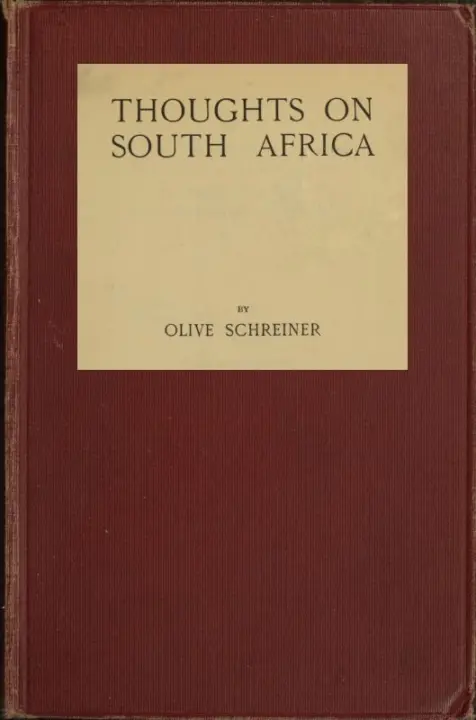
THE CLASSIC COLLECTION · 1923
"Thoughts on South Africa" by Olive Schreiner is a collection of essays written in the late 19th century. The work is an exploration of the complexities of South African society, reflecting on its natural landscapes, diverse peoples, and intricate political issues. Schreiner engages deeply with the experiences of the people, particularly the Boers, and investigates the intertwined relationships between various racial and cultural groups in South Africa. The opening of the book introduces Schreiner’s personal connection to South Africa, as she reflects on her childhood and upbringing in the region. She emphasizes the richness of the South African environment, characterized by its striking natural features and its diverse populations. Through her narrative, she recalls the moments that shaped her understanding of the country and her evolving sentiments towards the Boer community, ultimately expressing a desire to articulate her perceptions and feelings about her homeland. The text serves as a thoughtful commentary on the social dynamics at play in South Africa, setting the stage for a deeper examination of the inherent challenges facing the nation.
Introduction adapted from the source catalogue; source summaries may be automatically generated.
Free to read · English · 150,301 words · No account needed
MAKE TIME FOR A GOOD BOOK
On by default. Untick to stop anonymous reading totals. Each page counts after 10 seconds in view. How this works.
Anonymous counting is on unless you have switched it off.
If we are folk of respectable appearance, unmistakably white and mounted, he will open the lower half of the door and come out in his shirt and tan-cord trousers, and shake hands quietly, and having asked a few questions, will invite us to off-saddle. And when we have removed the saddles from our horses, and, having first securely knee-haltered them, turned them loose to feed on the bushes, and replied to our host's inquiries as to our names, our business, and other small details, we follow him into the house. The door is divided into two parts, partly because the upper half being left open, it admits all the air, and sometimes, if there be no window, all the light that gains accession to the front room--the windows being so made that they cannot open--and partly because the lower half, when closed, serves to keep the children in, and to keep the fowls and dogs out. When we enter we find the front room of large size as compared to the whole building, and we are asked to take a seat on one of the chairs or the sofa, whose seats are composed of thongs of dried ox-hide skilfully interlaced. The floor of the room is of hardened mud, worn here and there into inequalities by the tramping of feet; the walls are white-washed, and from the rafters or against the wall are rests for a couple of guns. In the centre of the room is a square table, often with unturned legs of some Colonial wood, and generally of African contrivance; on one side of the room, opposite the wooden sofa, and made of the same curious old wood, stands a little square table, generally with a coffee-urn upon it, and sometimes a little work-box or a large family Bible; beside it is invariably an elbow-chair of the same make as the sofa, and with a seat of the same interlaced leather thongs; before the elbow-chair stands a little square wooden stove, such as you may see exactly portrayed in many an old Flemish picture of the seventeenth century--a little solid wooden box with a hole at one side, into which a brazier of live coals may be put, the top carved out into holes of a fanciful pattern, through which the heat may rise to the feet of the person using it. Soon the door of the side room opens, and the mistress of the house, who also has been taking her siesta, appears in her dark print gown, and with a clean white pocket-handkerchief tied hastily round her throat in honour of the newcomer. She silently shakes hands, and goes to her elbow-chair, placing her feet on the stove, which, in the summertime, is coalless, and serves merely as a footstool. As she fans herself to drive away the flies, which in Africa and in the neighbourhood of stock kraals are numerous, she calls to the Kaffir maid in the kitchen at the back to make haste and let the kettle boil, or coaxes the three-year-old child, who stands pressing backwards against her knee, eyeing the stranger from under a mass of tumbled hair, with a finger in its mouth, to go and tell the elder sister to come and make the coffee. Even in her youth the house-mother has been generally buxom, and, when past it, is often stout, as the result of a quiescent life and from the lack of open-air exercise.[48] From time to time the elder children slink out of the side sleeping apartments, with little bare feet or with undressed leather shoes, and generally no socks. They extend their little hands and say "Dag!"[49] and seat themselves silently on the chairs with their little feet dangling down. Presently an older girl, almost or quite grown-up, appears, who has been detained by some efforts at personal adornment; she has smoothed the top of her heavy, silky, dark or fair hair with a brush or comb, and has put a silk handkerchief round her throat, and perhaps has on her Sunday town-made shoes. She shakes hands somewhat bashfully, and goes through to the back room, hurrying on the coffee-making, while we sit, and, with intervals of silence, discuss the weather and the health of the stock. Presently one of the children, growing tired of its perch on the chair, goes out, and leaves the lower half of the front door open, and the hens enter, and the two large dogs slink quietly in and lie down under the table. When the hand-lamb and a couple more fowls follow, the mother calls to one of the children to drive them out, but the dogs remain under the table, winking with their yellow eyes at us. By this time the coffee has come. It is placed in an urn on the little side-table with a brazier of hot coals beneath it, and the eldest daughter pours it out and hands it round. In the wall of the room there is generally a small cupboard, the door of which is made with panes of glass, and which looks like a blind window. Here are kept the spare cups and saucers, the black bottle of cocoa-nut oil with which the whole family oil their heads on Sunday mornings, and whatever else in the way of crockery and ornament, and not for daily use, the house contains; and, if there be not enough cups out, some are now produced for the use of the strangers. Even the smallest child has its basin of coffee, and when the cups and basins have been used they are put into a brass dish of water and covered with a cloth, to be free from flies and ready for further use.
Your reading position is saved on this browser. Take it to another device with a library code. Reading pages adapt to text, rather than matching a printed edition.
Olive Schreiner
Olive Schreiner
Olive Schreiner
Olive Schreiner
BEHIND THE BOOK
This eBook is for the use of anyone anywhere in the United States and most other parts of the world at no cost and with almost no restrictions whatsoever. You may copy it, give it away or re-use it under the terms of the Project Gutenberg License included with this eBook or online at www.gutenberg.org. If you are not located in the United States, you will have to check the laws of the country where you are located before using this eBook. Read the source licence.
The original source file, including credits and licence, is retained by this library. Request an original-format copy at no charge. Please include the book title and Project Gutenberg identifier #64520.
KEEP YOUR CURIOSITY GOING

David Patterson (Spirit) Hatch

David Patterson (Spirit) Hatch

David Patterson (Spirit) Hatch
Cécile Tormay

Moritz Busch
John L. Ransom