
Letters to a Friend, Written to Mrs. Ezra S. Carr, 1866-1879
John Muir
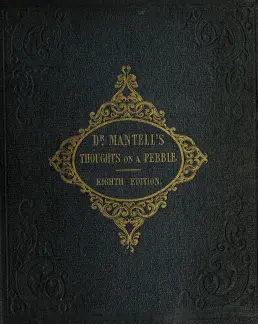
THE CLASSIC COLLECTION · 1846
"Thoughts on a Pebble, or, A First Lesson in Geology" by Gideon Algernon Mantell is a scientific publication written in the mid-19th century. The book is designed as an introductory guide to geology, intended particularly for a younger audience. It explores the significance of even the smallest natural objects, such as a pebble, in understanding the broader physical history of the Earth as revealed through modern geology. At the start of this work, the author reflects on the intricate connections between natural objects and the vast history they embody, specifically focusing on a flint pebble he finds by a stream. He examines its origins and the geological processes that led to its formation, revealing the compelling tales of ancient life preserved in its structure. Through this detailed observation, Mantell aims to inspire curiosity about the natural world, emphasizing that even simple stones contain profound truths about the past, the layers of the Earth, and the forces of nature that shaped them.
Introduction adapted from the source catalogue; source summaries may be automatically generated.
Free to read · English · 16,749 words · No account needed
MAKE TIME FOR A GOOD BOOK
On by default. Untick to stop anonymous reading totals. Each page counts after 10 seconds in view. How this works.
Anonymous counting is on unless you have switched it off.
NAUTILUS and the AMMONITE.
(See Page 22.)
By the late G. F. Richardson, Esq.
The Nautilus and the Ammonite
Were launch'd in storm and strife;
Each sent to float, in its tiny boat,
On the wide, wild sea of life.
And each could swim on the ocean's brim,
And anon, its sails could furl;
And sink to sleep in the great sea deep,
In a palace all of pearl.
And their's was a bliss, more fair than this,
That we feel in our colder time;
For they were rife in a tropic life,
In a brighter, happier clime.
They swam 'mid isles, whose summer smiles
No wintry winds annoy;
Whose groves were palm, whose air was balm.
Where life was only joy.
They roam'd all day, through creek and bay,
And travers'd the ocean deep;
And at night they sank on a coral bank,
In its fairy bowers to sleep.
And the monsters vast, of ages past.
They beheld in their ocean caves;
And saw them ride, in their power and pride,
And sink in their billowy graves.
Thus hand in hand, from strand to strand,
They sail'd in mirth and glee;
Those fairy shells, with their crystal cells,
Twin creatures of the sea.
But they came at last, to a sea long past,
And as they reach'd its shore,
The Almighty's breath spake out in death,
And the Ammonite liv'd no more.
And the Nautilus now, in its shelly prow,
As o'er the deep it strays,
Still seems to seek, in bay and creek,
Its companion of other days.
And thus do we, in life's stormy sea,
As we roam from shore to shore;
While tempest-tost, seek the lov'd--the lost--
But find them on earth no more!
Geology, in the magnitude and sublimity of the objects of which it treats, ranks next to Astronomy in the scale of the sciences.
Sir J. F. W. Herschel.
Note I. Page 13. Shells in Chalk.
The shells of mollusca, in consequence of their durability, are the most abundant fossils in the sedimentary strata;[X] entire layers of marble and other limestone, of great thickness and extent, are wholly composed of an aggregation of a few species or genera: in some instances of fresh-water snails--as, for example, the Sussex and Purbeck marbles;[Y] in others, of marine bivalves and univalves, as the oyster-conglomerate of Bromley, and the shelly limestones of Portland, Dorsetshire, &c.
[X] For an account of the geological value of fossil shells, see 'Medals of Creation,' vol. i. p. 363.
[Y] See 'Wonders of Geology,' 6th Edition, p. 402.
Your reading position is saved on this browser. Take it to another device with a library code. Reading pages adapt to text, rather than matching a printed edition.
BEHIND THE BOOK
This eBook is for the use of anyone anywhere in the United States and most other parts of the world at no cost and with almost no restrictions whatsoever. You may copy it, give it away or re-use it under the terms of the Project Gutenberg License included with this eBook or online at www.gutenberg.org. If you are not located in the United States, you will have to check the laws of the country where you are located before using this eBook. Read the source licence.
The original source file, including credits and licence, is retained by this library. Request an original-format copy at no charge. Please include the book title and Project Gutenberg identifier #62871.
KEEP YOUR CURIOSITY GOING
John Muir

Asa Gray
Asa Gray

Florence Nightingale
Elizabeth Robins Pennell
Denison Olmsted