
Last letters from the living dead man
David Patterson (Spirit) Hatch
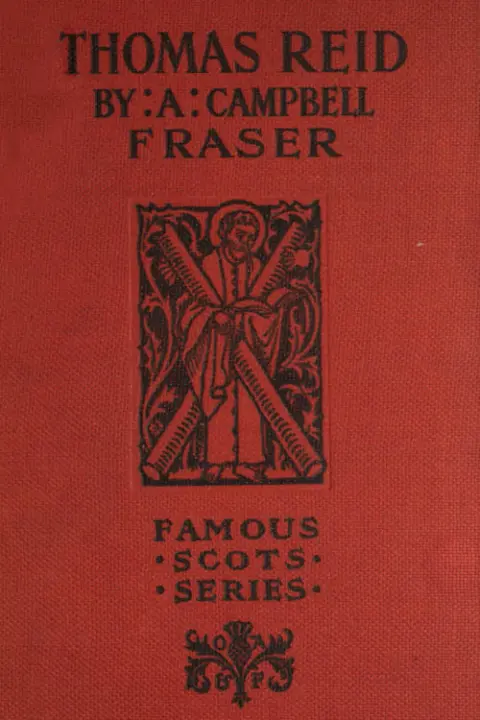
THE CLASSIC COLLECTION · 1898
"Thomas Reid" by Alexander Campbell Fraser is a philosophical biography written in the late 19th century. This work explores the life and thought of the Scottish philosopher Thomas Reid, particularly his development of the "Common Sense" philosophy, as a response to the scepticism of his contemporaries, particularly David Hume. Fraser delves into Reid's intellectual journey from his boyhood in a rural parish to his significant contributions to moral philosophy. The opening of the book introduces Reid's early life in the manse of Strachan, detailing his family background and the intellectual lineage that influenced him. It describes the rural environment of Kincardineshire, which fostered a reflective individuality in young Thomas, who was marked by modesty and diligence. The chapter sets the stage for Reid's eventual pursuit of higher education at Marischal College, outlines his familial influences, and foreshadows his philosophical engagements with figures like Hume, emphasizing the conflicts and motivations that would shape his life's work. This context provides a foundation for understanding Reid's later philosophical endeavors and the significant themes of common sense as the bedrock of knowledge and belief.
Introduction adapted from the source catalogue; source summaries may be automatically generated.
Free to read · English · 46,535 words · No account needed
MAKE TIME FOR A GOOD BOOK
On by default. Untick to stop anonymous reading totals. Each page counts after 10 seconds in view. How this works.
Anonymous counting is on unless you have switched it off.
It was in 1774 that Reid’s appeal in 1764 to the common reason of human nature aroused hostile criticism. He had been seconded by others in his response to the sceptics. The resort to a ‘sense’ of self-evident truth, in his Inquiry in 1764, which itself looked like a reply to argument by feeling, was followed in 1766 by An Appeal to Common Sense on behalf of Religion, by Dr. James Oswald, minister of Methven in Perthshire. In 1770 Beattie’s Essay on the Nature and Immutability of Truth, in opposition to Sophistry and Scepticism, followed. Oswald and Beattie were not deep and patient thinkers like Reid;[19] but the rising literary and social reputation of Beattie, secured for the Essay on Truth more rapid and widespread admiration than was given to the Inquiry. Beattie often visited London, was there one of the lions of the day, was made a D.C.L. of Oxford, and had interviews with George the Third, who admired his book, conferred a pension on Beattie, and rallied Mr. Dundas about ‘Scotch Philosophy.’ Reid, Beattie, and Oswald thus became known as a triumvirate of ‘Scottish Philosophers’; and the appeal to common sense, in which they were at least verbally agreed, began to be spoken about as ‘the Scottish Philosophy,’ a term which has since been adopted in this country and abroad.
This Scottish triumvirate, helped into vogue by Beattie, roused Joseph Priestley, an English dissenter. Priestley had abandoned the Calvinism of his early creed for materialism, philosophical necessity, and free thought, and, after serving for some years as pastor of a nonconformist chapel in Cheshire, and next as a schoolmaster much devoted to experiments in the natural sciences, was already known as an author in natural science. In 1774, when he was living with Lord Shelburne, as librarian and literary companion, he appeared for the first time as a metaphysical critic, in An Examination of Reid’s Inquiry, Beattie’s Essay, and Oswald’s Appeal to Common Sense. He played upon the term ‘common sense,’ and took for granted that the aim of the triumvirate was to substitute mere feeling and authority for reason,—the authority of the multitude for that of the philosophical elect,—alleging blind instinct when unable to produce argument, and multiplying instincts to suit each controversial emergency. ‘As men have imagined innate ideas, because they had forgot how they came by their ideas, the Scottish philosophers set up almost as many distinct instincts as there are acquired principles of acting.’ He ridiculed Reid for his supposed discovery of the root of scepticism in the ideal hypothesis; charging him with innocently mistaking a metaphor for a scientific theory, and for overlooking the leading part which mental association plays, as the cause of those convictions which Reid mistook for infallible constituents of common sense. ‘If we consider the general tenor of the writings of these philosophers,’ Dr. Priestley said, ‘it will appear that they are saying one thing and doing another—talking plausibly about the necessity for admitting axioms as the foundation of all reasoning, but meaning to recommend particular assumptions of their own as axioms—not as being founded on perception of the agreement of ideas, which is the great doctrine of Mr. Locke, and which makes truth to depend upon the necessary nature of things, to be therefore absolute, unchangeable, and everlasting, but merely on some unaccountable instinctive persuasions, depending upon the arbitrary constitution of our nature—which makes all truth be relative to ourselves only, and consequently to be infinitely vague and precarious. This system admits of no final appeal to reason properly considered, which any person might be at liberty to examine and discuss; on the contrary every man is taught to think himself authorised to pronounce dogmatically upon every question, according to his present feeling and persuasion, under the notion of its being something original, instructive, and incontrovertible; although, stoutly analysed, it may appear to be mere prejudice.’ Thus, as opposed to the man of straw he set up under the name of Reid, Priestley postulated a materialistic conception of man, as only an organism, the so-called mental and moral power of which was the natural issue of physical structure; his perceptions the effects of their own objects; and on the whole a necessitated system of the universe, which excluded morally responsible agency.
Your reading position is saved on this browser. Take it to another device with a library code. Reading pages adapt to text, rather than matching a printed edition.
BEHIND THE BOOK
This eBook is for the use of anyone anywhere in the United States and most other parts of the world at no cost and with almost no restrictions whatsoever. You may copy it, give it away or re-use it under the terms of the Project Gutenberg License included with this eBook or online at www.gutenberg.org. If you are not located in the United States, you will have to check the laws of the country where you are located before using this eBook. Read the source licence.
The original source file, including credits and licence, is retained by this library. Request an original-format copy at no charge. Please include the book title and Project Gutenberg identifier #60399.
KEEP YOUR CURIOSITY GOING
David Patterson (Spirit) Hatch
Coulson Kernahan

Ralph Waldo Emerson
Frances Wright

Edwin Abbott Abbott

Joseph Droz