
Last letters from the living dead man
David Patterson (Spirit) Hatch
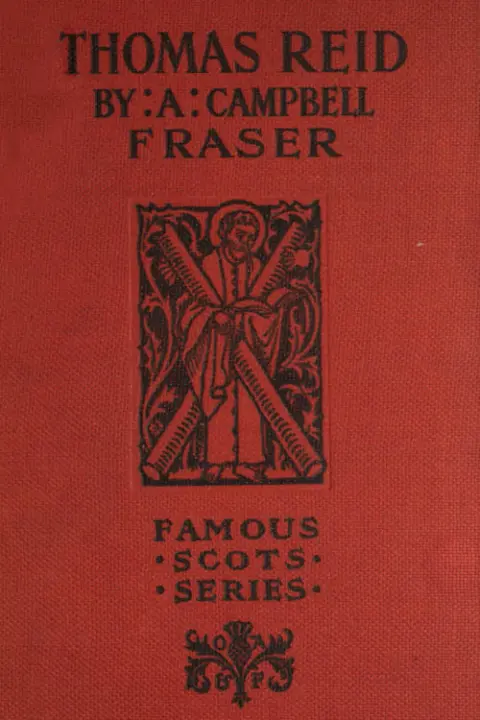
THE CLASSIC COLLECTION · 1898
"Thomas Reid" by Alexander Campbell Fraser is a philosophical biography written in the late 19th century. This work explores the life and thought of the Scottish philosopher Thomas Reid, particularly his development of the "Common Sense" philosophy, as a response to the scepticism of his contemporaries, particularly David Hume. Fraser delves into Reid's intellectual journey from his boyhood in a rural parish to his significant contributions to moral philosophy. The opening of the book introduces Reid's early life in the manse of Strachan, detailing his family background and the intellectual lineage that influenced him. It describes the rural environment of Kincardineshire, which fostered a reflective individuality in young Thomas, who was marked by modesty and diligence. The chapter sets the stage for Reid's eventual pursuit of higher education at Marischal College, outlines his familial influences, and foreshadows his philosophical engagements with figures like Hume, emphasizing the conflicts and motivations that would shape his life's work. This context provides a foundation for understanding Reid's later philosophical endeavors and the significant themes of common sense as the bedrock of knowledge and belief.
Introduction adapted from the source catalogue; source summaries may be automatically generated.
Free to read · English · 46,535 words · No account needed
MAKE TIME FOR A GOOD BOOK
On by default. Untick to stop anonymous reading totals. Each page counts after 10 seconds in view. How this works.
Anonymous counting is on unless you have switched it off.
‘I must launch forth in the morning, so as to be at the College (which is a walk of eight minutes) half an hour after seven, when I speak for an hour without interruption to an audience of about a hundred. At eleven I examine for an hour upon my morning prelection; but my audience is a little more than a third part of what it was in the morning. In a week or two I must, for three days in the week, have a second prelection at twelve, upon a different subject, where my audience will be made up of those who hear me in the morning but do not attend at eleven. My hearers commonly attend my class two years at least. They pay fees for the first two years, and then they are cives of the class, and may attend gratis as many years as they please. Many attend the moral philosophy class four or five years; so that I have many preachers and students of divinity and law of considerable standing, before whom I stand in awe to speak without more preparation than I have leisure for. I have a great inclination to attend some of the professors here, several of whom are very eminent in their way; but I cannot find leisure. Much time is consumed in our college meetings about business, of which we have commonly four or five in the week. We have a Literary Society once a week, consisting of the Masters and two or three more; where each of the members has a discourse once in the session.... Near a third part of our students are Irish. Thirty came over lately in one ship, besides three that went to Edinburgh. We have a good many English, and some foreigners. Many of the Irish, as well as Scotch, are poor, and come up late to save money; so that we are not yet fully convened, although I have been teaching ever since the 10th of October. Those who pretend to know, say that the number of students this year, when fully convened, will amount to 300.... By this time I am sure you have enough of the College; for you know as much as I can tell you of the fine houses of the Masters, of the Astronomical Observatory, of Robin Foulis’ collection of pictures and painting college, and of the foundry for types and printing-house. Therefore I will carry you home to my own house, which lyes among the middle of the weavers, like the back-wynd in Aberdeen. You go through a long, dark, abominably nasty entry, which leads you into a clean little close. You walk upstairs to a neat little dining-room, and find as many other little rooms as just accommodate my family; so scantily that my apartment is a closet of six feet by eight or nine off the dining-room. To balance these little inconveniences, the house is new and free of buggs; it has the best air and finest prospect in Glasgow; the privilege of a large garden, very airy, to walk in, which is not so nicely kept, but one may use freedom with it. A five minutes’ walk leads us up a rocky precipice into a large park, partly planted with firs, and partly open, which overlooks the town and all the country round, and gives a view of the windings of the Clyde for a great way. The ancient Cathedral stands at the foot of the rock, half of its height below you, and half above you; and indeed it is a very magnificent pile. When we came here, the street we live in (which is called the Drygate) was infested with the small-pox, which were very mortal. Two families in our neighbourhood lost all their children, being three each. Little David was seized with the infection, and had a very great eruption both on his face and over his whole body, which you will believe would discompose his mother.... Although my salary here be the same as Aberdeen, yet if the class does not fall off, nor my health, so as to disable me from teaching, I believe I shall be able to live as easily as at Aberdeen, notwithstanding the differences in the expense of living at the two places. I have touched about £70 of fees, and may possibly make out the £100 this session.... The common people here have a gloom in their countenance, which I am at a loss whether to ascribe to their religion or to the air and climate. There is certainly more of religion among the common people in this town than in Aberdeen; and although it has a gloomy enthusiastical cast, yet I think it makes them tame and sober. I have not heard either of a house or of a head broke, or of a pocket picked, or of any flagrant crime, since I came here. I have not heard any swearing in the streets, nor seen a man drunk (excepting, inter nos, one Prof—r) since I came here.... If this scroll tire you, impute it to this, that to-morrow is to be employed in choosing a Rector, and I can sleep till ten o’clock, which I shall not do again for six weeks.’
Your reading position is saved on this browser. Take it to another device with a library code. Reading pages adapt to text, rather than matching a printed edition.
BEHIND THE BOOK
This eBook is for the use of anyone anywhere in the United States and most other parts of the world at no cost and with almost no restrictions whatsoever. You may copy it, give it away or re-use it under the terms of the Project Gutenberg License included with this eBook or online at www.gutenberg.org. If you are not located in the United States, you will have to check the laws of the country where you are located before using this eBook. Read the source licence.
The original source file, including credits and licence, is retained by this library. Request an original-format copy at no charge. Please include the book title and Project Gutenberg identifier #60399.
KEEP YOUR CURIOSITY GOING
David Patterson (Spirit) Hatch
Coulson Kernahan

Ralph Waldo Emerson
Frances Wright

Edwin Abbott Abbott

Joseph Droz