
Last letters from the living dead man
David Patterson (Spirit) Hatch
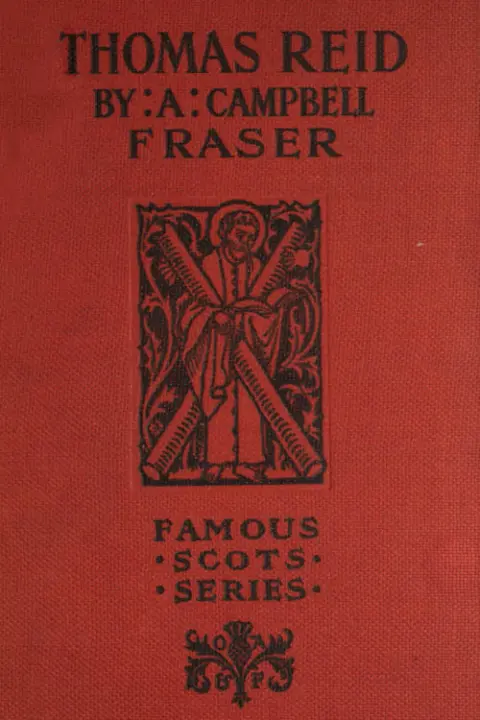
THE CLASSIC COLLECTION · 1898
"Thomas Reid" by Alexander Campbell Fraser is a philosophical biography written in the late 19th century. This work explores the life and thought of the Scottish philosopher Thomas Reid, particularly his development of the "Common Sense" philosophy, as a response to the scepticism of his contemporaries, particularly David Hume. Fraser delves into Reid's intellectual journey from his boyhood in a rural parish to his significant contributions to moral philosophy. The opening of the book introduces Reid's early life in the manse of Strachan, detailing his family background and the intellectual lineage that influenced him. It describes the rural environment of Kincardineshire, which fostered a reflective individuality in young Thomas, who was marked by modesty and diligence. The chapter sets the stage for Reid's eventual pursuit of higher education at Marischal College, outlines his familial influences, and foreshadows his philosophical engagements with figures like Hume, emphasizing the conflicts and motivations that would shape his life's work. This context provides a foundation for understanding Reid's later philosophical endeavors and the significant themes of common sense as the bedrock of knowledge and belief.
Introduction adapted from the source catalogue; source summaries may be automatically generated.
Free to read · English · 46,535 words · No account needed
MAKE TIME FOR A GOOD BOOK
On by default. Untick to stop anonymous reading totals. Each page counts after 10 seconds in view. How this works.
Anonymous counting is on unless you have switched it off.
‘Our wills are ours, we know not how,
Our wills are ours, to make them Thine.
We have but faith: we cannot know;
For knowledge is of things we see;
And yet we trust it comes from Thee,
A beam in darkness: let it grow.
Let knowledge grow from more to more,
But more of reverence in us dwell;
That mind and soul, according well,
May make one music as before,
But vaster.’
Our scientific interpretation of the ever-changing universe at last rests on ethical theistic faith, and the Christian revelation of divine love is responded to by the divine inspiration of God in Man, in the form of the spiritual Common Sense. If this be not so, we cannot rely on the Common Sense, for it then belongs to a morally untrustworthy universe.
Established on this faith, philosophy or theology, in Scotland and throughout the world, awaits the sceptical criticism and the spiritual healing power of the masters of thought in the twentieth century, for its further development, and application to human affairs.
[1] The above from data at Birkwood.
[2] Scottish Notes and Queries, iii. 84-88; 128.
[3] The number is, unfortunately, unrecorded.
[4] Birkwood MSS.
[5] In Scotland and Scotsmen of the Eighteenth Century, by Ramsay of Ochtertyre, there is an interesting account of this Mr. Bisset.
[6] Essays on the Intellectual Powers, II. ch. 10.
[7] While he lived here, he seems to have retained the incumbency of New
Machar till May 1752.
[8] Long ago removed. I have an engraving of it.
[9] These MS. dissertations have been lately recovered, and I have thus been able to compare them with the Inquiry, in which I find them mostly embodied.
[10] Birkwood MS.
[11] I have elsewhere discussed the true meaning of Berkeley’s philosophy.
[12] Between the College and the Cathedral, diverging to the east.
[13] Watt began those experiments in Glasgow about 1763.
[14] The American revolt was a severe stroke to Glasgow at the time, though it led to a great development of manufactures in the city afterwards. See Colville’s By-Ways of History (1897), pp. 281-314.
[15] William Traill, a Glasgow graduate, was elected. Playfair (of St. Andrews), afterwards Professor John Playfair of Edinburgh, was also a candidate, then only eighteen.
[16] The Bell of the Brae.
[17] The Forth and Clyde Canal was commenced in 1768 and opened from sea
to sea in 1790.
[18] Ramsay of Ochtertyre, who often met him at Blair Drummond, mentions that ‘for more than fifteen years Reid spent great part of the College vacation there with Lord Kames.’
[19] Kant’s uncritical identification of Reid’s philosophical appeal to the common rational sense with the popular appeal and declamation of Oswald and even Beattie, is exposed by Professor Sidgwick in Mind (April 1895).
[20] Birkwood MSS.
[21] Birkwood MSS.
Your reading position is saved on this browser. Take it to another device with a library code. Reading pages adapt to text, rather than matching a printed edition.
BEHIND THE BOOK
This eBook is for the use of anyone anywhere in the United States and most other parts of the world at no cost and with almost no restrictions whatsoever. You may copy it, give it away or re-use it under the terms of the Project Gutenberg License included with this eBook or online at www.gutenberg.org. If you are not located in the United States, you will have to check the laws of the country where you are located before using this eBook. Read the source licence.
The original source file, including credits and licence, is retained by this library. Request an original-format copy at no charge. Please include the book title and Project Gutenberg identifier #60399.
KEEP YOUR CURIOSITY GOING
David Patterson (Spirit) Hatch
Coulson Kernahan

Ralph Waldo Emerson
Frances Wright

Edwin Abbott Abbott

Joseph Droz