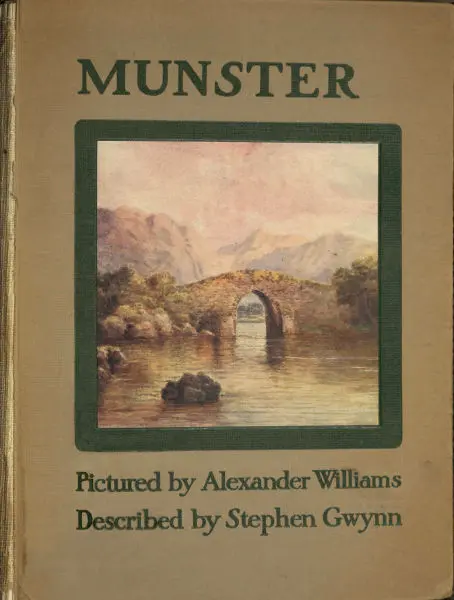
Munster
Stephen Lucius Gwynn
THE CLASSIC COLLECTION · 1905
"Thomas Moore" by Stephen Lucius Gwynn is a biographical account written in the early 20th century. The book explores the life and work of the Irish poet Thomas Moore, detailing his rise to fame from humble beginnings in Dublin and his significant contributions to English literature. Moore's friendships with notable literary figures and the impact of his poetry, particularly the "Irish Melodies," are central themes in this work. The opening of the book introduces the reader to Moore's childhood and early poetic endeavors, highlighting his talent that brought him into the spotlight of brilliant societal connections. It outlines his upbringing and the strong influence of his family and education on his character development and burgeoning artistic abilities. The narrative sets the tone for understanding how his early experiences shaped his literary achievements and friendships, ultimately leading to his substantial influence in the world of poetry and literature.
Introduction adapted from the source catalogue; source summaries may be automatically generated.
Free to read · English · 56,343 words · No account needed
MAKE TIME FOR A GOOD BOOK
On by default. Untick to stop anonymous reading totals. Each page counts after 10 seconds in view. How this works.
Anonymous counting is on unless you have switched it off.
Novella, a young Bolognese,
The daughter of a learn'd Law Doctor,
Who had with all the subtleties
Of old and modern jurists stock'd her,
Was so exceeding fair, 'tis said,
And over hearts held such dominion,
That when her father, sick in bed,
Or busy, sent her, in his stead,
To lecture on the Code Justinian,
She had a curtain drawn before her,
Lest, if her eyes were seen, the students
Should let their young eyes wander o'er her,
And quite forget their jurisprudence.
Just so it is with Truth, when seen,
Too dazzling far,--'tis from behind
A light, thin allegoric screen,
She thus can safest teach mankind.
In Thibet once there reign'd, we're told,
A little Lama, one year old--
Raised to the throne, that realm to bless,
Just when his little Holiness
Had cut--as near as can be reckon'd--
Some say his first tooth, some his second.
Chronologers and Nurses vary,
Which proves historians should be wary.
We only know th' important truth,
His Majesty had cut a tooth.
And much his subjects were enchanted,--
As well all Lama's subjects may be,
And would have giv'n their heads, if wanted,
To make tee-totums for the baby.
Throned as he was by Right Divine--
(What Lawyers call Jure Divino,
Meaning a right to yours, and mine,
And everybody's goods and rhino,)
Of course, his faithful subjects' purses,
Were ready with their aids and succours;
Nothing was seen but pension'd Nurses,
And the land groan'd with bibs and tuckers.
Oh! had there been a Hume or Bennet,
Then sitting in the Thibet Senate,
Ye Gods, what room for long debates
Upon the Nursery Estimates!
What cutting down of swaddling-clothes
And pin-a-fores, in nightly battles!
What calls for papers to expose
The waste of sugar-plums and rattles!
But no--If Thibet had M.P.'s,
They were far better bred than these;
Nor gave the slightest opposition,
During the Monarch's whole dentition.
But short this calm:--for, just when he
Had reach'd th' alarming age of three,
When Royal natures, and, no doubt,
Those of all noble beasts break out--
The Lama, who till then was quiet,
Show'd symptoms of a taste for riot;
And, ripe for mischief, early, late,
Without regard for Church or State,
Made free with whosoe'er came nigh;
Tweak'd the Lord Chancellor by the nose,
Turn'd all the Judges' wigs awry,
And trod on the old Generals' toes:
Pelted the Bishops with hot buns,
Rode cockhorse on the City maces,
And shot from little devilish guns,
Hard peas into his subjects' faces.
In short, such wicked pranks he play'd,
And grew so mischievous, God bless him!
That his Chief Nurse--with ev'n the aid
Of an Archbishop--was afraid,
When in these moods, to comb or dress him.
Nay, ev'n the persons most inclined
Through thick and thin, for Kings to stickle,
Thought him (if they'd but speak their mind,
Which they did not) an odious pickle.
Your reading position is saved on this browser. Take it to another device with a library code. Reading pages adapt to text, rather than matching a printed edition.
Stephen Lucius Gwynn
Stephen Lucius Gwynn
Stephen Lucius Gwynn
Stephen Lucius Gwynn
BEHIND THE BOOK
This eBook is for the use of anyone anywhere in the United States and most other parts of the world at no cost and with almost no restrictions whatsoever. You may copy it, give it away or re-use it under the terms of the Project Gutenberg License included with this eBook or online at www.gutenberg.org. If you are not located in the United States, you will have to check the laws of the country where you are located before using this eBook. Read the source licence.
The original source file, including credits and licence, is retained by this library. Request an original-format copy at no charge. Please include the book title and Project Gutenberg identifier #34930.
KEEP YOUR CURIOSITY GOING
Eric Mackay
Edmund Gosse
Sophia Margaretta Hensley
Gilbert Parker
George MacDonald
Elizabeth Bibesco