
Last letters from the living dead man
David Patterson (Spirit) Hatch
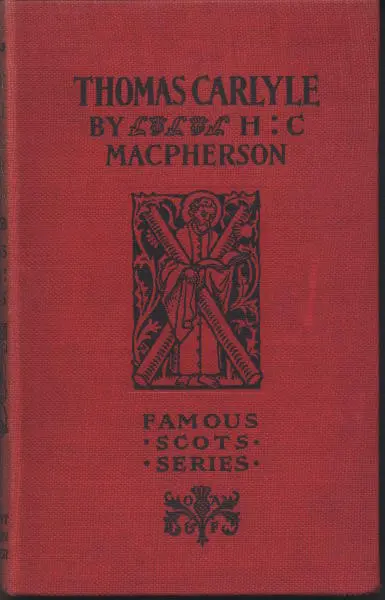
THE CLASSIC COLLECTION · 1897
"Thomas Carlyle" by Hector Macpherson is a biographical account written in the late 19th century. This book explores the life and work of Thomas Carlyle, placing particular emphasis on his early life, influences, and literary contributions. It aims to provide insights into Carlyle's thoughts, as well as his role as a significant figure in literature and philosophy, particularly in the context of German thought. The opening of the book introduces Thomas Carlyle's early life, discussing his family background, education, and early intellectual influences. It highlights his relationship with his parents, particularly the impact of his mother’s nurturing juxtaposed against his father’s sternness. Carlyle’s formative years at school, his struggles with academic institutions, and his shift away from the ministry towards a literary career are detailed. The author also hints at Carlyle's friendships, notably with Edward Irving, and foreshadows Carlyle's burgeoning literary ambitions, setting the stage for his eventual contributions to literature and thought.
Introduction adapted from the source catalogue; source summaries may be automatically generated.
Free to read · English · 36,664 words · No account needed
MAKE TIME FOR A GOOD BOOK
On by default. Untick to stop anonymous reading totals. Each page counts after 10 seconds in view. How this works.
Anonymous counting is on unless you have switched it off.
'In a very few minutes after the doors were opened, the large hall was filled in every part; and when up the central passage the Principal, the Lord Rector, the Members of the Senate, and other gentlemen advanced towards the platform, the cheering was vociferous and hearty. The Principal occupied the chair, of course; the Lord Rector on his right, the Lord Provost on his left. When the platform gentlemen had taken their seats, every eye was fixed on the Rector. To all appearance, as he sat, time and labour had dealt tenderly with him. His face had not yet lost the country bronze which he brought up with him from Dumfriesshire as a student, fifty-six years ago. His long residence in London had not touched his Annandale look, nor had it--as we soon learned--touched his Annandale accent. His countenance was striking, homely, sincere, truthful--the countenance of a man on whom "the burden of the unintelligible world" had weighed more heavily than on most. His hair was yet almost dark; his moustache and short beard were iron-grey. His eyes were wide, melancholy, sorrowful; and seemed as if they had been at times a-weary of the sun. Altogether, in his aspect there was something aboriginal, as of a piece of unhewn granite, which had never been polished to any approved pattern, whose natural and original vitality had never been tampered with. In a word, there seemed no passivity about Mr Carlyle; he was the diamond, and the world was his pane of glass; he was a graving tool, rather than a thing graven upon--a man to set his mark on the world--a man on whom the world could not set its mark.... The proceedings began by the conferring of the degree of LL.D. on Mr Erskine of Linlathen--an old friend of Mr Carlyle's--on Professors Huxley, Tyndall, and Ramsay, and on Dr Rae, the Arctic explorer. That done, amid a tempest of cheering and hats enthusiastically waved, Mr Carlyle, slipping off his Rectorial robe--which must have been a very shirt of Nessus to him--advanced to the table, and began to speak in low, wavering, melancholy tones, which were in accordance with the melancholy eyes, and in the Annandale accent with which his play-fellows must have been familiar long ago. So self-centred was he, so impregnable to outward influences, that all his years of Edinburgh and London life could not impair, even in the slightest degree, that. The opening sentences were lost in the applause, and when it subsided, the low, plaintive, quavering voice was heard going on: "Your enthusiasm towards me is very beautiful in itself, however undeserved it may be in regard to the object of it. It is a feeling honourable to all men, and one well known to myself when in a position analogous to your own." And then came the Carlylean utterance, with its far-reaching reminiscence and sigh over old graves--Father's and Mother's, Edward Irving's, John Sterling's, Charles Buller's, and all the noble known in past time--and with its flash of melancholy scorn. "There are now fifty-six years gone, last November, since I first entered your city, a boy of not quite fourteen--fifty-six years ago--to attend classes here, and gain knowledge of all kinds, I knew not what--with feelings of wonder and awe-struck expectation; and now, after a long, long course, this is what we have come to.... There is something touching and tragic, and yet at the same time beautiful, to see the third generation, as it were, of my dear old native land, rising up, and saying: Well, you are not altogether an unworthy labourer in the vineyard. You have toiled through a great variety of fortunes, and have had many judges." And thereafter, without aid of notes, or paper preparation of any kind, in the same wistful, earnest, hesitating voice, and with many a touch of quaint humour by the way, which came in upon his subject like glimpses of pleasant sunshine, the old man talked to his vast audience about the origin and function of Universities, the Old Greeks and Romans, Oliver Cromwell, John Knox, the excellence of silence as compared with speech, the value of courage and truthfulness, and the supreme importance of taking care of one's health. "There is no kind of achievement you could make in the world that is equal to perfect health. What to it are nuggets and millions? The French financier said, 'Alas! why is there no sleep to be sold?' Sleep was not in the market at any quotation." But what need of quoting a speech which by this time has been read by everybody? Appraise it as you please, it was a thing per se. Just as, if you wish a purple dye, you must fish up the Murex; if you wish ivory, you must go to the East; so if you desire an address such as Edinburgh listened to the other day, you must go to Chelsea for it. It may not be quite to your taste, but, in any case, there is no other intellectual warehouse in which that kind of article is kept in stock.'[33]
Your reading position is saved on this browser. Take it to another device with a library code. Reading pages adapt to text, rather than matching a printed edition.
BEHIND THE BOOK
This eBook is for the use of anyone anywhere in the United States and most other parts of the world at no cost and with almost no restrictions whatsoever. You may copy it, give it away or re-use it under the terms of the Project Gutenberg License included with this eBook or online at www.gutenberg.org. If you are not located in the United States, you will have to check the laws of the country where you are located before using this eBook. Read the source licence.
The original source file, including credits and licence, is retained by this library. Request an original-format copy at no charge. Please include the book title and Project Gutenberg identifier #32626.
KEEP YOUR CURIOSITY GOING
David Patterson (Spirit) Hatch
Coulson Kernahan
John L. Ransom

Ralph Waldo Emerson
Frances Wright

Herman W. Mudgett