
Last letters from the living dead man
David Patterson (Spirit) Hatch
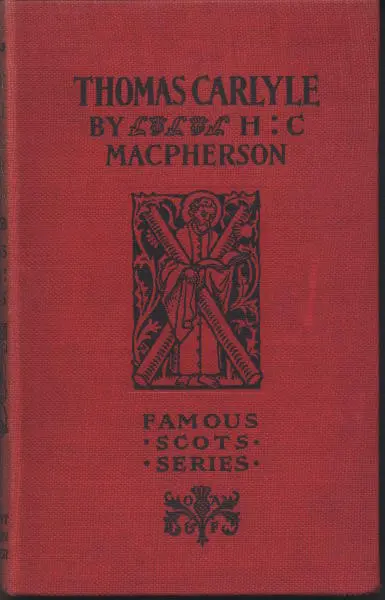
THE CLASSIC COLLECTION · 1897
"Thomas Carlyle" by Hector Macpherson is a biographical account written in the late 19th century. This book explores the life and work of Thomas Carlyle, placing particular emphasis on his early life, influences, and literary contributions. It aims to provide insights into Carlyle's thoughts, as well as his role as a significant figure in literature and philosophy, particularly in the context of German thought. The opening of the book introduces Thomas Carlyle's early life, discussing his family background, education, and early intellectual influences. It highlights his relationship with his parents, particularly the impact of his mother’s nurturing juxtaposed against his father’s sternness. Carlyle’s formative years at school, his struggles with academic institutions, and his shift away from the ministry towards a literary career are detailed. The author also hints at Carlyle's friendships, notably with Edward Irving, and foreshadows Carlyle's burgeoning literary ambitions, setting the stage for his eventual contributions to literature and thought.
Introduction adapted from the source catalogue; source summaries may be automatically generated.
Free to read · English · 36,664 words · No account needed
MAKE TIME FOR A GOOD BOOK
On by default. Untick to stop anonymous reading totals. Each page counts after 10 seconds in view. How this works.
Anonymous counting is on unless you have switched it off.
Mrs Carlyle joined her husband on the 1st of October 1831, and they took lodgings at 4 Ampton Street, Gray's Inn Lane, with a family of the name of Miles, belonging to Irving's congregation. Jeffrey was a frequent visitor there, and sometimes the Carlyles called at Jermyn Street. Carlyle says that they were at first rather surprised that Jeffrey did not introduce him to some of his 'grand literary figures,' or try in some way to be of help to one for whom he evidently had a value. The explanation, Carlyle thinks, was that he himself 'expressed no trace of aspiration that way'; that Jeffrey's 'grand literary or other figures' were clearly by no means 'so adorable to the rustic hopelessly Germanised soul as an introducer of one might have wished.' Besides, Jeffrey was so 'heartily miserable,' as to think Carlyle and his other fellow-creatures happy in comparison, and to have no care left to bestow upon them.
Here is a characteristic outburst in the 'Reminiscences': 'The beggarly history of poor "Sartor" among the blockheadisms is not worth my recording or remembering--least of all here! In short, finding that whereas I had got L100 (if memory serve) for "Schiller" six or seven years before, and for "Sartor," at least thrice as good, I could not only not get L200, but even get no Murray, or the like, to publish it on half-profits (Murray, a most stupendous object to me; tumbling about, eyeless, with the evidently strong wish to say "yes and no"; my first signal experience of that sad human predicament); I said, "We will make it No, then; wrap up our MS.; wait till this Reform Bill uproar abate."'[12]
On Tuesday, January 26th, 1832, Carlyle received tidings of the death of his father. He departed on the Sunday morning previous 'almost without a struggle,' wrote his favourite sister Jane. It was a heavy stroke for Carlyle. 'Natural tears,' he exclaimed shortly afterwards, 'have come to my relief. I can look at my dear Father, and that section of the Past which he has made alive for me, in a certain sacred, sanctified light, and give way to what thoughts rise in me without feeling that they are weak and useless.' Carlyle determined that the time till the funeral was past (Friday) should be spent with his wife only. All others were excluded. He walked 'far and much,' chiefly in the Regent's Park, and considered about many things, his object being to see clearly what his calamity meant--what he lost, and what lesson that loss was to teach him. Carlyle considered his father as one of the most interesting men he had known. 'Were you to ask me,' he said, 'which had the greater natural faculty,' Robert Burns or my father, 'I might, perhaps, actually pause before replying. Burns had an infinitely wider Education, my Father a far wholesomer. Besides, the one was a man of Musical Utterance; the other wholly a man of Action, even with Speech subservient thereto. Never, of all the men I have seen, has one come personally in my way in whom the endowment from Nature and the Arena from Fortune were so utterly out of all proportion. I have said this often, and partly know it. As a man of Speculation--had Culture ever unfolded him--he must have gone wild and desperate as Burns; but he was a man of Conduct, and Work keeps all right. What strange shapeable creatures we are!'[13] Nothing that the elder Carlyle undertook to do but he did it faithfully, and like a true man. 'I shall look,' said his distinguished son, 'on the houses he built with a certain proud interest. They stand firm and sound to the heart all over his little district. No one that comes after him will ever say, "Here was the finger of a hollow eye-servant." They are little texts for me of the gospel of man's free will. Nor will his deeds and sayings in any case be found unworthy--not false and barren, but genuine and fit. Nay, am not I also the humble James Carlyle's work? I owe him much more than existence; I owe him a noble inspiring example (now that I can read it in that rustic character). It was he exclusively that determined on educating me; that from his small hard-earned funds sent me to school and college, and made me whatever I am or may become. Let me not mourn for my father, let me do worthily of him. So shall he still live even here in me, and his worth plant itself honourably forth into new generations.'[14] One of the wise men about Ecclefechan told James Carlyle: 'Educate a boy, and he grows up to despise his ignorant parents.' His father once told Carlyle this, and added: 'Thou hast not done so; God be thanked for it.' When James Carlyle first entered his son's house at Craigenputtock, Mrs Carlyle was greatly struck with him, 'and still farther,' says her husband, 'opened my eyes to the treasure I possessed in a father.'
Your reading position is saved on this browser. Take it to another device with a library code. Reading pages adapt to text, rather than matching a printed edition.
BEHIND THE BOOK
This eBook is for the use of anyone anywhere in the United States and most other parts of the world at no cost and with almost no restrictions whatsoever. You may copy it, give it away or re-use it under the terms of the Project Gutenberg License included with this eBook or online at www.gutenberg.org. If you are not located in the United States, you will have to check the laws of the country where you are located before using this eBook. Read the source licence.
The original source file, including credits and licence, is retained by this library. Request an original-format copy at no charge. Please include the book title and Project Gutenberg identifier #32626.
KEEP YOUR CURIOSITY GOING
David Patterson (Spirit) Hatch
Coulson Kernahan
John L. Ransom

Ralph Waldo Emerson
Frances Wright

Herman W. Mudgett