
The Writing of News A Handbook with Chapters on Newspaper Correspondence and Copy Reading
Charles G. (Charles Griffith) Ross
THE CLASSIC COLLECTION · 1900
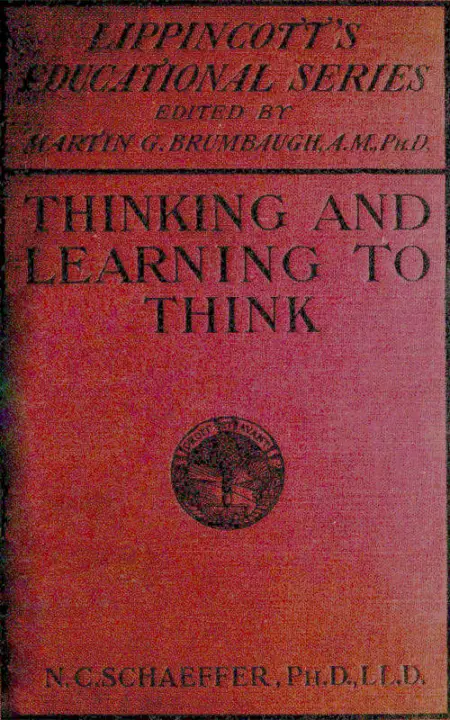
"Thinking and Learning to Think" by Nathan Christ Schaeffer is an educational treatise written in the early 20th century. This work explores the essential aspects of teaching students how to think critically and reflectively, addressing various problem areas in education. Schaeffer emphasizes that the highest goal of education is to develop the intellectual abilities of students, providing them with the tools and materials necessary for effective thoughts and understanding. The opening portion of the book introduces key concepts surrounding the importance of active thinking in education. It discusses the need for teachers to make students engage mentally with the material, rather than simply memorizing information. Schaeffer argues for clear and distinct thinking as the foundation of more complex thought processes. Moreover, he critiques traditional teaching methods that encourage rote memorization over genuine understanding, advocating instead for an approach that builds critical thinking through clear concepts and adequate materials that foster reflective learning and deeper comprehension.
Introduction adapted from the source catalogue; source summaries may be automatically generated.
Free to read · English · 94,271 words · No account needed
MAKE TIME FOR A GOOD BOOK
On by default. Untick to stop anonymous reading totals. Each page counts after 10 seconds in view. How this works.
Anonymous counting is on unless you have switched it off.
[Sidenote: Substitute teachers.]
This stimulus to thought is employed by every master in the art of teaching. The question may be used to badger and confuse a pupil, especially if the teacher is not fully acquainted with the ideas and thoughts already in the learner’s mind. To cause each pupil to place side by side in his mind ideas and concepts whose relation he had not before perceived, it is necessary that the teacher be familiar with the intellectual storehouse of every member of the class. At this point the substitutes who occasionally supply the places of regular teachers are at a serious disadvantage. Not knowing what the pupils have mastered, they must often waste time in finding out where the new should be linked to the old, and where it is necessary to clarify and develop ideas with which the members of the class are only partially familiar. Often these lose interest in the recitation while the new teacher quizzes them on things that have grown stale by repetition.
[Sidenote: The living teacher.]
[Sidenote: The dead line.]
[Sidenote: Knowledge and teaching power.]
[Sidenote: The course of study.]
[Sidenote: Difficulties.]
Back of the Socratic method must be a Socrates to ask the questions. Education results not from highly differentiated methods, but primarily from the play of mind upon mind, heart upon heart, will upon will. In the difficult art of making others think the most important factor is the teacher himself. Thinking begets thinking. In this connection one cannot forbear contrasting the living teacher with other educational forces. Treatises on education are in the habit of printing nature with a capital letter, whilst words like teacher, humanity, unless they stand at the beginning of the sentence, begin with a small letter. Are lifeless rocks, dead leaves, stuffed birds, and transfixed bugs more potent in begetting thought than the teacher himself? If nature were such a wonderful teacher, then the savage, who is in daily contact with nature, and who knows little or nothing of the artificial life of our great cities and great seats of learning, should be the best thinker. A teacher whose power to stimulate thought is not superior to dead leaves and bugs and butterflies must have reached the dead line. Teachers may be divided into two classes,—those who have ceased to grow and those who are still alive and growing. Under the tuition of the former the boy soon loses interest in study, and seldom acquires the power to think. From a dead tree you cannot propagate life. Ingraft a lifeless teacher upon the school; the most skilful devices of school management and recitation serve only to intensify the dull routine, the mechanical iteration and repetition which Bishop Spalding declares to be the most radical defect in our systems of education. It takes life to beget life. A growing mind is required to beget growth in other minds. A good thinker begets habits of close and careful thinking in those whom he moulds. Some minds are more gifted in this respect than others. Without doubt the reader can recall the difference between knowledge and teaching power which he felt while under several instructors at the same time. From those gifted with stimulating power he came away with a mind full of interrogation points, and with the attention riveted upon problems calling for investigation. Under their tuition the commonest things acquired new interest and became food for thought. The thinking seemed to spring out of that upon which the mind was feeding. Without the stimulating influence which comes from a live teacher, contact with nature, access to libraries and laboratories, may amount to very little. The chief trouble in our schools is not that the courses of study are too crowded, but the teachers are too empty. There is not enough fuel in their minds to keep alive the glow of thought. A course of study in the hands of a skilful instructor is like a good bill of fare under the direction of a skilful caterer. The latter does not expect every guest to eat his way through the entire bill of fare; he so manages the succession of dishes as to stimulate the appetite to the end of the feast; he sends the guests away without the feeling of satiety,—in fact, anxious for the next banquet. The wise teacher does not expect the pupils to assimilate everything in the course of study; he aims so to feed and stimulate their minds that they find genuine pleasure in thinking, and go away from him with a desire not only for more knowledge, but also for things that give suitable exercise to the reflective powers. Watch a boy at work upon a puzzle, and you will be convinced that he finds genuine delight in thinking that which is difficult. The most popular teachers are not they who smooth away every difficulty in the pathway of the student, but they who stimulate his thinking and help him to a sense of mastery over intellectual difficulties. The quickening, stimulative influence of the Socratic question lies in its content rather than its form; and both form and content derive their vivifying power from the personality of the teacher.
Your reading position is saved on this browser. Take it to another device with a library code. Reading pages adapt to text, rather than matching a printed edition.
BEHIND THE BOOK
This eBook is for the use of anyone anywhere in the United States and most other parts of the world at no cost and with almost no restrictions whatsoever. You may copy it, give it away or re-use it under the terms of the Project Gutenberg License included with this eBook or online at www.gutenberg.org. If you are not located in the United States, you will have to check the laws of the country where you are located before using this eBook. Read the source licence.
The original source file, including credits and licence, is retained by this library. Request an original-format copy at no charge. Please include the book title and Project Gutenberg identifier #60893.
KEEP YOUR CURIOSITY GOING
Charles G. (Charles Griffith) Ross
Hannah Webster Foster

Emily Lawless
Edwin Hamlin Carr

Charles De Lano Hine
Andrew Ure