
The Writing of News A Handbook with Chapters on Newspaper Correspondence and Copy Reading
Charles G. (Charles Griffith) Ross
THE CLASSIC COLLECTION · 1900
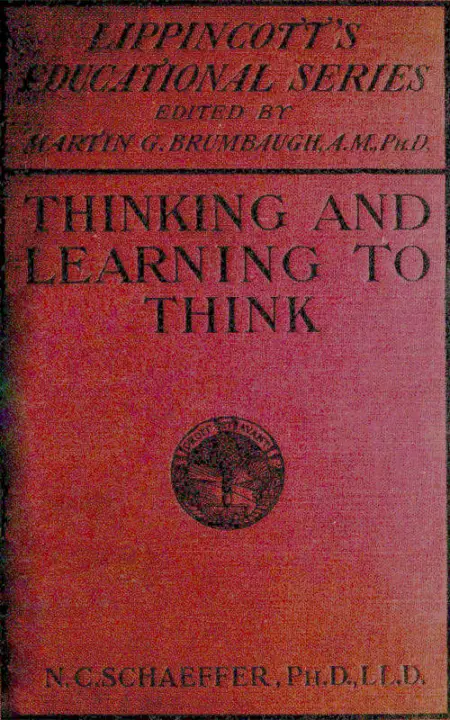
"Thinking and Learning to Think" by Nathan Christ Schaeffer is an educational treatise written in the early 20th century. This work explores the essential aspects of teaching students how to think critically and reflectively, addressing various problem areas in education. Schaeffer emphasizes that the highest goal of education is to develop the intellectual abilities of students, providing them with the tools and materials necessary for effective thoughts and understanding. The opening portion of the book introduces key concepts surrounding the importance of active thinking in education. It discusses the need for teachers to make students engage mentally with the material, rather than simply memorizing information. Schaeffer argues for clear and distinct thinking as the foundation of more complex thought processes. Moreover, he critiques traditional teaching methods that encourage rote memorization over genuine understanding, advocating instead for an approach that builds critical thinking through clear concepts and adequate materials that foster reflective learning and deeper comprehension.
Introduction adapted from the source catalogue; source summaries may be automatically generated.
Free to read · English · 94,271 words · No account needed
MAKE TIME FOR A GOOD BOOK
On by default. Untick to stop anonymous reading totals. Each page counts after 10 seconds in view. How this works.
Anonymous counting is on unless you have switched it off.
[5] See “How London Lives,” Thomas Nelson & Sons, London.
[6] “Johannes Kepler (1571-1630) was at one time in Prague assistant to the Danish astronomer Tycho Brahe. Unlike Tycho, Kepler had no talent for observation and experimentation. But he was a great thinker, and excelled as a mathematician. He absorbed Copernican ideas, and early grappled with the problem of determining the real paths of the planets. In his first attempts he worked on the dreams of the Pythagoreans concerning figure and number. Intercourse with Tycho led him to reject such mysticism and to study on the planets recorded by his master. He took the planet Mars, and found that no combinations of circles would give a path which could be reconciled with the observations. In one case the difference between the observed and his computed values was eight minutes, and he knew that so accurate an observer as Tycho could not make an error so great. He tried an oval orbit for Mars, and rejected it; he tried an ellipse, and it fitted. Thus, after more than four years of assiduous computation, and after trying nineteen imaginary paths, and rejecting each because it was inconsistent with observation, Kepler in 1618 discovered the truth. An ellipse! Why did he not think of it before? What a simple matter—after the puzzle is once solved! He worked out what are known as Kepler’s laws, which accorded with observation, but conflicted with the Ptolemaic hypothesis. Thus the old system was logically overthrown. But not until after a bitter struggle between science and theology did the new system find general acceptation.”—Cajori’s “History of Physics,” pages 29, 30.
[7] Young’s “The Sun,” pages 43, 44, second edition.
[8] Young’s “Astronomy,” page 174.
[9] Now the well-known Lord Kelvin.
[10] “Actinism,” by Professor Charles F. Himes, pages 18, 19.
[11] Dr. Morrell’s “Elements of Psychology,” quoted by Galloway in “Education, Scientific and Technical,” page 165.
[12] Quoted by Galloway in “Education, Scientific and Technical,” pages
116, 117.
[13] Hinsdale’s “The Language Arts,” pages 17, 18.
[14] Mr. Smiles, “Life of Stephenson,” third edition, page 474, tells how George Stephenson, arguing one evening on the coal question with Dr. Buckland, was quite unable to make good his case. The next morning he talked over the matter with Sir W. Follett, and that illustrious advocate, from the materials supplied by the practical knowledge of Stephenson, was able easily to discomfit the learned dean. Quoted by A. S. Wilkins’s “Cicero de Oratore,” page 105, second edition.
[15] Phelps’s “Men and Books,” page 303.
[16] Lowell’s “Books and Libraries,” pages 88-90, vol. vi., Riverside
Edition.
[17] Phelps’s “Men and Books,” pages 105, 106.
[18] Ibid., page 124.
[19] N. Porter’s “Books and Reading,” page 57.
[20] Charles F. Himes’s “Actinism,” pages 5, 6.
[21] Jevons’s “Principles of Science,” pages 399, 400.
[22] “Talks on Psychology,” page 34.
Your reading position is saved on this browser. Take it to another device with a library code. Reading pages adapt to text, rather than matching a printed edition.
BEHIND THE BOOK
This eBook is for the use of anyone anywhere in the United States and most other parts of the world at no cost and with almost no restrictions whatsoever. You may copy it, give it away or re-use it under the terms of the Project Gutenberg License included with this eBook or online at www.gutenberg.org. If you are not located in the United States, you will have to check the laws of the country where you are located before using this eBook. Read the source licence.
The original source file, including credits and licence, is retained by this library. Request an original-format copy at no charge. Please include the book title and Project Gutenberg identifier #60893.
KEEP YOUR CURIOSITY GOING
Charles G. (Charles Griffith) Ross
Hannah Webster Foster

Emily Lawless
Edwin Hamlin Carr

Charles De Lano Hine
Andrew Ure