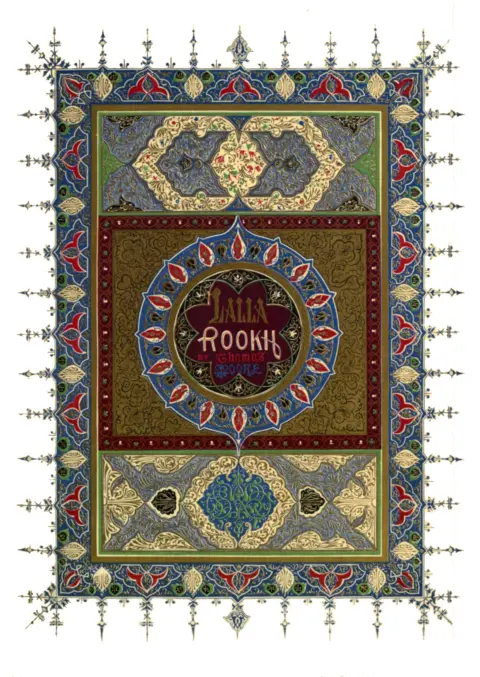
Lalla Rookh
Thomas Moore
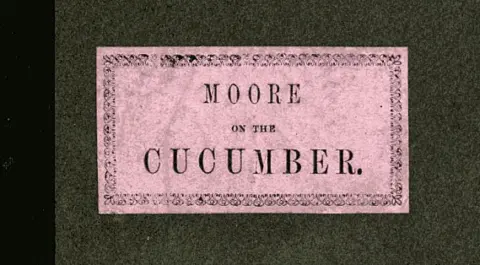
THE CLASSIC COLLECTION · 1847
"Theory and Practice, Applied to the Cultivation of the Cucumber in the Winter Season" by Thomas Moore is a scientific publication written in the mid-19th century. The work primarily focuses on the methods and principles of growing cucumbers during the winter season, offering insights into horticultural practices and advancements at the time. It aims to provide guidance to both novice and experienced gardeners by emphasizing the scientific approach to successful cultivation. The opening of the treatise lays the groundwork for understanding cucumber cultivation, discussing the plant's botanical classification, historical context, and its significance in gardening. Moore introduces the key elements that influence plant growth, such as light, temperature, and soil composition, thereby encouraging readers to apply scientific principles to their gardening practices. This section highlights the importance of a balanced approach to horticulture, advocating for a deeper understanding of the natural processes affecting plant health and productivity.
Introduction adapted from the source catalogue; source summaries may be automatically generated.
Free to read · English · 21,664 words · No account needed
MAKE TIME FOR A GOOD BOOK
On by default. Untick to stop anonymous reading totals. Each page counts after 10 seconds in view. How this works.
Anonymous counting is on unless you have switched it off.
On Atmospheric Humidity.
Cucumbers cannot at any time be successfully grown in an arid atmosphere, although, during the winter season, they require a much less proportion of atmospheric humidity, than under the influence of longer days and brighter light; and conversely, the degree which would be necessary to secure their welfare in summer, would be fatal to them in winter. An experienced gardener would tell almost instinctively, at either season, whether a sufficient supply was present or not; but less experienced cultivators would need some index, or register, to guide them. Such an index is afforded by the hygrometer; but most of the kinds of hygrometers are delicate instruments, and hardly suited for garden use. What is needed in this case is, not an instrument which requires minute observations and calculations, but something that will at once indicate the atmospheric humidity as plainly as the thermometer does the temperature, and which may be as easily read off and understood. Simmons' hygrometer, recently introduced to the notice of horticulturists, professes to supply this desideratum; and though, perhaps, not a sufficiently accurate instrument for purely scientific purposes, yet, as simply and clearly indicating what is at least an approximation to the existing degree of atmospheric humidity, it is to be regarded as a useful garden hygrometer. By it, the degree of dryness or humidity is indicated on a dial-plate, by means of a moveable arm resembling the hand of a clock. The dial-plate is marked off into degrees, expressing the amount of moisture in the air, between what is observed when the instrument is plunged in water on the one hand, and exposed to excessive dryness on the other. As my own experience of this instrument, though favourable to its use, is still but limited, I cannot do better than introduce here the following remarks of Mr. Beck, of Isleworth, a very successful cultivator of plants, and one who has had considerable experience in the use of these instruments. It will be observed that Mr. Beck's standard for the orchid-house will be about suitable for cucumbers.[4] Mr. Beck observes,--"The skilful gardener, observing the pointer to advance with dryness and return with moisture, will soon form a standard for himself, by which to regulate his stove, greenhouse, &c.; still some general scale is desirable. Two conditions must be carefully observed:--1. The instrument must neither be hung in the sun, nor where it will be liable to get wetted or saturated. 2. It must not be subjected to greater heat than is suited to vegetable life. For the six months commencing with August and ending with January, 40 deg. in, the morning, increasing to 60 deg. about noon, and declining again to 40 deg. at night, is about the right scale for the orchid-house; whilst a range from 50 deg. to 80 deg. would be suitable for both the stove and greenhouse in those months. In the other half year, February and July inclusive, 30 deg. to 40 deg., morning and evening, running up to 80 deg. in the middle of the day for the orchid-house; 40 deg. and 50 deg., and up to 70 deg. for the stove; and 50 deg. to 80 deg. for the greenhouse, will prove very suitable. The above scale is desirable, but I do not say it is always attainable. Ours is an uncertain climate; sometimes a dry east wind will almost parch us up; at other times a southerly one, with wet, will cause a superabundance, which will have to be corrected, possibly by a gentle fire, and a free admission of air. The alteration hereby effected in the atmosphere of the houses will soon be evidenced by the hygrometer, and mildew and fogging off be kept at a distance. Opposed to an excess of moisture in the dull months of the year, is the dryness consequent on the summer and autumnal sunshine. Then, during the heat of the days, the instrument will seem to have run wild. Throwing water on the floors of the houses, and every means of increasing the amount of moisture, seems but of little or temporary avail; Simmons will go up, spite of all, to 90 deg. or 100 deg., and none the worse either, for it is still a faithful indicator, and as sure as the day declines, and the heat of the sun is withdrawn, so will it come back to a suitable point, when the plants are watered and the floors are wetted for the night. Remembering then, the variableness of our climate, I candidly admit that I consider any precise directions of very little value. None can be given that shall be implicitly followed, or on which success shall certainly attend. Horticultural practice should be made dependant upon ever-varying circumstances."
Your reading position is saved on this browser. Take it to another device with a library code. Reading pages adapt to text, rather than matching a printed edition.
Thomas Moore
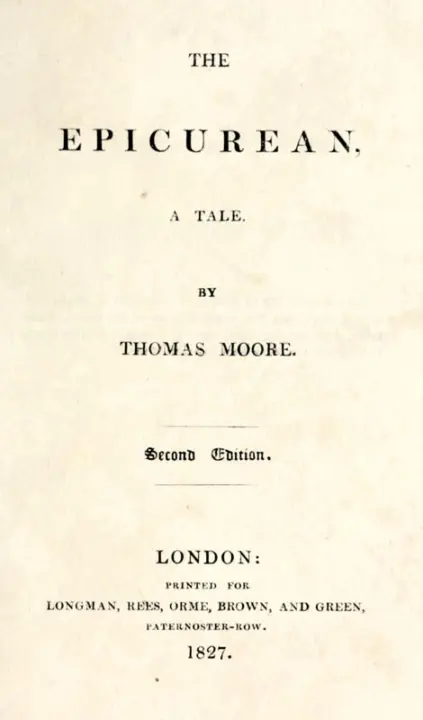
Thomas Moore
BEHIND THE BOOK
This eBook is for the use of anyone anywhere in the United States and most other parts of the world at no cost and with almost no restrictions whatsoever. You may copy it, give it away or re-use it under the terms of the Project Gutenberg License included with this eBook or online at www.gutenberg.org. If you are not located in the United States, you will have to check the laws of the country where you are located before using this eBook. Read the source licence.
The original source file, including credits and licence, is retained by this library. Request an original-format copy at no charge. Please include the book title and Project Gutenberg identifier #32818.
KEEP YOUR CURIOSITY GOING

John Muir

Asa Gray
Asa Gray

Florence Nightingale
Elizabeth Robins Pennell
Denison Olmsted