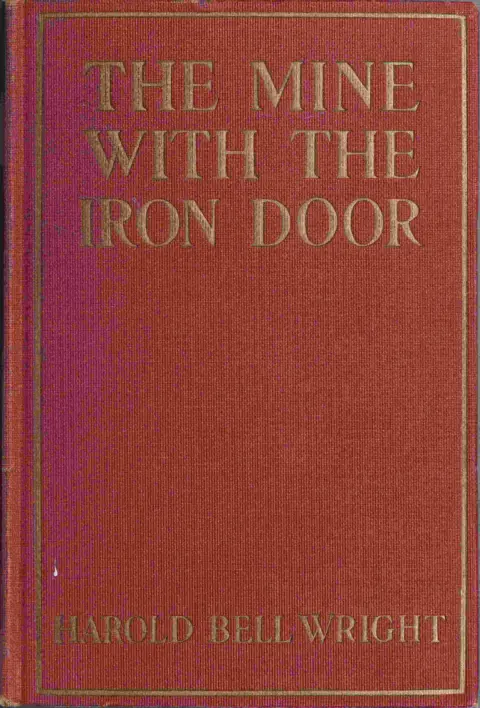
The Mine with the Iron Door
Harold Bell Wright
THE CLASSIC COLLECTION · 1912
"Their Yesterdays" by Harold Bell Wright is a philosophical novel written in the early 20th century. This work delves into themes of dreams, love, and the passage of time, focusing on two characters—a man and a woman—who reflect on their lives and the fundamental truths they find within their yesterdays. The narrative emphasizes the universal experiences of life, love, dreams, and the quest for meaning as the characters navigate their internal landscapes. The beginning of "Their Yesterdays" introduces readers to the dual journeys of the man and the woman, each embarking on a reflective exploration of their pasts. The man grapples with the realization of his manhood and the dreams that form the foundation of his existence, while the woman contemplates her newly recognized womanhood and the societal expectations surrounding it. As both characters revisit their yesterdays, they discover significant life principles that resonate with their present lives—friendship, love, ambition, and more. Through this lens, Wright sets up a narrative that is rich with contemplation, inviting the reader to consider how past experiences shape their current identities and life paths.
Introduction adapted from the source catalogue; source summaries may be automatically generated.
Free to read · English · 66,989 words · No account needed
MAKE TIME FOR A GOOD BOOK
On by default. Untick to stop anonymous reading totals. Each page counts after 10 seconds in view. How this works.
Anonymous counting is on unless you have switched it off.
Dear, innocent, sheltered, protected, Yesterdays--when mother told her child all that was needful for her to know, and told her in a most tender, beautiful, way. Dear, blessed, Yesterdays--when love did not leave vice to teach the sacred truths of love--days that were days of blissful Ignorance--not vicious Ignorance but ignorance of the vicious. There was a wealth of Ignorance in those Yesterdays that is of more worth to womanhood, by far, than much knowledge of the world.
And often the boy would come, too, and, together, they would wade hand in hand in the clear flood, mingling their shouts and laughter with the music of their playmate brook, while the minnows darted to and fro about their bare legs; or, they would build brave dams and bridges and harbors with the bright stones; or, best of all, fashion and launch the ships of childhood.
Oh, childish ships of the Yesterdays! What precious cargoes they
carried! What priceless treasures they bore to the far away port of
dreams!
The little brook was a safe stream for the boy and the girl to play beside. Nor did they know, then, that their streamlet flowed on and on until it joined the river; and that the river, in its course, led it past great cities that poured into it the poisons and the filth of their sewers, fouling its bright waters, until it was unfit for children to play beside.
They did not know, then--but the woman knew, now.
And what--she thought as she came back from her Yesterdays--what of the boy who had played with her beside the brook? He, too, must have learned what happened to their brook. In learning, what had happened to him--she wondered--and wondering, she was afraid.
Because she was no longer ignorant, she was afraid for the mate of her Yesterdays. Not that she thought over to meet him again. She did not wish, now, to meet him for she was afraid. She would rather have him as he was in her Yesterdays.
Slowly the woman turned away from the quiet seat beside the brook. It
was time for her to go.
Not far away, she passed the gray haired policeman, who again smiled
and touched his hat.
Smiling in return she bade him: "Good afternoon."
"Good afternoon, Miss," he said, still smiling gravely. "Come again, Miss, when ye's want a breath of air that's pure and clean."
May heaven bless, for the sweet sake of womanhood, all men who
understand.
It was springtime--blossoming time--mating time. The world was a riot of color and perfume and song.
Your reading position is saved on this browser. Take it to another device with a library code. Reading pages adapt to text, rather than matching a printed edition.
Harold Bell Wright
Harold Bell Wright
Harold Bell Wright
Harold Bell Wright
BEHIND THE BOOK
This eBook is for the use of anyone anywhere in the United States and most other parts of the world at no cost and with almost no restrictions whatsoever. You may copy it, give it away or re-use it under the terms of the Project Gutenberg License included with this eBook or online at www.gutenberg.org. If you are not located in the United States, you will have to check the laws of the country where you are located before using this eBook. Read the source licence.
The original source file, including credits and licence, is retained by this library. Request an original-format copy at no charge. Please include the book title and Project Gutenberg identifier #6105.
KEEP YOUR CURIOSITY GOING

David Patterson (Spirit) Hatch
Coulson Kernahan

Ralph Waldo Emerson

Maurice Baring
Frances Wright
Cécile Tormay