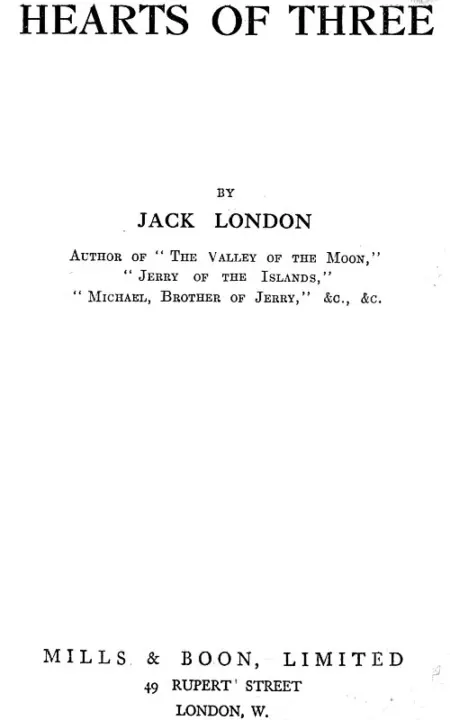
Hearts of three
Jack London
THE CLASSIC COLLECTION · 1910
"Theft: A Play In Four Acts" by Jack London is a dramatic work written in the early 20th century. The play unfolds within the political arena of Washington D.C., focusing primarily on the lives of Senator Chalmers, his wife Margaret, and the reformist congressman Howard Knox. Themes of power, ethics, and societal justice circulate throughout the narrative, posing significant questions about morality and the implications of wealth in governance. At the start of the play, the characters are introduced in a series of interactions that highlight the tension between wealth and reform. In the first act, Senator Chalmers and the journalist Hubbard plot to discredit Howard Knox, who poses a threat to their political power with his radical ideas. Margaret Chalmers is revealed as a woman caught between her loyalties to her influential father and her admiration for Knox's progressive ideals. The opening establishes a landscape ripe for conflict, hinting at imminent political machinations and personal dilemmas that intertwine as the plot unfolds, especially with the impending speech that Knox plans to deliver, which may jeopardize the status quo.
Introduction adapted from the source catalogue; source summaries may be automatically generated.
Free to read · English · 32,237 words · No account needed
MAKE TIME FOR A GOOD BOOK
On by default. Untick to stop anonymous reading totals. Each page counts after 10 seconds in view. How this works.
Anonymous counting is on unless you have switched it off.
(Hurt, showing that he will stay.) I am not a coward.
{Chalmers}
(In a stifled voice that grows stronger.) Yes; wait I have a word
for you.
(He pauses a moment, and when he speaks again his voice is all
right.)
(Witheringly.) A nice specimen of a reformer, I must say. You, who babbled yesterday about theft. The most high, righteous and noble Ali Baba, who has come into the den of thieves and who is also a thief.
(Mimicking Margaret.) "Ah, you flame, you flame!"
(In his natural voice.) I should call you; you thief, you thief,
you wife-stealer, you.
{Margaret}
(Coolly.) I should scarcely call it theft.
{Chalmers}
(Sneeringly.) Yes; I forgot. You mean it is not theft for him to take what already belongs to him.
{Margaret}
Not quite that--but in taking what has been freely offered to
him.
{Chalmers}
You mean you have so forgotten your womanhood as to offer--
{Margaret}
Just that. Last night. And Mr. Knox did himself the honor of
refusing me.
{Knox}
(Bursting forth.) You see, nothing else remains, Margaret.
{Chalmers}
(Twittingly.) Ah, "Margaret."
{Knox}
(Ignoring him.) The situation is intolerable.
{Chalmers}
(Emphatically). It is intolerable. Don't you think you had better leave this house? Every moment of your presence dishonors it.
{Margaret}
Don't talk of honor, Tom.
{Chalmers}
I make no excuses for myself. I fancy I never fooled you
very much. But at any rate I never used my own house for such
purposes.
{Knox}
(Springing at him.) You cur!
{Margaret}
(Interposing.) No; don't. His heart.
{Chalmers}
(Mimicking Margaret.) No dramatics, please.
{Margaret}
(Plaintively, looking from one man to the other.) Men are so strangely and wonderfully made. What am I to do with the pair of you? Why won't you reason together like rational human beings?
{Chalmers}
(Bitterly gay, rising to his feet.) Yes; let us come and reason together. Be rational. Sit down and talk it over like civilized humans. This is not the stone age. Be reassured, Mr. Knox. I won't brain you. Margaret--
(Indicating chair,) Sit down. Mr. Knox--
(Indicating chair.) Sit down.
(All three seat themselves, in a triangle.) Behold the problem--the ever ancient and ever young triangle of the playwright and the short story writer--two men and a woman.
{Knox}
True, and yet not true. The triangle is incomplete. Only one of
the two men loves the woman.
{Chalmers}
Yes?
{Knox}
And I am that man.
{Chalmers}
I fancy you're right.
(Nodding his head.) But how about the woman?
{Margaret}
She loves one of the two men.
{Knox}
And what are you going to do about it?
{Chalmers}
(Judicially.) She has not yet indicated the man.
Your reading position is saved on this browser. Take it to another device with a library code. Reading pages adapt to text, rather than matching a printed edition.
Jack London
Jack London
Jack London
Jack London
BEHIND THE BOOK
This eBook is for the use of anyone anywhere in the United States and most other parts of the world at no cost and with almost no restrictions whatsoever. You may copy it, give it away or re-use it under the terms of the Project Gutenberg License included with this eBook or online at www.gutenberg.org. If you are not located in the United States, you will have to check the laws of the country where you are located before using this eBook. Read the source licence.
The original source file, including credits and licence, is retained by this library. Request an original-format copy at no charge. Please include the book title and Project Gutenberg identifier #21936.
KEEP YOUR CURIOSITY GOING
Maurice Baring
W. B. (William Butler) Yeats
Edward Martyn

John Brougham & Charlotte Brontë
Marguerite Merington
Leonid Andreyev