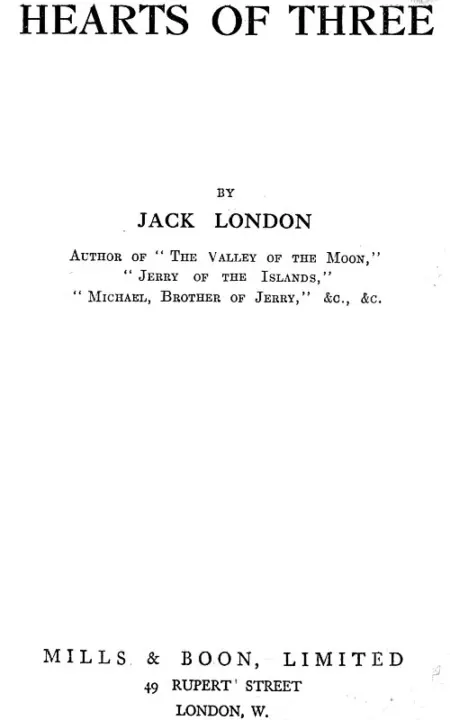
Hearts of three
Jack London
THE CLASSIC COLLECTION · 1910
"Theft: A Play In Four Acts" by Jack London is a dramatic work written in the early 20th century. The play unfolds within the political arena of Washington D.C., focusing primarily on the lives of Senator Chalmers, his wife Margaret, and the reformist congressman Howard Knox. Themes of power, ethics, and societal justice circulate throughout the narrative, posing significant questions about morality and the implications of wealth in governance. At the start of the play, the characters are introduced in a series of interactions that highlight the tension between wealth and reform. In the first act, Senator Chalmers and the journalist Hubbard plot to discredit Howard Knox, who poses a threat to their political power with his radical ideas. Margaret Chalmers is revealed as a woman caught between her loyalties to her influential father and her admiration for Knox's progressive ideals. The opening establishes a landscape ripe for conflict, hinting at imminent political machinations and personal dilemmas that intertwine as the plot unfolds, especially with the impending speech that Knox plans to deliver, which may jeopardize the status quo.
Introduction adapted from the source catalogue; source summaries may be automatically generated.
Free to read · English · 32,237 words · No account needed
MAKE TIME FOR A GOOD BOOK
On by default. Untick to stop anonymous reading totals. Each page counts after 10 seconds in view. How this works.
Anonymous counting is on unless you have switched it off.
Oh, by the way, just a little friendly warning, Senator Chalmers. Not so fast and loose up New York way. That certain lady, not to be mentioned--there's gossip about it in the New York newspaper offices. Of course, all such stories are killed. But be discreet, be discreet If Gherst gets hold of it, he'll play it up against the Administration in all his papers.
(Chalmers, who throughout this speech is showing a growing resentment, is about to speak, when voices are heard without and he checks himself.)
(Enter. Mrs. Starkweather, rather flustered and imminently in danger of a collapse, followed by Connie Starkweather, fresh, radiant, and joyous.)
{Mrs. Starkweather}
(With appeal and relief.)
Oh----Tom!
(Chalmers takes her hand sympathetically and protectingly.)
{Connie}
(Who is an exuberant young woman, bursts forth.) Oh, brother-in-law! Such excitement! That's what's the matter with mother. We ran into a go-cart. Our chauffeur was not to blame. It was the woman's fault. She tried to cross just as we were turning the corner. But we hardly grazed it. Fortunately the baby was not hurt--only spilled. It was ridiculous. (Catching sight of Hubbard.) Oh, there you are, Mr. Hubbard. How de do.
(Steps half way to meet him and shakes hands with him.) (Mrs. Starkweather looks around helplessly for a chair, and Chalmers conducts her to one soothingly.)
{Mrs. Starkweather}
Oh, it was terrible! The little child might have been killed. And such persons love their babies, I know.
{Connie}
(To Chalmers.) Has father come? We were to pick him up here.
Where's Madge?
{Mrs. Starkweather}
(Espying Hubbard, faintly.) Oh, there is Mr. Hubbard.
(Hubbard comes to her and shakes hands.) I simply can't get used to these rapid ways of modern life. The motor-car is the invention of the devil. Everything is too quick. When I was a girl, we lived sedately, decorously. There was time for meditation and repose. But in this age there is time for nothing. How Anthony keeps his head is more than I can understand. But, then, Anthony is a wonderful man.
{Hubbard}
I am sure Mr. Starkweather never lost his head in his life.
{Chalmers}
Unless when he was courting you, mother.
{Mrs. Starkweather}
(A trifle grimly.) I'm not so sure about that.
{Connie}
(Imitating a grave, business-like enunciation.) Father probably conferred first with his associates, then turned the affair over for consideration by his corporation lawyers, and, when they reported no flaws, checked the first spare half hour in his notebook to ask mother if she would have him.
(They laugh.) And looked at his watch at least twice while he was
proposing.
{Mrs. Starkweather}
Anthony was not so busy then as all that.
{Hubbard}
Your reading position is saved on this browser. Take it to another device with a library code. Reading pages adapt to text, rather than matching a printed edition.
Jack London
Jack London
Jack London
Jack London
BEHIND THE BOOK
This eBook is for the use of anyone anywhere in the United States and most other parts of the world at no cost and with almost no restrictions whatsoever. You may copy it, give it away or re-use it under the terms of the Project Gutenberg License included with this eBook or online at www.gutenberg.org. If you are not located in the United States, you will have to check the laws of the country where you are located before using this eBook. Read the source licence.
The original source file, including credits and licence, is retained by this library. Request an original-format copy at no charge. Please include the book title and Project Gutenberg identifier #21936.
KEEP YOUR CURIOSITY GOING
Maurice Baring
W. B. (William Butler) Yeats
Edward Martyn

John Brougham & Charlotte Brontë
Marguerite Merington
Leonid Andreyev