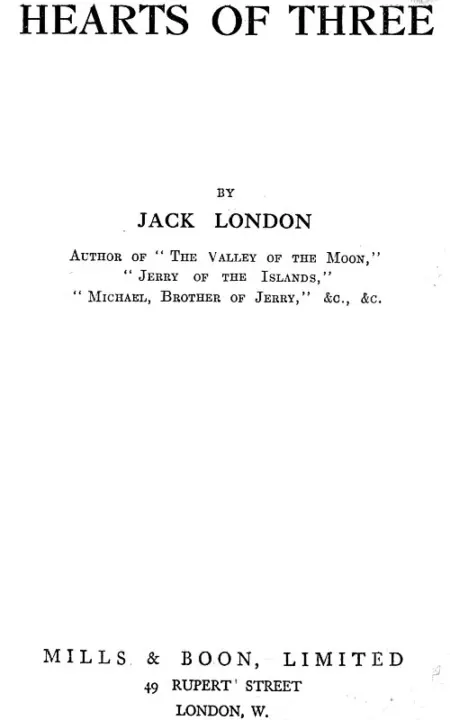
Hearts of three
Jack London
THE CLASSIC COLLECTION · 1910
"Theft: A Play In Four Acts" by Jack London is a dramatic work written in the early 20th century. The play unfolds within the political arena of Washington D.C., focusing primarily on the lives of Senator Chalmers, his wife Margaret, and the reformist congressman Howard Knox. Themes of power, ethics, and societal justice circulate throughout the narrative, posing significant questions about morality and the implications of wealth in governance. At the start of the play, the characters are introduced in a series of interactions that highlight the tension between wealth and reform. In the first act, Senator Chalmers and the journalist Hubbard plot to discredit Howard Knox, who poses a threat to their political power with his radical ideas. Margaret Chalmers is revealed as a woman caught between her loyalties to her influential father and her admiration for Knox's progressive ideals. The opening establishes a landscape ripe for conflict, hinting at imminent political machinations and personal dilemmas that intertwine as the plot unfolds, especially with the impending speech that Knox plans to deliver, which may jeopardize the status quo.
Introduction adapted from the source catalogue; source summaries may be automatically generated.
Free to read · English · 32,237 words · No account needed
MAKE TIME FOR A GOOD BOOK
On by default. Untick to stop anonymous reading totals. Each page counts after 10 seconds in view. How this works.
Anonymous counting is on unless you have switched it off.
I am not going now. You and Connie take the car.
{Mrs. Starkweather}
You mustn't forget you are going to that dinner.
{Starkweather}
(Wearily.) Do I ever forget?
(Servant enters and proceeds toward Starkweather, where he stands waiting while Mrs. Starkweather finishes the next speech. Starkweather listens to her with a patient, stony face.)
{Mrs. Starkweather}
Oh, these everlasting politics! That is what it has been all afternoon--high prices, graft, and theft; theft, graft, and high prices. It is terrible. When I was a girl we did not talk of such things. Well, come on, Connie.
{Mrs. Dowsett}
(Rising and glancing at Dowsett.) And we must be going, too.
(During the following scene, which takes place around
Starkweather, Margaret is saying good-bye to her departing
guests.)
(Mrs. Starkweather and Connie make exit.)
(Dowsett and Mrs. Dowsett make exit.)
(The instant Mrs. Dowsett's remark puts a complete end to Mrs. Starkweather's speech, Starkweather, without answer or noticing his wife, turns and interrogates Servant with a glance.)
{Servant}
Mr. Dobleman has already left some time to come here, sir.
{Starkweather}
Show him in as soon as he comes.
{Servant}
Yes, sir.
(Servant makes exit.)
(Margaret, Dolores Ortega, and Rutland are left in a group together, this time around tea-table, where Margaret serves Rutland another cup of tea. From time to time Margaret glances curiously at the serious group of men across the stage.)
(Starkweather is thinking hard with knitted brows. Hubbard is
likewise pondering.)
{Chalmers}
If I were certain Knox had those papers I would take him by the throat and shake them out of him.
{Starkweather}
No foolish talk like that, Tom. This is a serious matter.
{Hubbard}
But Knox has no money. A Starkweather stenographer comes high.
{Starkweather}
There is more than Knox behind this. (Enter Dobleman, walking quickly and in a state of controlled excitement.)
{Dobleman}
(To Starkweather.) You received that telegram, sir?
(Starkweather nods.) I got the New York office--Martinaw--right
along afterward, by long distance. I thought best to follow and
tell you.
{Starkweather}
What did Martinaw say?
{Dobleman}
The files seem in perfect order.
{Starkweather}
Thank God!
(During the following speech of Dobleman, Rutland says good-bye to Margaret and Dolores Ortega and makes exit.)
(Margaret and Dolores Ortega rise a minute afterward and
go toward exit, throwing curious glances at the men but not
disturbing them.)
(Dolores Ortega makes exit.)
(Margaret pauses in doorway a moment, giving a final anxious glance at the men, and makes exit.)
{Dobleman}
Your reading position is saved on this browser. Take it to another device with a library code. Reading pages adapt to text, rather than matching a printed edition.
Jack London
Jack London
Jack London
Jack London
BEHIND THE BOOK
This eBook is for the use of anyone anywhere in the United States and most other parts of the world at no cost and with almost no restrictions whatsoever. You may copy it, give it away or re-use it under the terms of the Project Gutenberg License included with this eBook or online at www.gutenberg.org. If you are not located in the United States, you will have to check the laws of the country where you are located before using this eBook. Read the source licence.
The original source file, including credits and licence, is retained by this library. Request an original-format copy at no charge. Please include the book title and Project Gutenberg identifier #21936.
KEEP YOUR CURIOSITY GOING
Maurice Baring
W. B. (William Butler) Yeats
Edward Martyn

John Brougham & Charlotte Brontë
Marguerite Merington
Leonid Andreyev