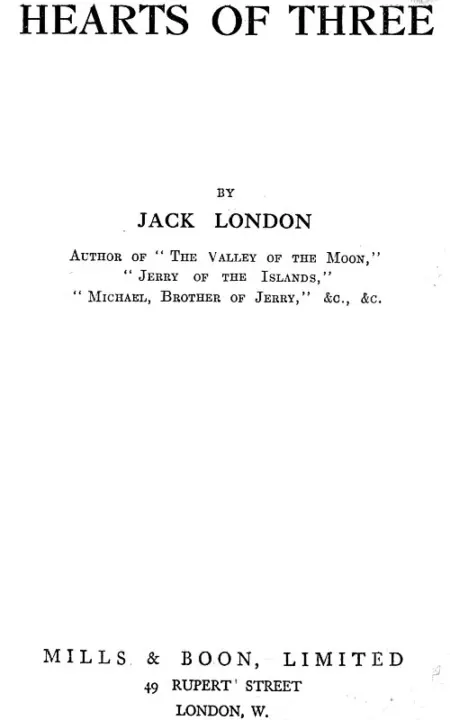
Hearts of three
Jack London
THE CLASSIC COLLECTION · 1910
"Theft: A Play In Four Acts" by Jack London is a dramatic work written in the early 20th century. The play unfolds within the political arena of Washington D.C., focusing primarily on the lives of Senator Chalmers, his wife Margaret, and the reformist congressman Howard Knox. Themes of power, ethics, and societal justice circulate throughout the narrative, posing significant questions about morality and the implications of wealth in governance. At the start of the play, the characters are introduced in a series of interactions that highlight the tension between wealth and reform. In the first act, Senator Chalmers and the journalist Hubbard plot to discredit Howard Knox, who poses a threat to their political power with his radical ideas. Margaret Chalmers is revealed as a woman caught between her loyalties to her influential father and her admiration for Knox's progressive ideals. The opening establishes a landscape ripe for conflict, hinting at imminent political machinations and personal dilemmas that intertwine as the plot unfolds, especially with the impending speech that Knox plans to deliver, which may jeopardize the status quo.
Introduction adapted from the source catalogue; source summaries may be automatically generated.
Free to read · English · 32,237 words · No account needed
MAKE TIME FOR A GOOD BOOK
On by default. Untick to stop anonymous reading totals. Each page counts after 10 seconds in view. How this works.
Anonymous counting is on unless you have switched it off.
Mr. Sakari suggested that himself, and when I agreed with him he proceeded to demolish it. He has treated me dreadfully.
{Rutland}
(Clearing his throat and expressing himself with ponderous unction.) You will find the solution in the drink traffic. It is liquor, alcohol, that is undermining our industry, our institutions, our faith in God--everything. Yearly the working people drink greater quantities of alcohol. Naturally, through resulting inefficiency, the cost of production is higher, and therefore prices are higher.
{Dowsett}
Partly so, partly so. And in line with it, and in addition to it, prices are high because the working class is no longer thrifty. If our working class saved as the French peasant does, we would sell more in the world market and have better times.
{Sakari} (Bowing.) As I understand it then, the more thrifty you are the more you save, and the more you save the more you have to sell, the more you sell, the better the times?
{Dowsett}
Exactly so. Exactly.
{Sakari}
The less you sell, the harder are the times?
{Dowsett}
Just so.
{Sakari}
Then if the people are thrifty, and buy less, times will be
harder?
{Dowsett}
(Perplexed.) Er--it would seem so.
{Sakari}
Then it would seem that the present bad times are due to the fact that the people are thrifty, rather than not thrifty?
(Dowsett is nonplussed, and Mrs. Dowsett throws up her hands in
despair.)
{Mrs. Dowsett}
(Turning to Knox.) Perhaps you can explain to us, Mr. Knox, the reason for this terrible condition of affairs.
(Starkweather closes note-book on finger and listens.) (Knox
smiles, but does not speak.)
{Dolores Ortega}
Please do, Mr. Knox. I am so dreadfully anxious to know why
living is so high now. Only this morning I understand meat went
up again.
(Knox hesitates and looks questioningly at Margaret.)
{Hubbard}
I am sure Mr. Knox can shed new light on this perplexing problem.
{Chalmers}
Surely you, the whirlwind of oratorical swords in the House, are
not timid here--among friends.
{Knox} (Sparring.) I had no idea that questions of such nature were topics of conversation at affairs like this.
{Starkweather}
(Abruptly and imperatively.) What causes the high prices?
{Knox}
(Equally abrupt and just as positive as the other was
imperative.) Theft!
(It is a sort of a bombshell he has exploded, but they receive it politely and smilingly, even though it has shaken them up.)
{Dolores Ortega}
What a romantic explanation. I suppose everybody who has anything
has stolen it.
{Knox}
Your reading position is saved on this browser. Take it to another device with a library code. Reading pages adapt to text, rather than matching a printed edition.
Jack London
Jack London
Jack London
Jack London
BEHIND THE BOOK
This eBook is for the use of anyone anywhere in the United States and most other parts of the world at no cost and with almost no restrictions whatsoever. You may copy it, give it away or re-use it under the terms of the Project Gutenberg License included with this eBook or online at www.gutenberg.org. If you are not located in the United States, you will have to check the laws of the country where you are located before using this eBook. Read the source licence.
The original source file, including credits and licence, is retained by this library. Request an original-format copy at no charge. Please include the book title and Project Gutenberg identifier #21936.
KEEP YOUR CURIOSITY GOING
Maurice Baring
W. B. (William Butler) Yeats
Edward Martyn

John Brougham & Charlotte Brontë
Marguerite Merington
Leonid Andreyev