THE CLASSIC COLLECTION✦More TriviaCLASSIC FREE BOOKS
More Trivia
Logan Pearsall Smith
THE CLASSIC COLLECTION · 1895
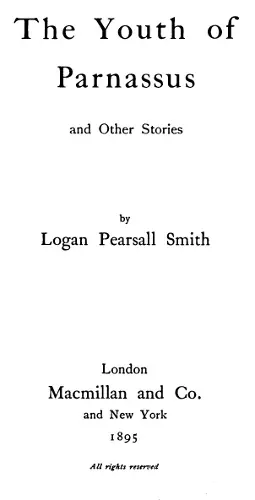
"The Youth of Parnassus and Other Stories" by Logan Pearsall Smith is a collection of short stories written in the late 19th century. The stories explore various themes surrounding youth, education, and cultural contrasts, particularly focusing on the experiences of Eliaphet Sutton, a young American studying at Oxford. The intersecting lives of this sensitive, introspective character and his British acquaintance Foley provide a rich backdrop for reflections on identity, belonging, and the impact of one's environment. The opening of the collection introduces Eliaphet Sutton as he arrives at Oxford from Parnassus City, Indiana. He grapples with his new surroundings, which he finds both fascinating and strange, especially the stark cultural differences between his American upbringing and the traditions of Oxford. The narrative details his initial encounters with British customs through the eyes of Foley, who represents the established world of Oxford. The friendship that develops between them reflects Sutton's internal struggle as he tries to find his place in this historic academic environment. The text captures Sutton’s awkward adjustments, his idealism, as well as the affection and misgivings he harbors towards his new life, setting the stage for the ensuing exploration of cultural and personal themes throughout the collection.
Introduction adapted from the source catalogue; source summaries may be automatically generated.
Free to read · English · 35,844 words · No account needed
MAKE TIME FOR A GOOD BOOK
On by default. Untick to stop anonymous reading totals. Each page counts after 10 seconds in view. How this works.
Anonymous counting is on unless you have switched it off.
Well no, honestly, it wasn't very comfortable, Allen replied. To tell the truth, he was rather disappointed in the place. He had gone there after hearing some undergraduates describe it, and tell how amusing they had found the people. But, somehow, he had not found the people different from people anywhere else. But then he had only made the acquaintance of one man--
"Well, didn't he turn out to be an old poacher, or a gipsy, or something romantic?" asked Mrs. Ross.
"No, not at all--he was a Methodist Calvinist deacon, who gave me a lift one wet afternoon, and lectured me all the way about Temperance. And, of course," Allen added, with rather a comic smile, "and, of course, I was already a total abstainer." They all laughed at this.
What was he working at over there? Ross asked him a few minutes afterwards. He was writing a paper, Allen replied; but what it was about Mrs. Ross did not understand. She hoped her husband would ask something more, but he merely said, "I see," without much interest, adding that he had not read any philosophy for years.
When they sat down to dinner, the lady's evening dress, the silver and flowers on the table, seemed to make Allen all the more awkward and conscious of his appearance. However, he plainly meant to do his best to talk, and, after a moment's silence, he remarked that he supposed the theory of farming was very interesting.
"Yes, it is," said Mrs. Ross, "and it's such fun ploughing in the autumn, and in the spring seeing the young green things come up."
"I suppose the climate is a great factor in the problem."
"Oh, of course, everything depends on that; suppose it comes on to rain just when you've cut your hay!"
Ross began to laugh. "I believe my wife thinks of nothing but hay now."
"You farm yourself, don't you?" Allen asked, looking at her rather
timidly.
"Oh, a little; I always say I manage our little farm, and I'm going to learn to plough. And I keep chickens--this is one of mine--poor little thing!" she added.
"She pretends to be sorry now, but when she has a chance to sell her chickens I never saw anyone so bloodthirsty."
"Oh, George, how can you say such things? Don't believe him, Mr. Allen. And anyhow," she added (it seemed a platitude, but platitudes were better than absolute silence), "anyhow, I suppose it is what the chickens are meant for."
Your reading position is saved on this browser. Take it to another device with a library code. Reading pages adapt to text, rather than matching a printed edition.
Logan Pearsall Smith
Logan Pearsall Smith
BEHIND THE BOOK
This eBook is for the use of anyone anywhere in the United States and most other parts of the world at no cost and with almost no restrictions whatsoever. You may copy it, give it away or re-use it under the terms of the Project Gutenberg License included with this eBook or online at www.gutenberg.org. If you are not located in the United States, you will have to check the laws of the country where you are located before using this eBook. Read the source licence.
The original source file, including credits and licence, is retained by this library. Request an original-format copy at no charge. Please include the book title and Project Gutenberg identifier #41682.
KEEP YOUR CURIOSITY GOING
Coulson Kernahan

Maurice Baring
Frances Wright
Cécile Tormay

Frederic Jesup Stimson

W. H. P. (William Henry Pope) Jarvis