THE CLASSIC COLLECTION✦More TriviaCLASSIC FREE BOOKS
More Trivia
Logan Pearsall Smith
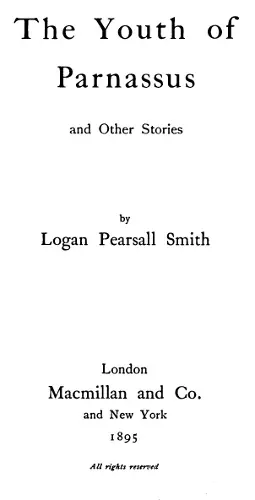
THE CLASSIC COLLECTION · 1895
"The Youth of Parnassus and Other Stories" by Logan Pearsall Smith is a collection of short stories written in the late 19th century. The stories explore various themes surrounding youth, education, and cultural contrasts, particularly focusing on the experiences of Eliaphet Sutton, a young American studying at Oxford. The intersecting lives of this sensitive, introspective character and his British acquaintance Foley provide a rich backdrop for reflections on identity, belonging, and the impact of one's environment. The opening of the collection introduces Eliaphet Sutton as he arrives at Oxford from Parnassus City, Indiana. He grapples with his new surroundings, which he finds both fascinating and strange, especially the stark cultural differences between his American upbringing and the traditions of Oxford. The narrative details his initial encounters with British customs through the eyes of Foley, who represents the established world of Oxford. The friendship that develops between them reflects Sutton's internal struggle as he tries to find his place in this historic academic environment. The text captures Sutton’s awkward adjustments, his idealism, as well as the affection and misgivings he harbors towards his new life, setting the stage for the ensuing exploration of cultural and personal themes throughout the collection.
Introduction adapted from the source catalogue; source summaries may be automatically generated.
Free to read · English · 35,844 words · No account needed
MAKE TIME FOR A GOOD BOOK
On by default. Untick to stop anonymous reading totals. Each page counts after 10 seconds in view. How this works.
Anonymous counting is on unless you have switched it off.
"Well, then, you ought to be! Imagine being so frivolous in a solemn place like this. Tell me, you study philosophy, don't you? It must be splendid; I do envy you so! When I am in a place like Oxford I feel so frivolous, somehow, and ignorant. Why, I feel afraid--" Then after a moment's charming hesitation, "Yes, quite afraid to talk to clever people. You mustn't mind what I say, will you?"
"But I'm not clever!" he exclaimed. "Why--"
"Oh, but Mr. Craik! Why, you've written a book!"
"But that's nothing. And it's only a sort of study, nothing really."
"I wish I could read it."
"Oh no! don't try; it's a stupid thing, only meant for students."
Miss Lamb paused, and, turning her eyes to Craik with a look full of reproach, she said: "Ah! you are like the others, you don't think I am serious; you think I would not understand it!"
"Oh no, not that!" Craik urged in quick distress. "You would understand it, of course, what there is to understand. I only meant," he stammered, "I only meant that it was not well written, not interesting--not really worth reading, I mean."
"Oh, I'm sure it is worth reading, and I hear it's so clever. It is about Asia Minor, isn't it. Asia Minor is so interesting; I wish you would tell me something about it, and about your work. Do you like it here? Of course you do. Have you been in Oxford long?"
For a third time they passed round the cloister square, loitering with slow footsteps, through the old arches and past the epitaphs of the ancient celibate Fellows, and Craik, talking with an unreserve that was intimate and sudden, and yet somehow seemed quite natural to him, told about his work, and the writing of his book. Then, in answer to a question of Miss Lamb's, he described his quiet bringing up in an obsolete old town where his parents were tradespeople; his early schooling, how he had come to Oxford on a scholarship, and how he had stayed there ever since, living in the same College, his parents having died, and the Logic tutorship being offered to him just when he had taken his degree. So he seemed to have lived a long while there, in that sleepy old College, within its high walls and buildings: as an undergraduate first, busy and almost solitary, save for a few friends similar to himself; then as a tutor, still more busy with his work, and still more solitary; and above all, during the last few years, when all his thought and leisure had been given to his book on Ionic philosophers. How many years was it altogether? Eight; no, ten. And then, as she seemed to be really interested, he gave a sketch, half humorous and half serious, of his life in College, his amusements, his walks with Ranken. A bare, monastic life it seemed to himself when he came to describe it. So little to tell of in so many years; and how long ago it seemed!
Your reading position is saved on this browser. Take it to another device with a library code. Reading pages adapt to text, rather than matching a printed edition.
Logan Pearsall Smith
Logan Pearsall Smith
BEHIND THE BOOK
This eBook is for the use of anyone anywhere in the United States and most other parts of the world at no cost and with almost no restrictions whatsoever. You may copy it, give it away or re-use it under the terms of the Project Gutenberg License included with this eBook or online at www.gutenberg.org. If you are not located in the United States, you will have to check the laws of the country where you are located before using this eBook. Read the source licence.
The original source file, including credits and licence, is retained by this library. Request an original-format copy at no charge. Please include the book title and Project Gutenberg identifier #41682.
KEEP YOUR CURIOSITY GOING
Coulson Kernahan

Maurice Baring
Frances Wright
Cécile Tormay

Frederic Jesup Stimson

W. H. P. (William Henry Pope) Jarvis