THE CLASSIC COLLECTION✦More TriviaCLASSIC FREE BOOKS
More Trivia
Logan Pearsall Smith
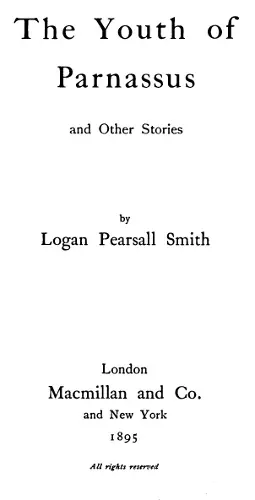
THE CLASSIC COLLECTION · 1895
"The Youth of Parnassus and Other Stories" by Logan Pearsall Smith is a collection of short stories written in the late 19th century. The stories explore various themes surrounding youth, education, and cultural contrasts, particularly focusing on the experiences of Eliaphet Sutton, a young American studying at Oxford. The intersecting lives of this sensitive, introspective character and his British acquaintance Foley provide a rich backdrop for reflections on identity, belonging, and the impact of one's environment. The opening of the collection introduces Eliaphet Sutton as he arrives at Oxford from Parnassus City, Indiana. He grapples with his new surroundings, which he finds both fascinating and strange, especially the stark cultural differences between his American upbringing and the traditions of Oxford. The narrative details his initial encounters with British customs through the eyes of Foley, who represents the established world of Oxford. The friendship that develops between them reflects Sutton's internal struggle as he tries to find his place in this historic academic environment. The text captures Sutton’s awkward adjustments, his idealism, as well as the affection and misgivings he harbors towards his new life, setting the stage for the ensuing exploration of cultural and personal themes throughout the collection.
Introduction adapted from the source catalogue; source summaries may be automatically generated.
Free to read · English · 35,844 words · No account needed
MAKE TIME FOR A GOOD BOOK
On by default. Untick to stop anonymous reading totals. Each page counts after 10 seconds in view. How this works.
Anonymous counting is on unless you have switched it off.
He was afraid he wouldn't have the time, he said.
"Oh, what a pity, you ought to come," she cried; but her voice was hushed when, out of the glare and sunshine, they went into the blue obscurity, the cool old smell and quiet of the chapel.
The ladies looked at the windows, the religious carving; and their movement, as they went about, filled with a rustling sound the vacant silence of the place. Then they all gathered in a group while one of the Fellows told them something of the history of the chapel: how it had been built in the fourteenth century, and how ever since then the members of the College had worshipped there, and among them many whose names had afterwards grown famous.
"Tell me," Ruth Ellwood whispered, as they walked away, "is this where the undergraduates sit; where do you sit?" He showed her the Scholars' seats, and the old brass eagle from which they read the lessons, and then, when they went through the ante-chapel, she paused a moment, looking at the inscriptions and monuments.
"Were there any nice old epitaphs?" she asked. "Do show them to me, if
there are."
The rest of the party had left the chapel, but could still be seen through the open door standing not far off in the sunshine, and the gossip of their voices came in faintly now and then.
The old brasses, dating from Gothic times, bore inscriptions in rhyming Latin, that Rutherford read and translated to his companion; there were monuments of a later time, adorned with urns, cherubs, and garlands--old trappings of death that made death itself seem almost quaint and charming. But in the seventeenth century the tranquil records of the scholars' lives were disturbed by echoes of old war and exile. "Reader, look to thy feet! Honest and Loyal men are sleeping under Thee," one inscription ran; and the name of more than one was recorded "who, when Loyalty and the Church fainted, lay down and Died."
Other monuments were put up to the memory of young men who had died at College. Well-born and modest, the old Latin described them, and dead, centuries ago, in the flower of their fruitless years. "Vivere dulce fuit!" one of them had complained, as four hundred years before, in florid Latin, he bade farewell to youth and hope.
Of another it was quaintly said, "Talis erat vita, qualis stylus, elegans et pura"; while another undergraduate's virtues were recorded in verses ending with the line,
"Expertus praedico, tutor eram."
Then there was an inscription in English verse, from some Cavalier poet,
Rutherford thought,
Your reading position is saved on this browser. Take it to another device with a library code. Reading pages adapt to text, rather than matching a printed edition.
Logan Pearsall Smith
Logan Pearsall Smith
BEHIND THE BOOK
This eBook is for the use of anyone anywhere in the United States and most other parts of the world at no cost and with almost no restrictions whatsoever. You may copy it, give it away or re-use it under the terms of the Project Gutenberg License included with this eBook or online at www.gutenberg.org. If you are not located in the United States, you will have to check the laws of the country where you are located before using this eBook. Read the source licence.
The original source file, including credits and licence, is retained by this library. Request an original-format copy at no charge. Please include the book title and Project Gutenberg identifier #41682.
KEEP YOUR CURIOSITY GOING
Coulson Kernahan

Maurice Baring
Frances Wright
Cécile Tormay

Frederic Jesup Stimson

W. H. P. (William Henry Pope) Jarvis