THE CLASSIC COLLECTION✦More TriviaCLASSIC FREE BOOKS
More Trivia
Logan Pearsall Smith
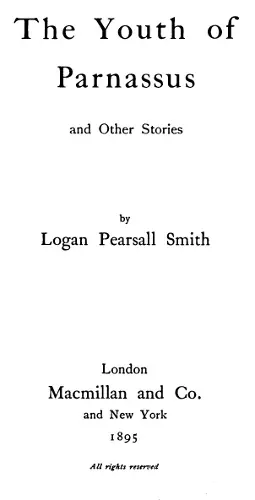
THE CLASSIC COLLECTION · 1895
"The Youth of Parnassus and Other Stories" by Logan Pearsall Smith is a collection of short stories written in the late 19th century. The stories explore various themes surrounding youth, education, and cultural contrasts, particularly focusing on the experiences of Eliaphet Sutton, a young American studying at Oxford. The intersecting lives of this sensitive, introspective character and his British acquaintance Foley provide a rich backdrop for reflections on identity, belonging, and the impact of one's environment. The opening of the collection introduces Eliaphet Sutton as he arrives at Oxford from Parnassus City, Indiana. He grapples with his new surroundings, which he finds both fascinating and strange, especially the stark cultural differences between his American upbringing and the traditions of Oxford. The narrative details his initial encounters with British customs through the eyes of Foley, who represents the established world of Oxford. The friendship that develops between them reflects Sutton's internal struggle as he tries to find his place in this historic academic environment. The text captures Sutton’s awkward adjustments, his idealism, as well as the affection and misgivings he harbors towards his new life, setting the stage for the ensuing exploration of cultural and personal themes throughout the collection.
Introduction adapted from the source catalogue; source summaries may be automatically generated.
Free to read · English · 35,844 words · No account needed
MAKE TIME FOR A GOOD BOOK
On by default. Untick to stop anonymous reading totals. Each page counts after 10 seconds in view. How this works.
Anonymous counting is on unless you have switched it off.
Yes, there must be a good deal, Ames admitted doubtfully; at least everyone seemed very much occupied there.
"All I want is some work, that isn't too much grind, and decent pay."
"Ah, that is all that most people want," Ames observed, with half a
sigh.
"Of course at first I shouldn't expect anything very much," Waters went on, hardly heeding his tutor's vague remarks; and he explained again that he only wanted some decent occupation, with pay enough to live on. Then he waited, gazing at his tutor's blank face as one might gaze at a revolving lighthouse, waiting for its flash of light. As nothing came, however, he said, "Surely there are lots of places where they want Oxford men?"
"Possibly there were"; Ames looked as if he, however, had never heard of
them.
"But Grant and Vaughan had got good places, and Sturdy, they said, was
doing well at the Bar."
"Ah, I see you mean those clever men, who do so well in the Schools and all. You're quite right; a man like Cornish for instance; I thought you meant more the average man."
No, it wasn't Cornish, Waters meant; it wasn't the average man either. "I mean more the man--what you call an all-round-man."
"What I call an all-round-man?" Ames looked bewildered.
"I mean," Waters continued, with desperate efforts to explain himself, "I mean the man who is rather good all round, rows, and that sort of thing. Perhaps he didn't get a First; didn't care much what he got, didn't approve of the system."
Ames seemed busy looking for his glasses.
"There are people who don't approve of the system," Waters went on. "I read an article once by someone, Professor something, not approving of examinations. I forget just who it was."
"Professor Freeman, perhaps?"
"Yes, that's it! Well now, a man like that, what is he going to do?" Waters asked, with renewed confidence.
"But Professor Freeman is dead, you know."
"But,--but,--I'm not speaking of Professor Freeman."
"How would you like to be a solicitor?" Ames asked, putting on his
glasses.
"A solicitor! oh, I shouldn't care for that," Waters promptly replied. "You see it isn't the kind of work I like, and then the vacations are too short."
Ames said nothing. He was sitting unusually still, and his large glasses reflecting the light, resembled two enormous shining oval eyes in the smoothness of his face. What he was really looking at Waters could not tell, and he grew more and more uncomfortable. At last, with diminished confidence, "There are men who get on well at the Bar?" he said.
"There are."
Your reading position is saved on this browser. Take it to another device with a library code. Reading pages adapt to text, rather than matching a printed edition.
Logan Pearsall Smith
Logan Pearsall Smith
BEHIND THE BOOK
This eBook is for the use of anyone anywhere in the United States and most other parts of the world at no cost and with almost no restrictions whatsoever. You may copy it, give it away or re-use it under the terms of the Project Gutenberg License included with this eBook or online at www.gutenberg.org. If you are not located in the United States, you will have to check the laws of the country where you are located before using this eBook. Read the source licence.
The original source file, including credits and licence, is retained by this library. Request an original-format copy at no charge. Please include the book title and Project Gutenberg identifier #41682.
KEEP YOUR CURIOSITY GOING
Coulson Kernahan

Maurice Baring
Frances Wright
Cécile Tormay

Frederic Jesup Stimson

W. H. P. (William Henry Pope) Jarvis