
Last letters from the living dead man
David Patterson (Spirit) Hatch
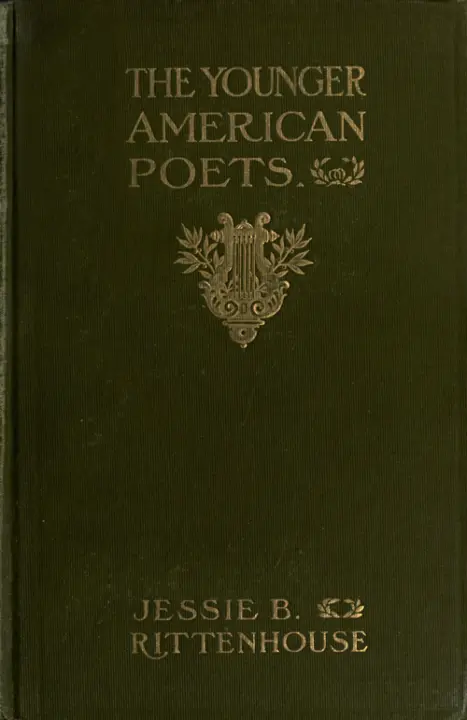
THE CLASSIC COLLECTION · 1904
"The Younger American Poets" by Jessie Belle Rittenhouse is a collection of literary studies written in the early 20th century. This work delves into the poetry of a selection of younger American poets, exploring their contributions and distinct styles within the broader context of contemporary poetry. Rittenhouse offers insight into the thematic elements and individual characteristics of these poets, likely focusing on their artistic approaches and the socio-cultural conditions of their time. The beginning of this collection introduces Richard Hovey, characterizing him as a poet grounded in convictions and comradeship rather than mere whimsies of rhyme. Hovey is depicted as an artist deeply engaged with the essence of life, capturing the vibrancy of nature alongside themes of human connection and national pride. Rittenhouse highlights specific works and ideas from Hovey, noting his Whitmanesque influence while asserting his unique voice that emphasizes a harmonious relationship with the world around him. This opening segment sets the stage for further explorations of the varied styles and themes represented by the younger poets discussed in the subsequent chapters.
Introduction adapted from the source catalogue; source summaries may be automatically generated.
Free to read · English · 71,656 words · No account needed
MAKE TIME FOR A GOOD BOOK
On by default. Untick to stop anonymous reading totals. Each page counts after 10 seconds in view. How this works.
Anonymous counting is on unless you have switched it off.
And he set the name in my heart
For an unextinguished fire,
O wild, dark flower of woman,
Deep rose of my desire!
Metrically the poem jars in the line,
And breathed them into your soul,
departing as it does from the general scheme of the third lines, and rendering it necessary to make “soul” bisyllabic in order to carry the metre smoothly, and in accord with its companion verses. “Spirit” would have fitted the metrical exigency better, leaving the final unaccented syllable as in the majority of the lines, but would not have lent itself to repetition in the succeeding line as does “soul,”—so “who shall arbitrate”? Mr. Roberts rarely offends the ear in his metres, but instead his cadences are notably true.
Aside from the poems upon love, filling the first division of The Book of the Rose it has a miscellaneous group, of which the two that best represent it, to my fancy, are so widely diverse that their mere mention in juxtaposition is amusing; nevertheless they are the lines “To An Omar Punch Bowl,” and the reverent Nativity Song, “When Mary, the Mother, Kissed the Child.” The haunting couplets of the former are by no means of the convivial sort, but the essence of memory and desire, the pathos of this dust that is but “wind that hurries by,”—is in them. However, to be quoted, they need their full context, as does the Nativity Song mentioned.
Mr. Roberts has a rare sympathy with childhood, and a gift of reaching the hearts of the little ones; the “Sleepy Man” and “Wake-up Song” could scarcely be improved; note the picturing in the former and the drowsihood in its falling cadences:
When the Sleepy Man comes with the dust on his eyes
(Oh, weary, my Dearie, so weary!)
He shuts up the earth, and he opens the skies.
(So hush-a-by, weary my Dearie!)
He smiles through his fingers, and shuts up the sun;
(Oh, weary, my Dearie, so weary!)
The stars that he loves he lets out one by one.
(So hush-a-by, weary my Dearie!)
He comes from the castles of Drowsy-boy Town;
(Oh, weary, my Dearie, so weary!)
At the touch of his hand the tired eyelids fall down.
(So hush-a-by, weary my Dearie!)
Then the top is a burden, the bugle a bane,
(Oh, weary, my Dearie, so weary!)
When one would be faring down Dream-a-way Lane.
(So hush-a-by, weary my Dearie!)
When one would be wending in Lullaby Wherry
(Oh, weary, my Dearie, so weary!)
To Sleepy Man’s Castle by Comforting Ferry.
(So hush-a-by, weary my Dearie!)
Your reading position is saved on this browser. Take it to another device with a library code. Reading pages adapt to text, rather than matching a printed edition.
BEHIND THE BOOK
This eBook is for the use of anyone anywhere in the United States and most other parts of the world at no cost and with almost no restrictions whatsoever. You may copy it, give it away or re-use it under the terms of the Project Gutenberg License included with this eBook or online at www.gutenberg.org. If you are not located in the United States, you will have to check the laws of the country where you are located before using this eBook. Read the source licence.
The original source file, including credits and licence, is retained by this library. Request an original-format copy at no charge. Please include the book title and Project Gutenberg identifier #55447.
KEEP YOUR CURIOSITY GOING
David Patterson (Spirit) Hatch

David Patterson (Spirit) Hatch

David Patterson (Spirit) Hatch
Cécile Tormay

Moritz Busch
John L. Ransom