
Last letters from the living dead man
David Patterson (Spirit) Hatch
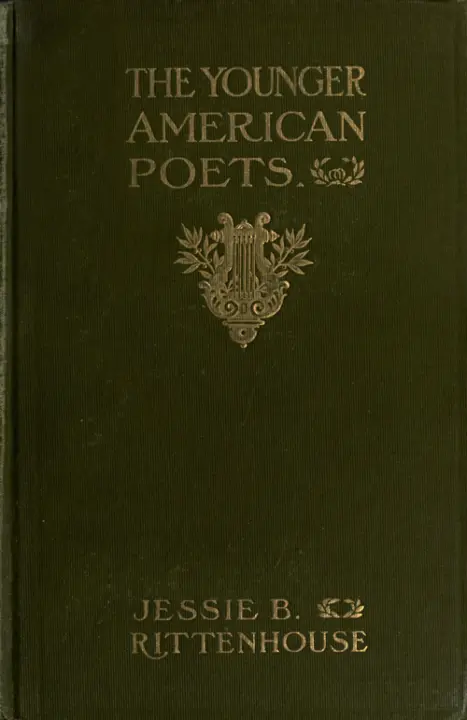
THE CLASSIC COLLECTION · 1904
"The Younger American Poets" by Jessie Belle Rittenhouse is a collection of literary studies written in the early 20th century. This work delves into the poetry of a selection of younger American poets, exploring their contributions and distinct styles within the broader context of contemporary poetry. Rittenhouse offers insight into the thematic elements and individual characteristics of these poets, likely focusing on their artistic approaches and the socio-cultural conditions of their time. The beginning of this collection introduces Richard Hovey, characterizing him as a poet grounded in convictions and comradeship rather than mere whimsies of rhyme. Hovey is depicted as an artist deeply engaged with the essence of life, capturing the vibrancy of nature alongside themes of human connection and national pride. Rittenhouse highlights specific works and ideas from Hovey, noting his Whitmanesque influence while asserting his unique voice that emphasizes a harmonious relationship with the world around him. This opening segment sets the stage for further explorations of the varied styles and themes represented by the younger poets discussed in the subsequent chapters.
Introduction adapted from the source catalogue; source summaries may be automatically generated.
Free to read · English · 71,656 words · No account needed
MAKE TIME FOR A GOOD BOOK
On by default. Untick to stop anonymous reading totals. Each page counts after 10 seconds in view. How this works.
Anonymous counting is on unless you have switched it off.
The shuttle singeth. And fair things
Upon the web do come and go;
Dim traceries like clouds ablow
Fade into cobweb glimmerings,
A silver, fretted with small wings,—
The while a voice is singing low.
Of the eight remaining stanzas several are equally lacking in anything that may be grasped, and while there is a certain art in imaging the elusive fancies which the weavers bring, there should be some more definite fancy or ideal to embody, rather than the mere intent to make beautiful lines. This is, perhaps, an extreme instance of the over-elaboration of the first volume, though it distinguishes the long poem which gives its name to the collection, and appears in many of the lyrics.
Miss Peabody is an inventive metrist, and her sense of rhythm is highly developed, or rather it is innately correct, being manifest with equal grace in the first collection; witness the music of these stanzas from “Spinning in April”:
Moon in heaven’s garden, among the clouds that wander, Crescent moon so young to see, above the April ways, Whiten, bloom not yet, not, yet, within the twilight yonder; All my spinning is not done, for all the loitering days.
Oh, my heart has two wild wings that ever would be flying! Oh, my heart’s a meadow-lark that ever would be free! Well it is that I must spin until the light be dying; Well it is the little wheel must turn all day for me!
All the hill-tops beckon, and beyond the western meadows Something calls me ever, calls me ever, low and clear: A little tree as young as I, the coming summer shadows,— The voice of running waters that I ever thirst to hear.
Oftentime the plea of it has set my wings a-beating; Oftentime it coaxes, as I sit in weary wise, Till the wild life hastens out to wild things all entreating, And leaves me at the spinning-wheel, with dark, unseeing eyes.
The poem has several other stanzas equally charming, but which detract from the artistic structure of the song by over-spinning the thought.
Among the simple, sincere lyrics which prevail more by their feeling than mechanism, are “One That Followed,” “Horizon,” “Dew-Fall,” “Befriended,” “The Song of A Shepherd-Boy at Bethlehem,” and the two stanzas called, “After Music,” whose intimate beauty renders them personally interpretative.
I saw not they were strange, the ways I roam, Until the music called, and called me thence, And tears stirred in my heart as tears may come To lonely children straying far from home, Who know not how they wandered so, nor whence.
Your reading position is saved on this browser. Take it to another device with a library code. Reading pages adapt to text, rather than matching a printed edition.
BEHIND THE BOOK
This eBook is for the use of anyone anywhere in the United States and most other parts of the world at no cost and with almost no restrictions whatsoever. You may copy it, give it away or re-use it under the terms of the Project Gutenberg License included with this eBook or online at www.gutenberg.org. If you are not located in the United States, you will have to check the laws of the country where you are located before using this eBook. Read the source licence.
The original source file, including credits and licence, is retained by this library. Request an original-format copy at no charge. Please include the book title and Project Gutenberg identifier #55447.
KEEP YOUR CURIOSITY GOING
David Patterson (Spirit) Hatch

David Patterson (Spirit) Hatch

David Patterson (Spirit) Hatch
Cécile Tormay

Moritz Busch
John L. Ransom