
Last letters from the living dead man
David Patterson (Spirit) Hatch
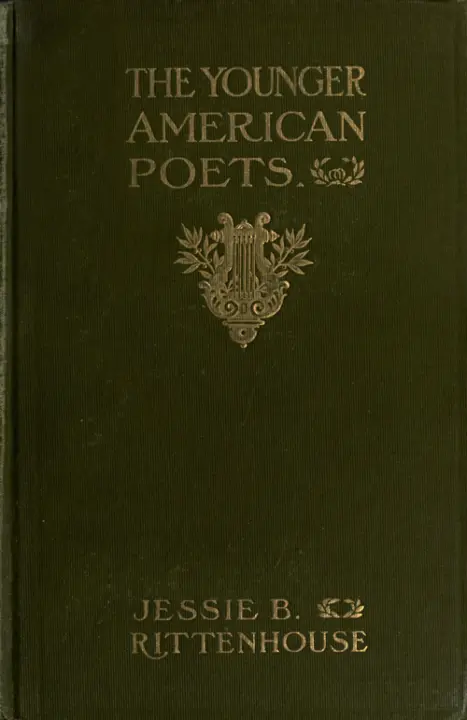
THE CLASSIC COLLECTION · 1904
"The Younger American Poets" by Jessie Belle Rittenhouse is a collection of literary studies written in the early 20th century. This work delves into the poetry of a selection of younger American poets, exploring their contributions and distinct styles within the broader context of contemporary poetry. Rittenhouse offers insight into the thematic elements and individual characteristics of these poets, likely focusing on their artistic approaches and the socio-cultural conditions of their time. The beginning of this collection introduces Richard Hovey, characterizing him as a poet grounded in convictions and comradeship rather than mere whimsies of rhyme. Hovey is depicted as an artist deeply engaged with the essence of life, capturing the vibrancy of nature alongside themes of human connection and national pride. Rittenhouse highlights specific works and ideas from Hovey, noting his Whitmanesque influence while asserting his unique voice that emphasizes a harmonious relationship with the world around him. This opening segment sets the stage for further explorations of the varied styles and themes represented by the younger poets discussed in the subsequent chapters.
Introduction adapted from the source catalogue; source summaries may be automatically generated.
Free to read · English · 71,656 words · No account needed
MAKE TIME FOR A GOOD BOOK
On by default. Untick to stop anonymous reading totals. Each page counts after 10 seconds in view. How this works.
Anonymous counting is on unless you have switched it off.
The term “original” is one to be used charily and with forethought, but it is one that belongs without danger of challenge to Miss Guiney’s work. There is a distinct quality, both of treatment and conception, that is hers alone, a rare, unfamiliar note, without reminiscent echoes. While it has a certain classic quaintness, it has also vitality and concrete forcefulness.
Her metrical command is varied, and she employs many forms with assurance of touch. She has a group of Alexandrian songs in A Roadside Harp, most of them with beauty of measure and atmosphere. Here, in three lines, is a rhythmic achievement:
Me, deep-tresséd meadows, take to your loyal keeping, Hard by the swish of sickles ever in Aulon sleeping, Philophron, old and tired, and glad to be done with reaping!
How the “swish of sickles” conveys their very sound! This ability to put into certain words both the music and the picture distinguishes Miss Guiney. In her sonnet upon the “Pre-Reformation Churches about Oxford,” even the names that would seem to suggest an inartistic enumeration are made to convey the sense of sabbatical sweetness and calm and to visualize the scene.
The Sonnets Written at Oxford mark, as a whole, her finest work in this form, although the twelve London sonnets are full of strong lines and images, and several of them, such as “Doves” and “In The Docks,” take swift hold upon one’s sympathy. The former flashes a picture at the close, by way of rebuke to the over-solicitous mood, which is not only charming from the artistic side, but opens the eyes in sudden content and gladness.
Ah, if man’s boast, and man’s advance be vain,
And yonder bells of Bow, loud-echoing home,
And the lone Tree foreknow it, and the Dome,
The monstrous island of the middle main;
If each inheritor must sink again
Under his sires, as falleth where it clomb
Back on the gone wave the disheartened foam—
I crossed Cheapside, and this was in my brain.
What folly lies in forecasts and in fears! Like a wide laughter sweet and opportune, Wet from the fount, three hundred doves of Paul’s Shook their warm wings, drizzling the golden noon, And in their rain-cloud vanished up the walls. “God keeps,” I said, “our little flock of years.”
This note of spiritual assurance appears throughout Miss Guiney’s work, speaking in her sonnet, “The Acknowledgment,” and again and again in other poems. She has the mystic’s passion for the One Good, the One Beauty—
O hidden, O perfect, O desired, the first and the final fair!—
and gives it impassioned expression in the lines, “Deo Optimo Maximo,”
Your reading position is saved on this browser. Take it to another device with a library code. Reading pages adapt to text, rather than matching a printed edition.
BEHIND THE BOOK
This eBook is for the use of anyone anywhere in the United States and most other parts of the world at no cost and with almost no restrictions whatsoever. You may copy it, give it away or re-use it under the terms of the Project Gutenberg License included with this eBook or online at www.gutenberg.org. If you are not located in the United States, you will have to check the laws of the country where you are located before using this eBook. Read the source licence.
The original source file, including credits and licence, is retained by this library. Request an original-format copy at no charge. Please include the book title and Project Gutenberg identifier #55447.
KEEP YOUR CURIOSITY GOING
David Patterson (Spirit) Hatch

David Patterson (Spirit) Hatch

David Patterson (Spirit) Hatch
Cécile Tormay

Moritz Busch
John L. Ransom