
Last letters from the living dead man
David Patterson (Spirit) Hatch
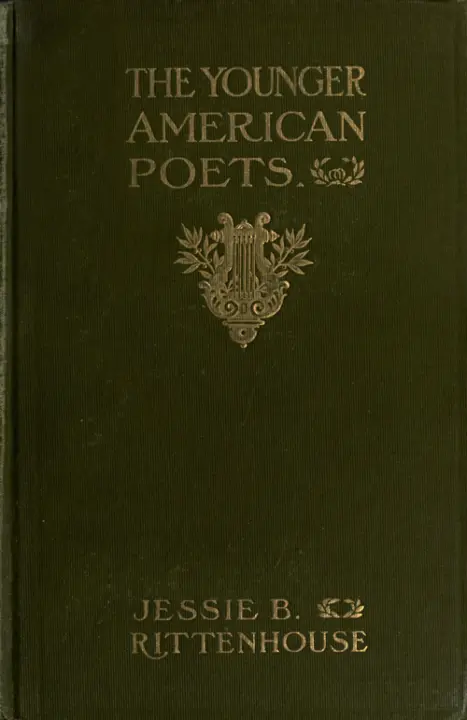
THE CLASSIC COLLECTION · 1904
"The Younger American Poets" by Jessie Belle Rittenhouse is a collection of literary studies written in the early 20th century. This work delves into the poetry of a selection of younger American poets, exploring their contributions and distinct styles within the broader context of contemporary poetry. Rittenhouse offers insight into the thematic elements and individual characteristics of these poets, likely focusing on their artistic approaches and the socio-cultural conditions of their time. The beginning of this collection introduces Richard Hovey, characterizing him as a poet grounded in convictions and comradeship rather than mere whimsies of rhyme. Hovey is depicted as an artist deeply engaged with the essence of life, capturing the vibrancy of nature alongside themes of human connection and national pride. Rittenhouse highlights specific works and ideas from Hovey, noting his Whitmanesque influence while asserting his unique voice that emphasizes a harmonious relationship with the world around him. This opening segment sets the stage for further explorations of the varied styles and themes represented by the younger poets discussed in the subsequent chapters.
Introduction adapted from the source catalogue; source summaries may be automatically generated.
Free to read · English · 71,656 words · No account needed
MAKE TIME FOR A GOOD BOOK
On by default. Untick to stop anonymous reading totals. Each page counts after 10 seconds in view. How this works.
Anonymous counting is on unless you have switched it off.
I fear no breathing bowman,
But only, east and west,
The awful other foeman
Impowered in my breast.
The outer fray in the sun shall be,
The inner beneath the moon;
And may Our Lady lend to me
Sight of the dragon soon.
At the outset of her work Miss Guiney sang an electrifying song of which men begrudged her the glory, being theft of Jove’s thunder. It was hight valiantly “The Wild Ride,” and has the spirit of all the knights and troopers in Christendom packed within its tense and vibrant lines:
I hear in my heart, I hear in its ominous pulses, All day, on the road, the hoofs of invisible horses; All night from their stalls, the importunate tramping and neighing.
Let cowards and laggards fall back! but alert to the saddle, Straight, grim, and abreast, go the weather-worn galloping legion, With a stirrup-cup each to the lily of women that loves him.
The trail is through dolor and dread, over crags and morasses; There are shapes by the way, there are things that appal or entice us: What odds? we are knights, and our souls are but bent on the riding.
I hear in my heart, I hear in its ominous pulses, All day, on the road, the hoofs of invisible horses; All night from their stalls, the importunate tramping and neighing.
We spur to a land of no name, outracing the storm-wind; We leap to the infinite dark, like the sparks from the anvil, Thou leadest, O God! all’s well with Thy troopers that follow!
“The Kings” and “The Perfect Hour” are other trumpet notes of Miss Guiney’s, illustrating the individuality of her point of view and the personality of her expression.
A poet’s words may be wind-blown feathers, or they may be flint-tipped arrows singing to a mark. The defect with much of present-day poetry is that it is not aimed, it is content to be a pretty flight of feathers, blown by the breath of fancy, and reaching no vital spot.
To test Miss Guiney’s marksmanship with words, one may separate her at once from the class who are flying airy illusions nowhither, for she concentrates, instead of diffusing, and has, at the outset, a definite point in view. She works upon the arrow principle, but now and again glances from the mark. In such a poem as “The Recruit,” in “The Wild Ride,” or the “Saint George” quoted from, in her stirring poem “Sanctuary,” beginning,
High above Hate I dwell,
O storms! farewell,
Your reading position is saved on this browser. Take it to another device with a library code. Reading pages adapt to text, rather than matching a printed edition.
BEHIND THE BOOK
This eBook is for the use of anyone anywhere in the United States and most other parts of the world at no cost and with almost no restrictions whatsoever. You may copy it, give it away or re-use it under the terms of the Project Gutenberg License included with this eBook or online at www.gutenberg.org. If you are not located in the United States, you will have to check the laws of the country where you are located before using this eBook. Read the source licence.
The original source file, including credits and licence, is retained by this library. Request an original-format copy at no charge. Please include the book title and Project Gutenberg identifier #55447.
KEEP YOUR CURIOSITY GOING
David Patterson (Spirit) Hatch

David Patterson (Spirit) Hatch

David Patterson (Spirit) Hatch
Cécile Tormay

Moritz Busch
John L. Ransom