
Last letters from the living dead man
David Patterson (Spirit) Hatch
THE CLASSIC COLLECTION · 1904
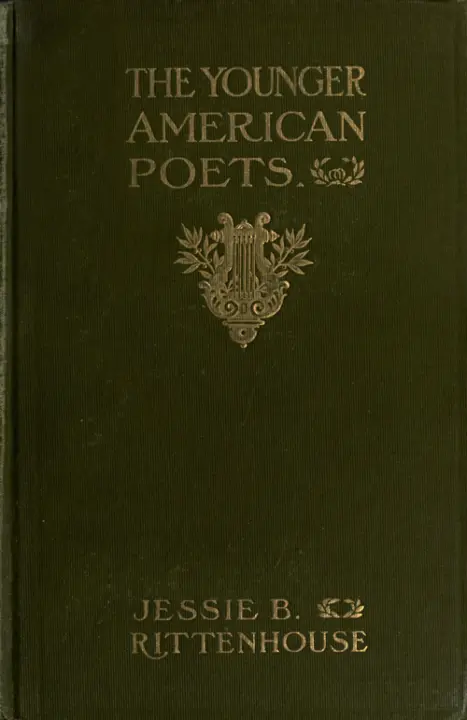
"The Younger American Poets" by Jessie Belle Rittenhouse is a collection of literary studies written in the early 20th century. This work delves into the poetry of a selection of younger American poets, exploring their contributions and distinct styles within the broader context of contemporary poetry. Rittenhouse offers insight into the thematic elements and individual characteristics of these poets, likely focusing on their artistic approaches and the socio-cultural conditions of their time. The beginning of this collection introduces Richard Hovey, characterizing him as a poet grounded in convictions and comradeship rather than mere whimsies of rhyme. Hovey is depicted as an artist deeply engaged with the essence of life, capturing the vibrancy of nature alongside themes of human connection and national pride. Rittenhouse highlights specific works and ideas from Hovey, noting his Whitmanesque influence while asserting his unique voice that emphasizes a harmonious relationship with the world around him. This opening segment sets the stage for further explorations of the varied styles and themes represented by the younger poets discussed in the subsequent chapters.
Introduction adapted from the source catalogue; source summaries may be automatically generated.
Free to read · English · 71,656 words · No account needed
MAKE TIME FOR A GOOD BOOK
On by default. Untick to stop anonymous reading totals. Each page counts after 10 seconds in view. How this works.
Anonymous counting is on unless you have switched it off.
O heart of insatiable longing,
What spell, what enchantment allures thee,
Over the rim of the world
With the sails of the sea-going ships?
And when the rose petals are scattered
At dead of still noon on the grass-plot,
What means this passionate grief,—
This infinite ache of regret?[1]
Among the most familiar of the fragments is that of the “apple reddening upon the topmost bough,” which Rossetti has put into charming phrase, together with its companion verse upon the wild hyacinth; but while these lines are of haunting charm, they do not make a complete stanza, the comparison being unknown; whereas Mr. Carman, in recasting the fragment, has supplied a logical complement to the lines and symmetrized them, together with their companion illustration, to a lyric. His rendering, too, while less musical, from being unrhymed, is picturesque and concise, each word being made to tell as a stroke in a sketch:
Art thou the topmost apple
The gatherers could not reach,
Reddening on the bough?
Shall not I take thee?
Art thou a hyacinth blossom
The shepherds upon the hills
Have trodden into the ground?
Shall not I lift thee?
The first Rossetti stanza ends with a fantastic play upon words
explaining that, although the gatherers did not get the coveted apple,
they
Forgot it not, nay, but got it not, for none could get it till now,
which, although a pleasant poetical mix-up, is hardly in keeping with the dignity of the comparison, which dignity Mr. Carman has well preserved.
Another fragment made familiar by adaptation is that to Hesperus, expanded by Byron into one of the great passages of “Don Juan.” Mr. Carman gives a more compact rendering and again brings the lines to such a close as shall render them a complete lyric. They scarcely vie in beauty with the Byron passage, which is one of the surest strokes of his hand, but have their own charm and grace:
Hesperus, bringing together
All that the morning star scattered,—
Sheep to be folded in twilight,
Children for mothers to fondle,—
Me, too, will bring to the dearest,
Tenderest breast in all Lesbos.
The fragment, “I loved thee, Athis, in the long ago,” has been expanded by Mr. Carman into a poem of reminiscent mood, the long, slow-moving pentameter enhancing the effect of pensive meditation which the lines convey. Many of the fragments are of a blither note, having the variety which distinguishes the original.
Your reading position is saved on this browser. Take it to another device with a library code. Reading pages adapt to text, rather than matching a printed edition.
BEHIND THE BOOK
This eBook is for the use of anyone anywhere in the United States and most other parts of the world at no cost and with almost no restrictions whatsoever. You may copy it, give it away or re-use it under the terms of the Project Gutenberg License included with this eBook or online at www.gutenberg.org. If you are not located in the United States, you will have to check the laws of the country where you are located before using this eBook. Read the source licence.
The original source file, including credits and licence, is retained by this library. Request an original-format copy at no charge. Please include the book title and Project Gutenberg identifier #55447.
KEEP YOUR CURIOSITY GOING
David Patterson (Spirit) Hatch

David Patterson (Spirit) Hatch

David Patterson (Spirit) Hatch
Cécile Tormay

Moritz Busch
John L. Ransom