
Last letters from the living dead man
David Patterson (Spirit) Hatch
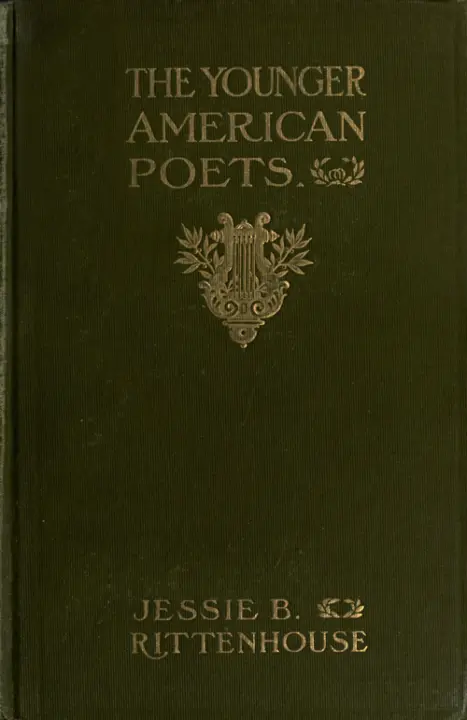
THE CLASSIC COLLECTION · 1904
"The Younger American Poets" by Jessie Belle Rittenhouse is a collection of literary studies written in the early 20th century. This work delves into the poetry of a selection of younger American poets, exploring their contributions and distinct styles within the broader context of contemporary poetry. Rittenhouse offers insight into the thematic elements and individual characteristics of these poets, likely focusing on their artistic approaches and the socio-cultural conditions of their time. The beginning of this collection introduces Richard Hovey, characterizing him as a poet grounded in convictions and comradeship rather than mere whimsies of rhyme. Hovey is depicted as an artist deeply engaged with the essence of life, capturing the vibrancy of nature alongside themes of human connection and national pride. Rittenhouse highlights specific works and ideas from Hovey, noting his Whitmanesque influence while asserting his unique voice that emphasizes a harmonious relationship with the world around him. This opening segment sets the stage for further explorations of the varied styles and themes represented by the younger poets discussed in the subsequent chapters.
Introduction adapted from the source catalogue; source summaries may be automatically generated.
Free to read · English · 71,656 words · No account needed
MAKE TIME FOR A GOOD BOOK
On by default. Untick to stop anonymous reading totals. Each page counts after 10 seconds in view. How this works.
Anonymous counting is on unless you have switched it off.
The climax of the play follows immediately upon the death of Stilbe, when the king, called to account by the insolent Belarion, in righteous indignation strikes him down. It may be questioned whether such a deed could follow so quickly upon the rapt spiritual state to which the king had been lifted; but one inclines to rejoice that the natural man, impelled by who shall say what higher force, triumphed, ere the queen, pointing to the dead body of the trusted messenger, Ananias, and repeating the Nazarene’s words, “Those most dear to you have peace,”—demanded of the king his blade.
As they stand defenceless but assured, the soldiers, awed by the might of some inner force in the king, shrink back, and the drama closes with the victorious words,—
Together, Love, we go unto the city!
Though the play, looked upon from a dramatic standpoint, lacks in the earlier scenes a certain magnetism of touch and vividness of action, and in the last scene is somewhat overcharged with them, it has many finely conceived situations which strike the golden mean, and the characterization throughout is strongly defined. Its literary quality must, however, take precedence of its dramatic in the truer appraisal. In diction it shows none of the strained effort toward the supposed speech of an earlier time, which usually distinguishes poetic dramas laid far in the past, but has throughout a fitting dignity and harmony, combined with ease and flexibility of phrase and frequent eloquence of dialogue, especially in the passages spoken by Abgar.
It is a play rather of character and high motive than of plot, a piece of sheer idealism, notable alike for its spiritual and its poetic quality.
BROWN, Alice. Born Hampton Falls, N. H., Dec. 5, 1857. Graduated Robinson Seminary, Exeter, N. H., 1876. On staff of Youth’s Companion. Author: Fools of Nature; Meadow-Grass; By Oak and Thorn (English travels); Life of Mercy Otis Warren; The Road to Castaly (poems); The Days of his Youth; Robert Louis Stevenson, A Study (with Louise I. Guiney); Tiverton Tales; King’s End; Margaret Warrener; The Mannerings; Judgment. Resides in Boston.
BURTON, Richard. Born Hartford, Conn., March 14, 1859. Graduated Trinity College, Hartford. Ph.D. Johns Hopkins, 1887. Married Oct. 7, 1889. Taught Old English Johns Hopkins, 1888. Managing Editor N. Y. Churchman, 1888-89. Travelled in Europe, 1889-90. Literary Editor Hartford Courant, 1890-97. Associate Editor Warner Library World’s Best Literature, 1897-99. Professor English Literature, University of Minnesota, 1898-1902. Editor Lothrop Publishing Co., 1902-04. Lectures upon literature and the drama. Author: (verse) Dumb in June, 1895; Memorial Day, 1897; Lyrics of Brotherhood, 1899; Message and Melody, 1903; (prose) Literary Likings, essays, 1898; Life of Whittier, in Beacon Biography Series, 1900; Forces in Fiction, essays, 1902. Resides in Boston.
Your reading position is saved on this browser. Take it to another device with a library code. Reading pages adapt to text, rather than matching a printed edition.
BEHIND THE BOOK
This eBook is for the use of anyone anywhere in the United States and most other parts of the world at no cost and with almost no restrictions whatsoever. You may copy it, give it away or re-use it under the terms of the Project Gutenberg License included with this eBook or online at www.gutenberg.org. If you are not located in the United States, you will have to check the laws of the country where you are located before using this eBook. Read the source licence.
The original source file, including credits and licence, is retained by this library. Request an original-format copy at no charge. Please include the book title and Project Gutenberg identifier #55447.
KEEP YOUR CURIOSITY GOING
David Patterson (Spirit) Hatch

David Patterson (Spirit) Hatch

David Patterson (Spirit) Hatch
Cécile Tormay

Moritz Busch
John L. Ransom