
Last letters from the living dead man
David Patterson (Spirit) Hatch
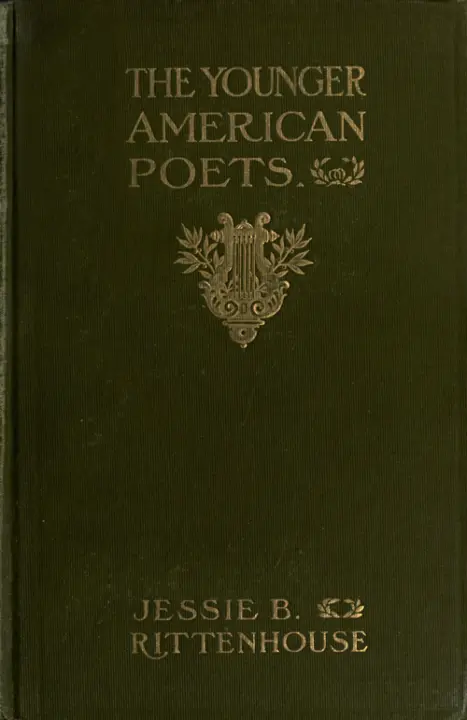
THE CLASSIC COLLECTION · 1904
"The Younger American Poets" by Jessie Belle Rittenhouse is a collection of literary studies written in the early 20th century. This work delves into the poetry of a selection of younger American poets, exploring their contributions and distinct styles within the broader context of contemporary poetry. Rittenhouse offers insight into the thematic elements and individual characteristics of these poets, likely focusing on their artistic approaches and the socio-cultural conditions of their time. The beginning of this collection introduces Richard Hovey, characterizing him as a poet grounded in convictions and comradeship rather than mere whimsies of rhyme. Hovey is depicted as an artist deeply engaged with the essence of life, capturing the vibrancy of nature alongside themes of human connection and national pride. Rittenhouse highlights specific works and ideas from Hovey, noting his Whitmanesque influence while asserting his unique voice that emphasizes a harmonious relationship with the world around him. This opening segment sets the stage for further explorations of the varied styles and themes represented by the younger poets discussed in the subsequent chapters.
Introduction adapted from the source catalogue; source summaries may be automatically generated.
Free to read · English · 71,656 words · No account needed
MAKE TIME FOR A GOOD BOOK
On by default. Untick to stop anonymous reading totals. Each page counts after 10 seconds in view. How this works.
Anonymous counting is on unless you have switched it off.
To old Zacchæus in his tree
What mattered leaves and botany?
His sycamore was but a seat
Whence he could watch that hallowed street.
But now to us each elm and pine
Is vibrant with the Voice divine,
Not only from but in the bough
Our larger creed beholds Him now.
To the true faith, bark, sap and stem
Are wonderful as Bethlehem;
No hill nor brook nor field nor herd
But mangers the incarnate Word!
Again we touch the healing hem
In Nazareth or Jerusalem;
We trace again those faultless years;
The cross commands our wondering tears.
Yet if to us the Spirit writes
On Morning’s manuscript and Night’s,
In gospels of the growing grain,
Epistles of the pond and plain,
In stars, in atoms, as they roll
Each tireless round its occult pole,
In wing and worm and fin and fleece,
In the wise soil’s surpassing peace,—
Thrice ingrate he whose only look
Is backward focused on the Book,
Neglectful what the Presence saith,
Though He be near as blood and breath!
The only atheist is one
Who hears no voice in wind or sun,
Believer in some primal curse,
Deaf in God’s loving universe!
Mr. Knowles has not embraced the diffusive faith that has no faith to stay it, but is endeavoring to read the newer meaning into the older truths, which is the present-day office of singer and seer. In the matter of personal valor, of optimistic, intrepid mood, Mr. Knowles’ work is altogether commendable. He awaits with buoyant cheer what lies beyond the turn o’ the road. His poem “Fear,” from the first collection, was widely quoted at the time because of its heartening tone, and in his new volume, “A Challenge,” “A Twofold Prayer,” and many another sounds the same invincible note. “Laus Mortis” is a hymn to death holding within it the truer acceptation of that natural and therefore kindly change:
Nay, why should I fear Death,
Who gives us life, and in exchange takes breath?
He is like cordial Spring
That lifts above the soil each buried thing;
Like autumn, kind and brief—
The frost that chills the branches frees the leaf;
Like winter’s stormy hours
That spread their fleece of snow to save the flowers.
The lordliest of all things,
Life lends us only feet, Death gives us wings.
Fearing no covert thrust,
Let me walk onward, armed in valiant trust;
Dreading no unseen knife,
Across Death’s threshold step from life to life!
O all ye frightened folk,
Whether ye wear a crown or bear a yoke,
Laid in one equal bed,
When once your coverlet of grass is spread,
Your reading position is saved on this browser. Take it to another device with a library code. Reading pages adapt to text, rather than matching a printed edition.
BEHIND THE BOOK
This eBook is for the use of anyone anywhere in the United States and most other parts of the world at no cost and with almost no restrictions whatsoever. You may copy it, give it away or re-use it under the terms of the Project Gutenberg License included with this eBook or online at www.gutenberg.org. If you are not located in the United States, you will have to check the laws of the country where you are located before using this eBook. Read the source licence.
The original source file, including credits and licence, is retained by this library. Request an original-format copy at no charge. Please include the book title and Project Gutenberg identifier #55447.
KEEP YOUR CURIOSITY GOING
David Patterson (Spirit) Hatch

David Patterson (Spirit) Hatch

David Patterson (Spirit) Hatch
Cécile Tormay

Moritz Busch
John L. Ransom