
Last letters from the living dead man
David Patterson (Spirit) Hatch
THE CLASSIC COLLECTION · 1904
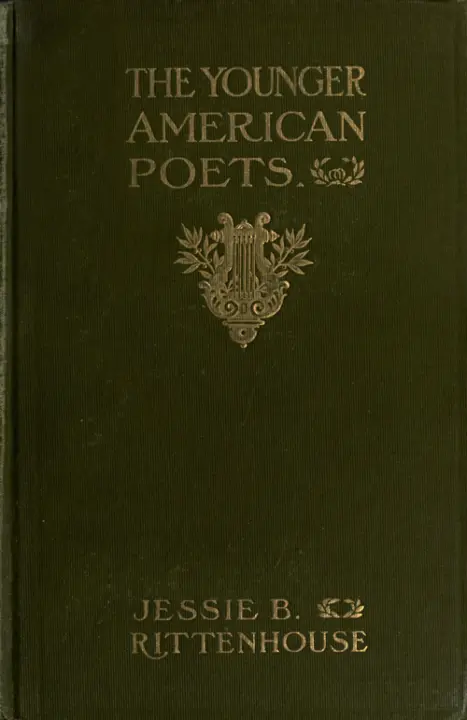
"The Younger American Poets" by Jessie Belle Rittenhouse is a collection of literary studies written in the early 20th century. This work delves into the poetry of a selection of younger American poets, exploring their contributions and distinct styles within the broader context of contemporary poetry. Rittenhouse offers insight into the thematic elements and individual characteristics of these poets, likely focusing on their artistic approaches and the socio-cultural conditions of their time. The beginning of this collection introduces Richard Hovey, characterizing him as a poet grounded in convictions and comradeship rather than mere whimsies of rhyme. Hovey is depicted as an artist deeply engaged with the essence of life, capturing the vibrancy of nature alongside themes of human connection and national pride. Rittenhouse highlights specific works and ideas from Hovey, noting his Whitmanesque influence while asserting his unique voice that emphasizes a harmonious relationship with the world around him. This opening segment sets the stage for further explorations of the varied styles and themes represented by the younger poets discussed in the subsequent chapters.
Introduction adapted from the source catalogue; source summaries may be automatically generated.
Free to read · English · 71,656 words · No account needed
MAKE TIME FOR A GOOD BOOK
On by default. Untick to stop anonymous reading totals. Each page counts after 10 seconds in view. How this works.
Anonymous counting is on unless you have switched it off.
Hovey occasionally makes the mistake of robbing some vital utterance of its dramatic value by interlarding it with ornament. True emotion is not literary, and Guinevere, meeting Lancelot alone at the lodge of Galahault, for the first time after their mutual confession, having come hither disguised and by a perilous course, would scarcely have chosen these decorative words:
Oh, do not jar with speech
This perfect chord of silence!—Nay, there needs
Thy throat’s deep music. Let thy lips drop words
Like pearls between thy kisses;
and Lancelot, of the overmastering passion, would scarcely have
babbled this reply:
Thy speech breaks
Against the interruption of my lips
Like the low laughter of a summer brook
Over perpetual pebbles.
But when the crisis of the play is reached, when the court is rife with rumors of the Queen’s disloyalty, and Lancelot and Guinevere, under imminent shadow of exposure, meet by chance in the throne room,—there is drawn a vital, moving picture, one whose art lies in revealing the swift transition from impulse to impulse through which one passes when making great decisions. First, the high light is thrown upon the stronger side of Guinevere, in such meditative passages as these, tinged with a melancholy beauty:
We have had a radiant dream; we have beheld
The trellises and temples of the South,
And wandered in the vineyards of the Sun:—
’Tis morning now; the vision fades away
And we must face the barren norland hills.
Lancelot. And must this be?
Guinevere. Nay, Lancelot, it is. How shall we stand alone against the world?
Lancelot. More lonely in it than against!
What’s the world to us?
Guinevere. The place in which we live.
We cannot slip it from us like a garment,
For it is like the air—if we should flee
To the remotest steppes of Tartary,
Arabia, or the sources of the Nile,—
It still is there, nor can it be eluded
Save in the airless emptiness of death.
And fortressed with resolve, she speaks of war, of rending the kingdom, of violating friendships, of desecrating the family bond, to all of which Lancelot opposes his own desires:
And I—
I, too, defend it when it is a family,
As I would kneel before the sacred Host
When through the still aisles sounds the sacring bell;
But if a jester strutted through the forms
And turned the holy Mass into a mock,
Would I still kneel, or would I rise in anger
And make an end of that foul mimicry?
This but adds strength to Guinevere’s argument,
Believest thou, then, the power of the Church?
The Church would give our love an ugly name.
Your reading position is saved on this browser. Take it to another device with a library code. Reading pages adapt to text, rather than matching a printed edition.
BEHIND THE BOOK
This eBook is for the use of anyone anywhere in the United States and most other parts of the world at no cost and with almost no restrictions whatsoever. You may copy it, give it away or re-use it under the terms of the Project Gutenberg License included with this eBook or online at www.gutenberg.org. If you are not located in the United States, you will have to check the laws of the country where you are located before using this eBook. Read the source licence.
The original source file, including credits and licence, is retained by this library. Request an original-format copy at no charge. Please include the book title and Project Gutenberg identifier #55447.
KEEP YOUR CURIOSITY GOING
David Patterson (Spirit) Hatch

David Patterson (Spirit) Hatch

David Patterson (Spirit) Hatch
Cécile Tormay

Moritz Busch
John L. Ransom