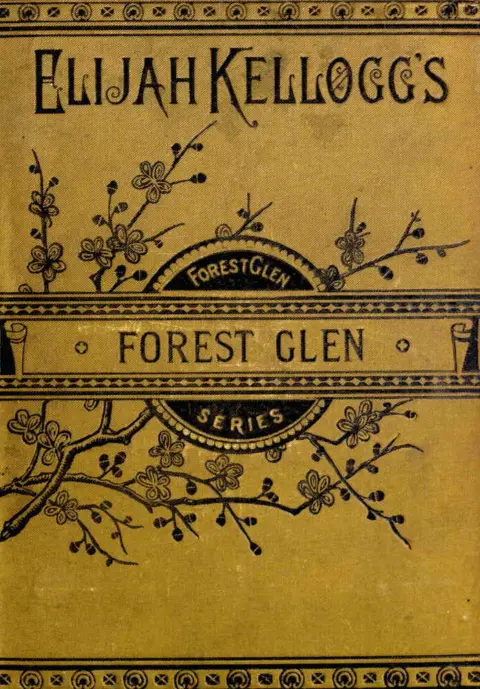
Forest Glen; or, The Mohawk’s Friendship
Elijah Kellogg
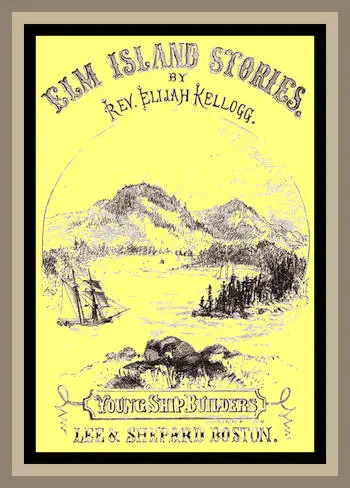
THE CLASSIC COLLECTION · 1870
"The Young Ship-Builders of Elm Island" by Elijah Kellogg is a novel written in the late 19th century. This story centers around young boys who are exploring the challenges of learning trades, specifically shipbuilding, in a vibrant seaside community. The book reflects themes of ambition, responsibility, and craftsmanship as the characters venture into undertaking building their own boat. At the start of the novel, we meet John Rhines, who is contemplating his future and the various trades he might pursue after a summer of hard work. His desire to learn a trade leads him to help a blacksmith, where he discovers a talent for making items. Alongside Charlie, his companion, they dream about crafting a significant project: a boat that could surpass canoes in design and performance. The opening portion sets the stage for their creative ideas and ambitions while introducing the supportive and industrious community around them, hinting at the trials and successes that lie ahead in their shipbuilding adventure.
Introduction adapted from the source catalogue; source summaries may be automatically generated.
Free to read · English · 63,594 words · No account needed
MAKE TIME FOR A GOOD BOOK
On by default. Untick to stop anonymous reading totals. Each page counts after 10 seconds in view. How this works.
Anonymous counting is on unless you have switched it off.
When the day arrived, Ben and Charlie went over in the Perseverance, as she was now ready for sea, and returned with Joe and his crew, Captain Rhines and his girls, Uncle Isaac, the Hadlocks, and others, among whom was Fred Williams. The most important personage of all was Parson Goodhue. The saucy little craft, her sails limed and snow-white, her decks white as a holy-stone and sand could make them, her masts scraped and slushed, with a little yellow ochre in the grease, her hull, mastheads, and spars gayly painted, and rigging fresh tarred, seemed, as she flung the foam from her bows and shot into the little harbor, proud of her burden.
The parson was brought ashore from the vessel in the large canoe; and as the beach was wet, Ben took him in his arms and set him down on the grass ground, without ruffling a feather; here he was met and welcomed by Sally.
Our young readers might be interested if we should describe the dress of this good man, whose arrival had excited so much interest, and caused such a commotion, on Elm Island; it was the usual dress of the ministers of that day, and quite remarkable.
A dark-blue broadcloth coat of the finest material, with a broad back, wide skirts, and a very long waist. It reached below the knees, the front edges on both sides being cut to the segment of a circle, from the end of the collar to the bottom of the skirts, the two edges just meeting in the middle over the abdomen, there fastened, when fastened at all, with a single hook and eye; the collar was quite wide, and laid over flat on the back; there was one row of black enamelled buttons in front, about the size of an old-fashioned Spanish milled dollar, with button holes to correspond to the size of the buttons, but which were never used, as the coat was never fastened except by the single hook and eye. The vest was of black kerseymere, reaching some six inches or more below the hips, with broad and deep pocket-flaps on each side, covering a capacious pocket. It was buttoned from the hips, close to the throat, with enamelled buttons as large as an English shilling, and finished round the neck with a narrow collar, three fourths of an inch wide. The lower corners of the vest were rounded off, so as always to hang open. To complete the dress, was a pair of dark-blue small clothes, buttoned tight around the body above the hips, and worn without suspenders, as they had not then been invented. A pair of heavy black silk stockings reached above the knee, under the small clothes, which were buttoned down close over the stockings below the knee, and there fastened by silver buckles. On his feet he wore a pair of round-toed shoes with short quarters, and fastened by a pair of large silver buckles that covered the whole of the instep. On his head he wore a large full-bottomed wig of silvery whiteness, fitting close to the head, the hair from the whole head being shaved twice a week, to permit the wig to fit close to the head. The back part of this wig, on the “bottom,” as it was technically called, was very large, and consisted of a mass of curls, of the kind that young ladies now call frizzled; and as the collar of the vest was narrow, and the collar of the coat laid flat on the back, the bottom of the wig could reach quite near to the shoulders without interfering with any part of the dress. Surmounting all was a large three-cornered cocked hat of the finest beaver, but without any nap; this, with cravat and ample bands under the chin, both of snowy whiteness, formed the costume of the venerable man, who, on the beach of Elm Island, received the congratulations of Sally and Mrs. Hadlock, and was regarded by these rebellious Yankees, who had recently flung off the yoke of monarchy, with a veneration as great as that of a true-bred Briton for his anointed king.
Your reading position is saved on this browser. Take it to another device with a library code. Reading pages adapt to text, rather than matching a printed edition.
Elijah Kellogg
Elijah Kellogg
Elijah Kellogg
Elijah Kellogg
BEHIND THE BOOK
This eBook is for the use of anyone anywhere in the United States and most other parts of the world at no cost and with almost no restrictions whatsoever. You may copy it, give it away or re-use it under the terms of the Project Gutenberg License included with this eBook or online at www.gutenberg.org. If you are not located in the United States, you will have to check the laws of the country where you are located before using this eBook. Read the source licence.
The original source file, including credits and licence, is retained by this library. Request an original-format copy at no charge. Please include the book title and Project Gutenberg identifier #50475.
KEEP YOUR CURIOSITY GOING
Coulson Kernahan

Maurice Baring
Frances Wright
Cécile Tormay

Frederic Jesup Stimson

W. H. P. (William Henry Pope) Jarvis