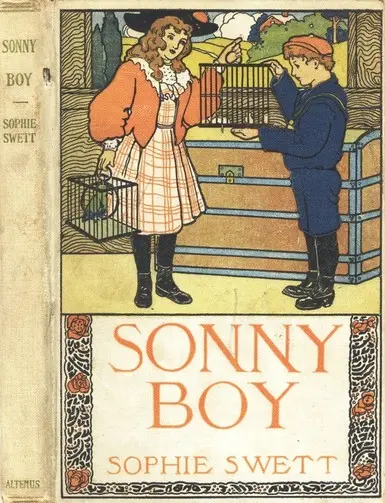
Sonny Boy
Sophie Swett
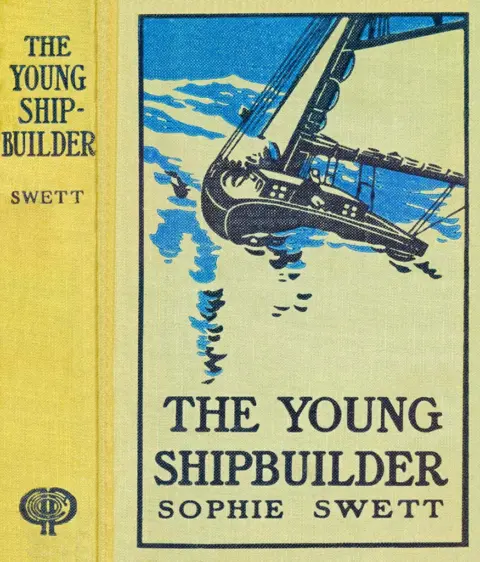
THE CLASSIC COLLECTION · 1902
"The Young Ship Builder" by Sophie Swett is a fictional work written in the early 20th century. The story revolves around the lives of the Dill family who navigate the complexities of life, family relationships, and the challenges presented by their family dynamics, especially following the return of their mother with two new half-siblings after a second marriage. The story is narrated by Bathsheba, one of the elder siblings, and the primary focus is on her brother Cyrus, whose aspirations are challenged by family duty and the arrival of their half-siblings, whom are perceived as "aliens" within the family. At the start of the narrative, the reader is introduced to Bathsheba's family on Groundnut Hill, where the dynamics have changed with the return of their mother and the incorporation of her new children, Estelle and David. Bathsheba reflects on the implications of having a mixed family, the expectations on Cyrus to sacrifice his own dreams for the sake of the younger children, and the emotional toll it takes on everyone involved. As the childhood antics of Bathsheba and her siblings unfold, we witness a deepening sense of responsibility emerge in Cyrus, who grapples with his desire to pursue a ministry against the harsh realities of caring for his family. The opening serves not only to set up the family dynamics but also hints at impending struggles and the burden of expectations that will shape the characters' lives going forward.
Introduction adapted from the source catalogue; source summaries may be automatically generated.
Free to read · English · 58,744 words · No account needed
MAKE TIME FOR A GOOD BOOK
On by default. Untick to stop anonymous reading totals. Each page counts after 10 seconds in view. How this works.
Anonymous counting is on unless you have switched it off.
But I said it I knew, with a doubtful accent, and not until Octavia and Estelle had stared at me, in reproachful dismay, and Alice had begun to look deeply hurt.
“I think the discipline he has had has been good for him, although some of us feel that it was rather uncalled for, but that he will be nobler and stronger for it always,” said Octavia.
“I know I’m not good enough for him,” said Alice, meekly. “But I am going to try to be, and learn just how a minister’s wife ought to behave.”
“A minister’s wife!” gasped Octavia and Estelle in chorus.
But I, who am not the quick-witted one of the family, I sprang up and
hugged her.
Estelle collapsed on a hassock.
“You no-end-of-a-humbug, we thought it was Dave,” she cried.
“That boy!” exclaimed Alice Yorke, who was herself nearly two years younger than the boy. “Cyrus thought so, and I--I had almost to ask him to have me!”
“If you have broken Dave’s heart you shall answer for it to me!” said Estelle. But she laughed. She evidently shared my opinion, that Dave’s heart was not very brittle.
Nevertheless, to this day I am not sure about it!
With all these gleams of sunshine the dreaded day of the auction sale came steadily on, and poor Cy’s happiness only showed itself occasionally in a flash of light across his worn face. I knew that he reproached himself for thinking of any happiness of his own at such a time.
On the very day before that appointed for the auction, Cyrus received a telegram from Dave, from whom no one had been able to hear a word for more than a fortnight.
“Stop sale, if possible. Can satisfy creditors!”
The telegram was brought to the house while we were at breakfast. Cyrus turned white to the lips as he read it.
“If there could be a chance!” he murmured, while grandma chirped to the canary in blissful unconcern. “But what is it possible for the boy to do? We have no credit now because we have no prospects! You don’t think I would have left any stone unturned, Bathsheba? It would be useless for me to try to stop the sale!”
“But Dave is not one to get foolish fancies into his head,” I insisted.
“Dave is a good fellow, but he’s only twenty,” said Cyrus; and threw the telegram into the waste-basket.
“I wish--I wish that Uncle Horace had not gone away,” I said,
desperately.
“He could do nothing,” said Cyrus, patiently. “Besides, he is almost unbalanced by his anxiety about Rob.”
Your reading position is saved on this browser. Take it to another device with a library code. Reading pages adapt to text, rather than matching a printed edition.
Sophie Swett
BEHIND THE BOOK
This eBook is for the use of anyone anywhere in the United States and most other parts of the world at no cost and with almost no restrictions whatsoever. You may copy it, give it away or re-use it under the terms of the Project Gutenberg License included with this eBook or online at www.gutenberg.org. If you are not located in the United States, you will have to check the laws of the country where you are located before using this eBook. Read the source licence.
The original source file, including credits and licence, is retained by this library. Request an original-format copy at no charge. Please include the book title and Project Gutenberg identifier #71346.
KEEP YOUR CURIOSITY GOING
Coulson Kernahan

Maurice Baring
Frances Wright
Cécile Tormay

Frederic Jesup Stimson

W. H. P. (William Henry Pope) Jarvis