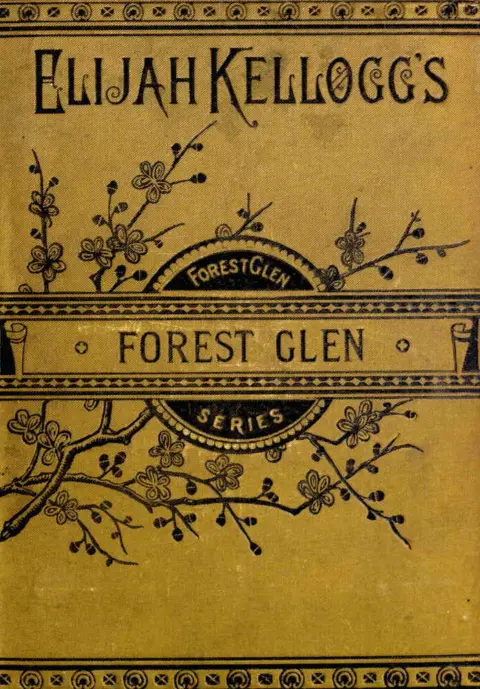
Forest Glen; or, The Mohawk’s Friendship
Elijah Kellogg

THE CLASSIC COLLECTION · 1871
"The Young Deliverers of Pleasant Cove" by Elijah Kellogg is a historical novel written in the late 19th century. The book follows the adventures of young protagonists, particularly focusing on Arthur Brown and his companions as they embark on daring voyages amidst the backdrop of historical maritime challenges and personal tribulations. Themes of camaraderie, courage, and the exploration of new lands are prominent as the characters engage with their environments and face various moral dilemmas. The opening of the narrative introduces readers to key characters and sets the stage for their upcoming adventures. Arthur Brown, a young man recently appointed captain of the brigantine named after his father, is joined by his friend Ned Gates, a smaller but determined sailor. The chapter establishes their camaraderie and introduces secondary characters, including Jacques, a local Frenchman knowledgeable about the coastline, and James Peterson, who is remembered fondly despite his struggles with alcohol. The narrative captures the boys' mixed feelings about their maritime duties and the profound impact of loss, particularly the death of Uncle Isaac. As preparations for another voyage to Marseilles begin, the young deliverers engage in tasks that reveal their ingenuity and resilience, laying the groundwork for the adventures and challenges that await them in the surrounding unfamiliar territories.
Introduction adapted from the source catalogue; source summaries may be automatically generated.
Free to read · English · 57,850 words · No account needed
MAKE TIME FOR A GOOD BOOK
On by default. Untick to stop anonymous reading totals. Each page counts after 10 seconds in view. How this works.
Anonymous counting is on unless you have switched it off.
"I don't know; let's see if we can't find a place where we can wade
across."
Following the stream till abreast the middle of the island, they espied a row of stepping-stones, upon which they crossed, and, finding a peasant at work, he informed them that they were "osiers," anglice sallows, and were used to make hampers for wine, cover bottles and demijohns, and tie vines to the stakes, were made into chairs and playthings for children, and that a great many, after being divested of their bark, were exported to New York.
"Why, Walter," said Ned, "these are the very things Mr. Bell made baskets of, that he and Charlie called sallies. I heard him ask the captain to get him some rods, and tell him that if he put them in earth or wet moss in the vessel's hold, they would grow by being stuck down, when the vessel got home."
"Then we will get a lot for him."
They asked the peasant, who told them the rods must be cut into pieces, seven or eight inches long, that in two years they would yield something, and in three a good crop of rods.
"Charlie has a splendid place to plant them on," said Ned, "right on a little flat by the mouth of the brook."
"Yes," said Walter, "but here are willows ten feet high. Mr. Bell carried no willows like these."
The peasant told him the reason that these grew so remarkably, was, that in the spring and fall the stream overflowed its banks, leaving a rich slime, which fertilized the soil, and the island, being surrounded by water, was moist throughout the year, and that the largest he was then cutting were used to hoop wine casks.
On the other side of the little isle was a rude bridge, upon which they crossed to the opposite shore. Following the course of the stream over heaps of gravel mixed with stones, brought down by streams from the mountains in the spring floods, they proceeded for miles through the most monotonous, dreary scenery imaginable; not a tree, bush, or scarcely a blade of grass to relieve the eye, Walter often repeating his favorite expression, "a God-forsaken country."
At length, as the sun attained its meridian, the face of the country became more diversified, breaking into gentle swells, and even hills of moderate elevation. Here they met with a little brook, which wound among the hills, and fell into the stream with a grateful murmur. Its banks were margined with a broad belt of green grass, and fringed with bushes and small trees, many of them evergreens.
Your reading position is saved on this browser. Take it to another device with a library code. Reading pages adapt to text, rather than matching a printed edition.
Elijah Kellogg

Elijah Kellogg

Elijah Kellogg

Elijah Kellogg
BEHIND THE BOOK
This eBook is for the use of anyone anywhere in the United States and most other parts of the world at no cost and with almost no restrictions whatsoever. You may copy it, give it away or re-use it under the terms of the Project Gutenberg License included with this eBook or online at www.gutenberg.org. If you are not located in the United States, you will have to check the laws of the country where you are located before using this eBook. Read the source licence.
The original source file, including credits and licence, is retained by this library. Request an original-format copy at no charge. Please include the book title and Project Gutenberg identifier #49745.
KEEP YOUR CURIOSITY GOING
Cécile Tormay

Moritz Busch
Coulson Kernahan
John L. Ransom

Maurice Baring
Frances Wright