
Forest Glen; or, The Mohawk’s Friendship
Elijah Kellogg
THE CLASSIC COLLECTION · 1871
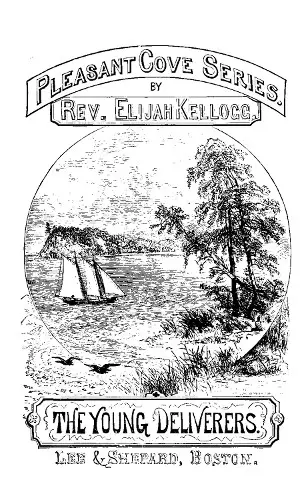
"The Young Deliverers of Pleasant Cove" by Elijah Kellogg is a historical novel written in the late 19th century. The book follows the adventures of young protagonists, particularly focusing on Arthur Brown and his companions as they embark on daring voyages amidst the backdrop of historical maritime challenges and personal tribulations. Themes of camaraderie, courage, and the exploration of new lands are prominent as the characters engage with their environments and face various moral dilemmas. The opening of the narrative introduces readers to key characters and sets the stage for their upcoming adventures. Arthur Brown, a young man recently appointed captain of the brigantine named after his father, is joined by his friend Ned Gates, a smaller but determined sailor. The chapter establishes their camaraderie and introduces secondary characters, including Jacques, a local Frenchman knowledgeable about the coastline, and James Peterson, who is remembered fondly despite his struggles with alcohol. The narrative captures the boys' mixed feelings about their maritime duties and the profound impact of loss, particularly the death of Uncle Isaac. As preparations for another voyage to Marseilles begin, the young deliverers engage in tasks that reveal their ingenuity and resilience, laying the groundwork for the adventures and challenges that await them in the surrounding unfamiliar territories.
Introduction adapted from the source catalogue; source summaries may be automatically generated.
Free to read · English · 57,850 words · No account needed
MAKE TIME FOR A GOOD BOOK
On by default. Untick to stop anonymous reading totals. Each page counts after 10 seconds in view. How this works.
Anonymous counting is on unless you have switched it off.
While they were talking and eating, wishing for a gale of wind--a real Gulf of Lyons gale--to scatter the fleet, they saw a man-o'-war get under way, evidently for England, convoying two supply-ships.
The captain ascertained her name through Jacques; and it afterwards appeared that Nelson wrote to his brother by the man-o'-war that the inhabitants of Marseilles and Toulon were starving; that the blockade had been so strict, not even a boat could get into either place or on the coast with provisions. While this brave seaman was battling with the furious gales, heavy seas, thunder, lightning, and squalls of the Mediterranean, Captain Brown, Walter Griffin, Ned Gates, and Sam Hadlock were lying among the foliage of the oak, eating honey and soft bread, or watching him through the glass, and counting the very buttons on his coat, as he stood back and forth along the coast, patient, resolute, faithful to his weary, harassing task, and congratulating himself upon the strictness of the blockade.
"For nineteen weeks," writes he, "my crew have not had a morsel of fresh meat or vegetables; only salt junk, hard bread, and lime-juice."
During all this time, a Yankee brigantine, loaded to the bends with wheat and good yellow corn raised by Captain Rhines, Uncle Isaac, Lion Ben, Charlie Bell, and their neighbors, and pork, beef, saltpetre, and arms bought in England or the British provinces, was lying, almost within gunshot, in a cul-de-sac, where she could not escape if discovered, and coining money for her officers, crew, and owners.
While thus eating and chatting, they were joined by Jacques, who had returned from a visit to his family.
"Pilot," said the captain, "is there any good place near here where we
can fill water?"
"Yes, captain; never a better."
The next morning, the water-casks were put into a boat, and Jacques piloted them to the place. It was a lovely spot. Over the edge of a precipice crowned with pines poured, in one broad sheet, a swift mountain torrent into a rocky basin, from which the white froth floated off into the cove. The water was of sufficient depth to enable them to approach with the boat to the edge of the basin, from which they dipped the clear, cool water--every instant renewed, and through which the white pebbles were gleaming--in buckets, and, passing them from hand to hand, filled the casks without taking them from the boat.
"We must be lively, boys," said Walter, "and get it in before the tide falls. O, I forgot; there is no tide here; so we can take our time."
Your reading position is saved on this browser. Take it to another device with a library code. Reading pages adapt to text, rather than matching a printed edition.
Elijah Kellogg
Elijah Kellogg

Elijah Kellogg

Elijah Kellogg
BEHIND THE BOOK
This eBook is for the use of anyone anywhere in the United States and most other parts of the world at no cost and with almost no restrictions whatsoever. You may copy it, give it away or re-use it under the terms of the Project Gutenberg License included with this eBook or online at www.gutenberg.org. If you are not located in the United States, you will have to check the laws of the country where you are located before using this eBook. Read the source licence.
The original source file, including credits and licence, is retained by this library. Request an original-format copy at no charge. Please include the book title and Project Gutenberg identifier #49745.
KEEP YOUR CURIOSITY GOING
Cécile Tormay

Moritz Busch
Coulson Kernahan
John L. Ransom

Maurice Baring
Frances Wright